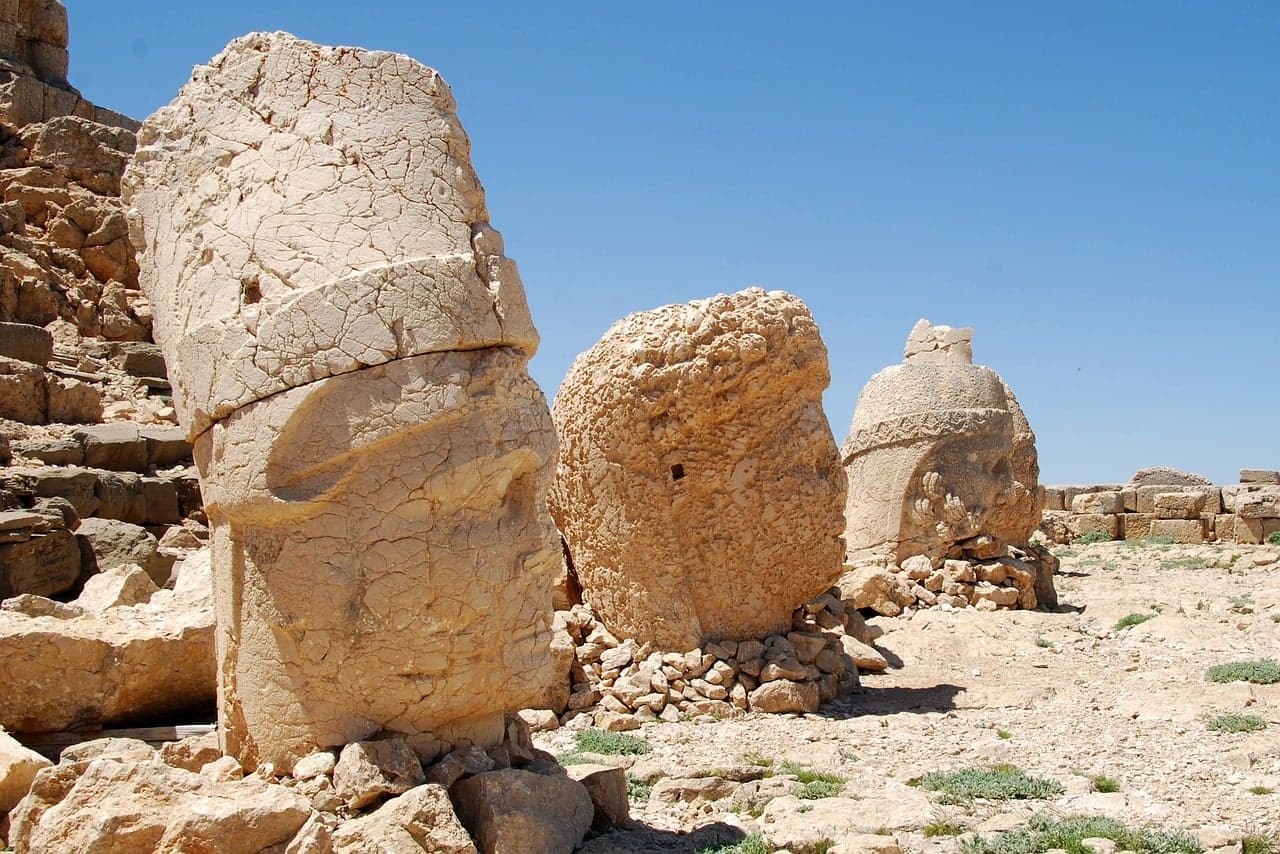
The reason you come to Adıyaman is most likely Mount Nemrut: the giant statues that King Antiochus of Commagene had built on the summit have been on the UNESCO World Heritage List since 1987. The Karakuş Tumulus, the Cendere Bridge, Arsameia and Yeni Kale on the road to Nemrut complete the story of the same kingdom. Add Perre in the city centre, Gerger Castle on the Euphrates and Old Besni, and with two or three days you will see Adıyaman layer by layer.
Why does Mount Nemrut need a day of its own?
The tumulus and the terraces
The sacred site on the summit, more than two thousand metres high in the Kâhta district, was built as the funerary monument of Antiochus I, the most famous king of Commagene. The tumulus, formed by piling up crushed stone and gravel, is about fifty metres high and a hundred and fifty metres across today; although the inscriptions say the king rests here, the burial chamber has never been found. The statues spread across the east, west and north terraces that surround the tumulus on three sides are counted among the grandest remains of the Hellenistic period.
The East Terrace
This is the best-preserved terrace. The enthroned statues, eight to ten metres high, are from left to right Antiochus I, Commagene, the mother goddess of the land, Zeus, Apollo and Heracles; on either side stand a lion, symbolising the kingdom's power on earth, and an eagle, symbolising its power in the sky. The stone bodies have partly collapsed and the heads are lined up in front of them. At Nemrut, sunrise is watched from this terrace.
The West Terrace and the lion horoscope
The statues are almost the same as those to the east; here there are also reliefs of the king shaking hands with the gods. The lion horoscope figure, decorated with reliefs of the moon and stars, is described as one of the oldest astrological calendars in the world and is protected. Watch the sunset from this side; the north terrace linking the two is a processional way about a hundred and eighty metres long.
What else is there on the road to Nemrut?
The Karakuş Tumulus
This funerary mound, visible from every direction across the region, was built by Mithridates II, son of Antiochus I, for his mother Isias and the women of the family. It is about twenty-one metres high and a hundred and ten metres across. It takes its name from the eagle statue on top of the southern column; there were nine columns around it when it was built, and four still stand today.
The Cendere Bridge
It was built over the Cendere stream on the orders of the Roman emperor Septimius Severus by the Sixteenth Legion, which was based at Samsat. The most surprising thing about the bridge, a hundred and twenty metres long and thirty metres high, with one main arch and one relief arch, is that it was built without mortar. Look at the Corinthian columns at its ends and the inscriptions saying they were raised in honour of the emperor and his family.
Arsameia
The site, built on the cliffs, was discovered in 1951; according to the inscription at its centre, its founder was Arsames, an ancestor of Antiochus I. Along the path used as a processional way are reliefs of the king shaking hands with the gods, a monumental burial chamber carved into the rock and the largest Greek inscription in Anatolia, with two hundred and fifty-six lines in five columns. A long tunnel reached by steps runs below the inscription.
Yeni Kale
The castle near Kocahisar village took its present form in the Mamluk period; its inscriptions record repairs by Mamluk sultans. Inside are water tanks, a bath, a mosque and a hidden water channel running down to the stream. It is easy to fit into the same half-day as Arsameia.
What can you see in central Adıyaman?
Perre
Perre, about three kilometres north of the centre, was one of the five great cities of Commagene and lay on the road linking Malatya and Samsat. Today its most impressive part is the necropolis lined with thousands of burial chambers carved into the rock; the presses beside it show that olive oil and wine were produced here. The city's fountain, still flowing, explains why caravans stopped here.
Adıyaman Castle and Adıyaman Museum
The castle, built on a mound about twenty-five metres high in the city centre, inspired the city's old name, Hısn-ı Mansur. Adıyaman Museum has, besides finds from the Palaeolithic to the Ottomans, an ethnography hall displaying handwoven carpets, kilims, cicim weavings, silver jewellery and copperware.
The Church of Mor Petrus and Mor Paulus
The church in the Mara neighbourhood is thought to have been built in the fourth or fifth century; inscriptions on its entrance door record repairs in 1888 and 1905. It is a three-aisled basilica running east to west, and the wooden altar in the apse was made in 1890. It is a place of worship still in use, so respect its visiting hours.
The Zey Caves
Around Zey village, seven kilometres from the centre, are rock settlements from the early Christian period. They suit a short afternoon trip.
What is there on the Euphrates and in Besni?
Gerger Castle
The castle on sheer rocks above the Euphrates valley, in Oymaklı village in the Gerger district, was one of the first seats of government of Commagene and controlled the Euphrates crossings. It has two parts, the Lower and Upper Castle; the relief of King Samos on the rock face and the Greek inscriptions are its most important details. The valley view is worth the long drive.
Old Besni and Besni Castle
Old Besni, at the junction of roads linking Commagene to Syria and Central Anatolia, was an important centre of the Dulkadiroğulları; in the Ottoman period akçe coins were minted here. In the abandoned town, inhabited until the mid-twentieth century, mosques, churches, baths and small stone bridges stand together. Besni Castle, a kilometre from the district centre, can be added to the route.
What should you eat in Adıyaman?
Çiğ köfte, common across the southern provinces, is a tradition of conversation and gathering in Adıyaman; you can taste versions made with different ingredients here. Hıtap baked in a stone oven, Adıyaman tava, made with tomatoes, peppers, aubergines and meat in a copper pan, and Kâhta's cold meyir soup are the standout savoury dishes. On the sweet side are cheese halva, a light baklava made with olive oil and şilke, a dessert with grape molasses.
How many days do you need in Adıyaman?
Two days is enough for the main route, and a third can go to the Euphrates and Besni. A sample route:
- Day one: The Karakuş Tumulus, the Cendere Bridge, Arsameia and Yeni Kale in the afternoon; climb Nemrut in the late afternoon and watch the sunset from the West Terrace.
- Day two: Nemrut again for sunrise, or rest in the city and see Perre, Adıyaman Castle, the museum and the Church of Mor Petrus and Mor Paulus.
- Day three: Gerger Castle, or Old Besni and Besni Castle.
For other stops in the southeast, see the City Routes page.
When should you go, and how do you get there?
Nemrut is a high mountain, so in winter snow and cold make a visit difficult; the best time is from late spring to mid-autumn. In summer the plain is very hot, while the summit is cool at night and in the morning. You can reach Adıyaman by air or by road. Nemrut is about eighty-seven kilometres from the provincial centre and forty-three from Kâhta; the road is asphalt as far as Karadut village and cobbled after that. Going on a tour or by car is easiest.
What should you keep in mind?
- At Nemrut the air turns sharply cold at sunrise and sunset; bring a thick cardigan or jacket even in summer.
- You will walk on stony ground between the terraces, so wear comfortable, non-slip shoes.
- Check on the official pages before you go whether buildings in the city centre such as the museum, castle and church are open to visitors.
- Find out current hours and ticket prices for archaeological sites and museums from official sources.
Frequently asked questions
How many days do you need in Adıyaman?
A day and a half for Mount Nemrut and the Karakuş Tumulus, Cendere Bridge, Arsameia and Yeni Kale on the way, and half a day for the city centre, is enough. If you also want to see Gerger Castle or Old Besni, add a third day.
When should you visit Mount Nemrut?
The period from late spring to mid-autumn is best. Sunrise is watched from the East Terrace and sunset from the West Terrace; it is very cool at the summit in the morning and evening, so bring warm clothes.
How do you get to Mount Nemrut?
Nemrut is about eighty-seven kilometres from central Adıyaman and forty-three from Kâhta. The road is asphalt as far as Karadut village and cobbled after that; going on a tour or by car is easiest.
Is Mount Nemrut on the UNESCO list?
Yes. Mount Nemrut was inscribed on the UNESCO World Heritage List in 1987.
What should you eat in Adıyaman?
Çiğ köfte, hıtap baked in a stone oven, Adıyaman tava made in a copper pan and Kâhta's cold meyir soup stand out. For dessert, try cheese halva, olive-oil baklava and şilke with grape molasses.
Editorial desk
Stories signed by the Cultvia editorial desk follow our editorial policy; every story lists its sources at the end and errors are fixed under our corrections policy.
Last updated:
What changed?
- : First published
Sources
- Nemrut Dağı — Kültür Portalı – T.C. Kültür ve Turizm Bakanlığı (Adıyaman İl Kültür ve Turizm Müdürlüğü)
- Cendere Köprüsü — Kültür Portalı – T.C. Kültür ve Turizm Bakanlığı (Adıyaman İl Kültür ve Turizm Müdürlüğü)
- Adıyaman'da Görülecek Yerler — Go Türkiye (Türkiye Turizm Tanıtım ve Geliştirme Ajansı)
- Kaleler — T.C. Adıyaman Valiliği
Up next
 City RoutesParis Photo 2026: opening hours, sectors and what to see13 November 2026 · 1 min read


