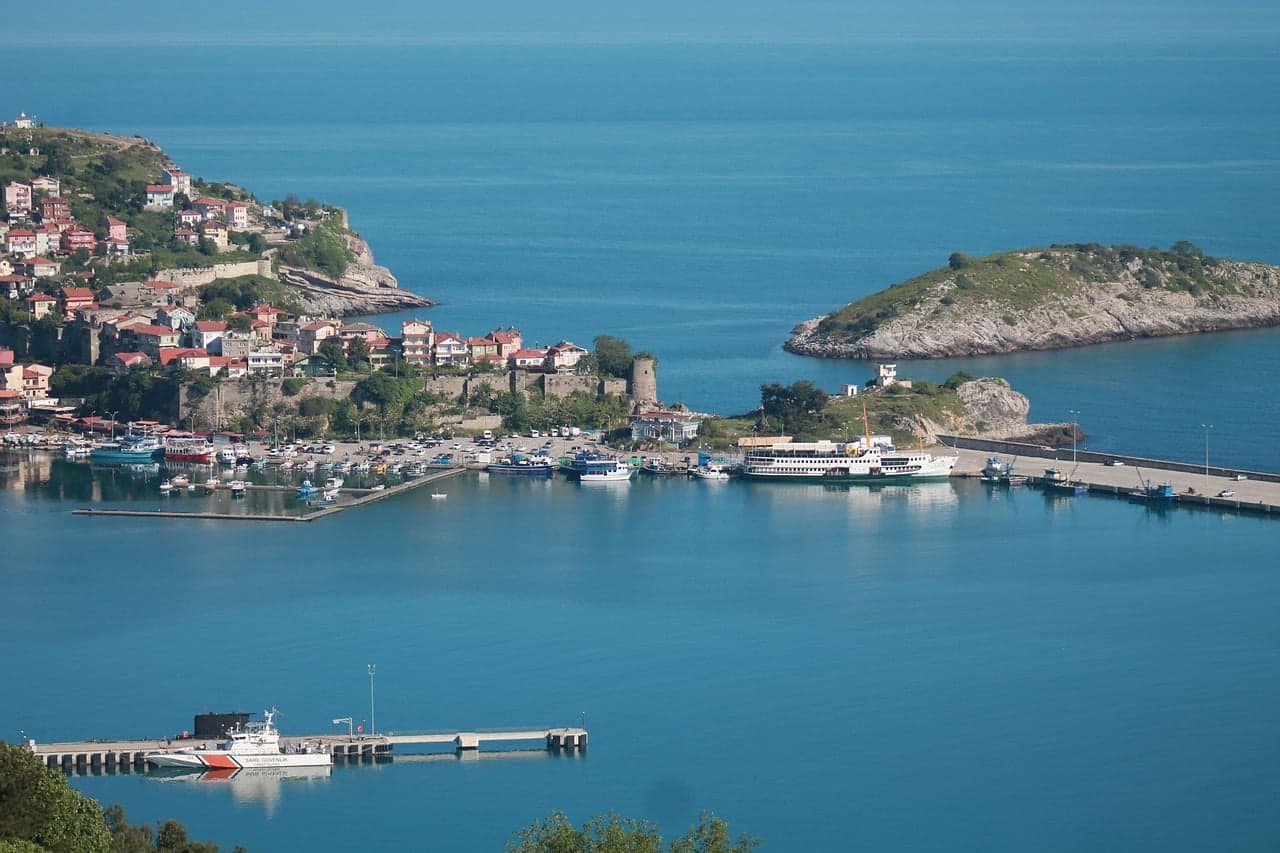
The first sights in Amasra are Amasra Castle, rising between the two harbours, and the single-arched Kemere Bridge that links it to Boztepe. This small harbour town in Bartın province, with its walls bearing Byzantine and Genoese traces, its coves and its fish-centred table, can be got to know in one or two days. It is not for nothing that it was once called "Çeşm-i Cihan", the eye of the world.
What should first-time visitors see in Amasra?
Amasra Castle
The castle, which goes back to the Byzantine period, was altered under the Genoese and extensively repaired in the fourteenth and fifteenth centuries. It has two main parts: Zindan Castle inside the town and Sormagir Castle on Boztepe, once an island. Look for the Genoese coats of arms set into different points of the walls and the stone figures of Eros, Medusa, an eagle and an ox head; your favourite detail of the castle will probably be one of them.
The Kemere Bridge and Karanlık Yer
The single-span stone bridge with a round arch linking Boztepe to Amasra is the town's emblem. Sources give different construction dates, but it is known to have been repaired in the Byzantine period. Once across the bridge, you enter Sormagir Castle through the vaulted main gate called "Karanlık Yer" (the Dark Place); from here one path leads to the Small Harbour and another to the Hacıdenizi side.
Boztepe
Boztepe, on the far side of the bridge, is Amasra's quietest corner, with its old neighbourhood fabric, castle walls and slopes facing the open sea. Seeing both harbours from here in the late afternoon is the quickest way to understand why the town is so loved. You will also see the surviving stretch of the western walls on this walk.
The Big Harbour and the Small Harbour
Amasra leans against two coves opening on either side of a spit of land. The Big Harbour is wider and windier, while the Small Harbour (the Ancient Harbour) is more sheltered and is where the fishing boats gather. Walking the short distance between the two harbours is the easiest way to see the town from end to end.
The old church and chapel inside the castle
Inside the castle are a Byzantine church built in the ninth century and converted into a mosque in the fifteenth, and a small chapel turned into a prayer room. With their stonework and arch arrangements, they are good examples for seeing medieval building traditions up close. To see inside, find out the current visiting situation on site or from official sources.
Direkli Kaya
East of the Small Harbour beach, a seven-metre structure rises on a rock inside the bay. It has a pool connected to the sea, steps carved into the rock and the remains of a marble jetty; locals call it the bath of Amastris. It is also a good excuse to listen to the stories about Queen Amastris, after whom the town is named.
Amasra Museum
The building, begun as a naval school in the late nineteenth century but never completed, was restored and turned into a museum. Its two archaeological and two ethnographic halls tell the town's past from the Hellenistic period to the Ottomans, and the stone works in the garden are as interesting as the displays inside. Check current hours and prices on the museum's official page.
The Kuşkayası Road Monument
At the fourth kilometre of the Amasra–Bartın road is a monument carved into the rock in the first century in honour of the Roman emperor Claudius. It consists of a headless human figure, a Roman eagle and two inscriptions, and is a road monument with no known equivalent in Anatolia. Follow the old Roman road running past it and you will come down into the Cevizlik Valley.
The Kemerdere Bridge and the Bedesten remains
The Kemerdere Bridge in the Cevizlik Valley should not be confused with the Kemere: it is a separate structure from the Roman period. The remains known as the Bedesten, just outside town, are thought to have belonged to a Roman bath or gymnasium. You can see both on the same short outing.
Çakraz and the coves to the west
The coast road from Amasra to Kurucaşile is full of small coves where wooded slopes run down to the sea. Çakraz is the best-known beach on this stretch, good for swimming with its clean sand and calm water. Further on, Kurucaşile is known for wooden boatbuilding skills handed down from father to son.
The Güzelcehisar lava columns
East of Amasra, on the Güzelcehisar shore near the centre of Bartın, four-, five- and six-sided columns formed as volcanic lava cooled and crystallised rise from the sea like a wall. It is hard to find another place that shows the region's geological past so strikingly. Watch out for slippery ground on the rocks.
What should you eat in Amasra?
The table in Amasra starts with the sea. Depending on the season, horse mackerel, whiting, red mullet and turbot come to the counters, and in winter anchovies take pride of place. They usually come with the local Amasra salad, a colourful mix of finely chopped seasonal greens, carrot and red cabbage. Eating fish in its season is both tastier and kinder to the sea. The wooden spoons and carvings sold in the bazaar are among the town's handicrafts too.
How many days do you need in Amasra?
One day is enough for the town itself; with two days you can see its surroundings too:
- Day one: Zindan Castle, the Kemere Bridge and Sormagir Castle in the morning; the Small Harbour and Direkli Kaya at midday; Amasra Museum in the afternoon; sunset on Boztepe.
- Day two: The Kuşkayası Road Monument and the Kemerdere Bridge in the morning; the coast road towards Çakraz or the Güzelcehisar lava columns in the afternoon.
For other routes along the Black Sea coast, take a look at the City Routes page.
When should you go, and how do you get there?
June to September is the best time for the sea and the coves, though the town gets very crowded on summer weekends. May and October are more pleasant for walking without the crowds. In winter the anchovy season begins and the town grows quiet. Amasra is reached by road via Bartın, with regular minibuses from Bartın.
What should you keep in mind?
- Some parts of the castle walls and the Boztepe slopes have no railings; keep away from the edges, especially with children.
- On the Black Sea, waves and currents can suddenly grow strong. Do not swim where there is no lifeguard or on windy days.
- Parking in town is hard on summer weekends; it is easier to leave your car at one of the car parks at the entrance and walk.
- Check current hours and prices for the museum and archaeological sites on official sources.
Frequently asked questions
How many days do you need in Amasra?
One day is enough for the castle, the Kemere Bridge, the harbours and the museum. If you also want to see the Kuşkayası Road Monument, the Çakraz coves and the Güzelcehisar lava columns, allow two days.
When is the best time to visit Amasra?
June to September is best for the sea, but summer weekends are crowded. May and October are quieter for walking; in winter the anchovy season begins.
How do you get to Amasra?
Amasra is reached by road via Bartın, and there are regular minibus services between Bartın and Amasra.
Are the Kemere Bridge and the Kemerdere Bridge the same?
No. The Kemere Bridge is in the town and links Boztepe to Amasra. The Kemerdere Bridge is in the Cevizlik Valley and is a separate structure from the Roman period.
What is Amasra salad?
A colourful local salad of finely chopped seasonal greens, carrot and red cabbage, served alongside fish.
Editorial desk
Stories signed by the Cultvia editorial desk follow our editorial policy; every story lists its sources at the end and errors are fixed under our corrections policy.
Last updated:
What changed?
- : First published
Sources
- Amasra Kalesi — Kültür Portalı – T.C. Kültür ve Turizm Bakanlığı
- Tarihi Kemere Köprüsü — T.C. Amasra Kaymakamlığı
- Gör: Bartın — Go Türkiye (Türkiye Turizm Tanıtım ve Geliştirme Ajansı)
Up next
 City RoutesParis Photo 2026: opening hours, sectors and what to see13 November 2026 · 1 min read


