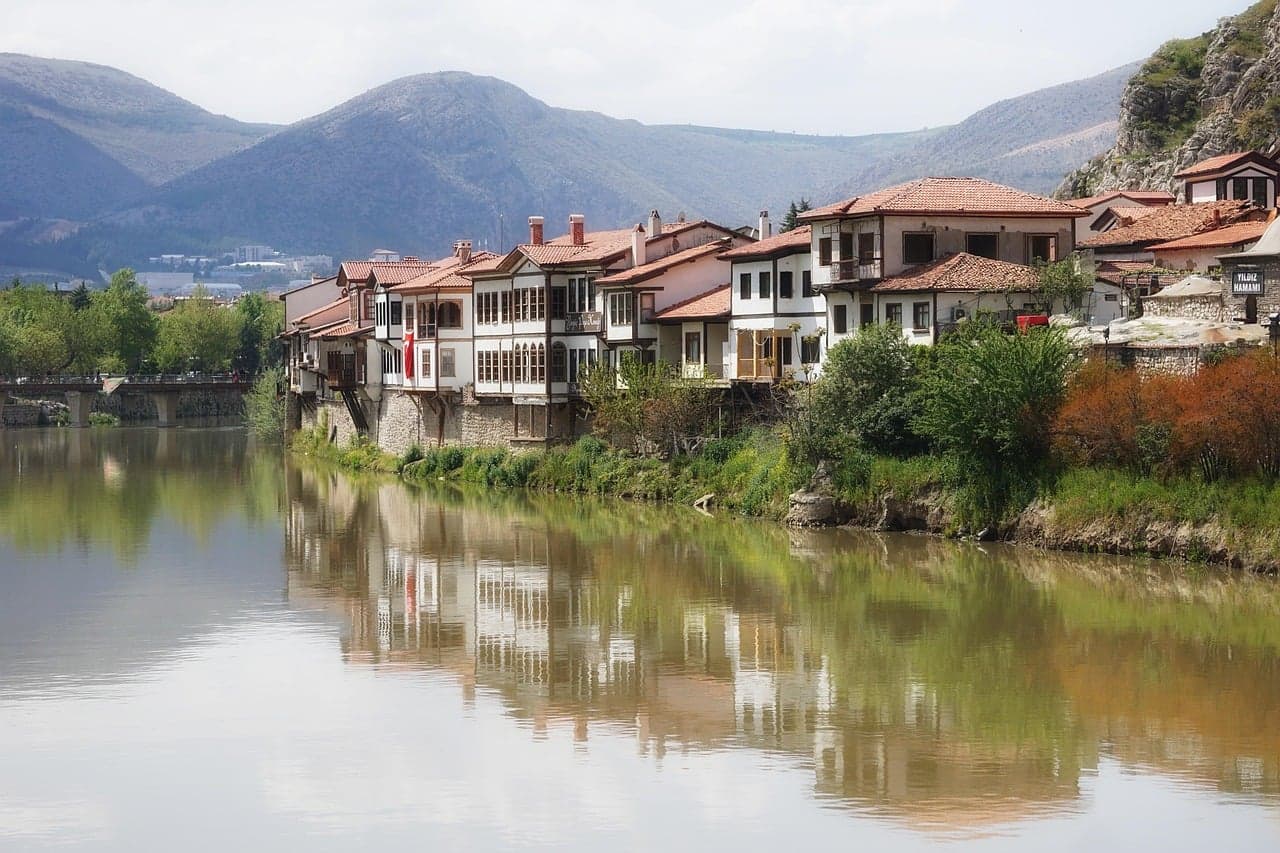
See Amasya on foot along the Yeşilırmak river: on one bank the Yalıboyu houses lined up along the water, the Pontic royal tombs carved into the rocks of Mount Harşena right behind them and the castle on the summit; on the other bank Seljuk and Ottoman mosques, madrasas and small museums. The city centre is easy to explore in a day or two. On your way home, do not forget a crate of misket apples and an Amasya çöreği, the local pastry made with walnuts and poppy seeds.
What should first-time visitors see on the north bank of the river?
Mount Harşena and the Pontic Royal Rock Tombs
The monumental tombs carved into the cliffs that rise right behind the Yalıboyu houses are counted among the most impressive rock tombs in Anatolia and are outstanding examples of the rock-tomb tradition worldwide. Together with Mount Harşena, they were added to the UNESCO World Heritage Tentative List in 2015. Make time to see the tombs both up close and from the opposite bank of the river; the two viewpoints are completely different.
Harşena Castle
The castle on Mount Harşena, right in the middle of the city, is made up of three parts: the Upper Castle or Acropolis, the Maidens' Palace (Kızlar Sarayı) and the Lower Castle or Inner City. From the top you can see the bend of the Yeşilırmak that divides the city in two, together with the old neighbourhoods on both banks. Save the climb for the cooler hours.
The Yalıboyu houses
The traditional mansions and houses lined up along the Yeşilırmak make up Amasya's postcard view. Most of the examples still standing today date from the nineteenth century. From the opposite bank, especially in the late afternoon, you can catch the reflection of the houses on the water and the royal tombs behind them in the same frame.
Hazeranlar Mansion (Museum House)
Built in 1865, the mansion, with its plan of four iwans around a central hall, is one of the finest examples of Amasya's civil architecture. It was expropriated and restored in 1979; today its upper floors are arranged as an ethnography museum and the basement as an art gallery. In rooms displaying around three hundred and fifty-five objects you will find nineteenth-century clothes, rugs with inscriptions, bindallı embroidered dresses, silver jewellery and gold-thread embroidery.
The Museum of the Princes
The museum displays statues of the Ottoman sultans who spent their years as princes in Amasya, along with clothing reflecting that period. This is where you will best understand Amasya's bond with the Ottoman princes.
Which historic buildings are on the south bank?
The Sultan Bayezid II Complex
Built in 1485–1486, the complex's mosque is one of the finest examples of the zaviye plan type. Of the complex, which originally consisted of five separate units, the mosque, the madrasa and the soup kitchen still stand today. Rest for a while under the plane trees on either side of the ablution fountain in the courtyard, which have given shade for more than five hundred years.
The Gökmedrese Mosque
This is a complex made up of a mosque, a madrasa and a tomb. It takes its name from the blue glazed bricks on the drum of the octagonal tomb. Its door is among the finest examples of wood carving, and the windows on either side of the main door are among the finest examples of Seljuk stonework.
The Burmalı Minare Mosque and the Bayezid Paşa Mosque
Built in 1242, the Burmalı Minare Mosque takes its name from the spiral grooves that wrap around its minaret. The Bayezid Paşa Mosque, built in 1414, stands out for its elegantly worked marble portico and its door and window shutters, rare examples of Ottoman woodwork.
The Sabuncuoğlu Şerefeddin Museum of the History of Medicine and Surgery
The darüşşifa, the only building in the city that has survived from the Ilkhanid period, is known as the first medical institution in Anatolia where music was used as therapy. Today you can visit it as a museum devoted to the history of medicine and surgery.
The Ferhat and Şirin Lovers' Museum and the Miniature Amasya Model Museum
Türkiye's first and only museum of lovers brings to life the stories of Ferhat and Şirin, Leyla and Mecnun, Kerem and Aslı, and Romeo and Juliet. The model museum, based on a photograph taken in 1914, shows not just the buildings but an old Amasya with life going on in its streets. Afterwards you can also stop at the Şeyh Hamdullah Museum of the History of Writing and Calligraphy.
What can you see around the city?
Aynalı Mağara (the Mirrored Cave)
This rock tomb near the city is the best worked of all the rock tombs in Amasya. The monumental tomb belongs to "the High Priest Tes", who lived in Amasya in the second century BC. If you come here after seeing the royal tombs, you can compare side by side how skilled the rock carving had become.
The Ferhat Water Channel
Built in the late Hellenistic to early Roman period by carving into the rock and opening tunnels to carry water to the ancient city, the channel is about six kilometres long. A two-kilometre section at Ferhatarası, near the start of the Amasya–Tokat road, is easy to see from the road. Locally it is linked with the legend of Ferhat, the painter who tried to cut through the mountain and bring water to the city in order to be united with Şirin.
Çakallar Hill
This hill overlooking the city centre offers a panoramic view of Amasya, especially at sunrise and sunset. These are the best hours for photographs.
The Terziköy hot springs
The water of these hot springs, thirty-six kilometres from the city centre, has been used since the Roman period. It makes a good break to relax after a day of castle and museums.
What should you eat in Amasya?
The first thing that comes to mind with Amasya is the misket apple, which has a geographical indication: thin-skinned and fragrant, red on one side and green on the other. Çatal çorba, made with green lentils, minced meat and wheat, toyga soup with strained yoghurt and chickpeas, patlıcan pehli, in which fried aubergine is baked with meat and tomato, and bakla dolması, with broad beans added to the filling, are the basic flavours of the local table. Keşkek is cooked the Amasya way, so that its ingredients can still be picked out one by one. Lamb with amasgen plums from Gümüşhacıköy, etli çiçek bamyası made with small dried okra, Amasya çöreği with walnuts and poppy seeds, and Amasya yağlısı cooked on a griddle are also among the dishes to try.
How many days do you need in Amasya?
One full day is enough for the city centre; add half a day if you want to see the surroundings too. A sample route:
- In the morning, climb up to Harşena Castle, then walk to the royal rock tombs.
- At midday, the Yalıboyu houses, Hazeranlar Mansion and the Museum of the Princes.
- In the afternoon, cross the bridge to the other bank for the Sultan Bayezid II Complex, the Gökmedrese Mosque, the Burmalı Minare Mosque and the Sabuncuoğlu museum.
- In the late afternoon, sunset on Çakallar Hill, followed by a walk along the river.
- On the morning of the second day, Aynalı Mağara and the Ferhat Water Channel.
For other cities in the inland Black Sea region, take a look at the City Routes page.
When should you go, and how do you get there?
Spring and autumn are the best seasons for walking along the river. Summers can be hot, so head for the castle and the rock tombs early in the morning. Amasya is easy to reach by road; the airport in the province's Merzifon district is another option. The stops in the city centre are within walking distance of each other.
What should you keep in mind?
- You will be walking uphill to the castle and the rock tombs; wear comfortable, non-slip shoes.
- Visit mosques outside prayer times and in suitable clothing.
- When taking photographs in the old neighbourhoods, respect the privacy of the people living in the houses.
- Check the current opening hours and fees of the museums on their official pages.
Frequently asked questions
How many days do you need in Amasya?
One full day is enough for the castle, the royal rock tombs, the Yalıboyu houses, the mosques and the museums in the city centre. You can add another half day for Aynalı Mağara and the Ferhat Water Channel.
When is the best time to visit Amasya?
Spring and autumn are the best times for walking along the Yeşilırmak and climbing up to the castle. Summers can be hot, so plan the castle and the rock tombs for early in the morning.
How do you get to Amasya?
Amasya is easy to reach by road; the airport in the province's Merzifon district is another option. The stops in the city centre are within walking distance of each other.
Are the royal rock tombs of Amasya on the UNESCO list?
Mount Harşena and the Pontic Royal Rock Tombs were added to the UNESCO World Heritage Tentative List in 2015. The tentative list covers sites that are candidates for the permanent list.
What should you eat in Amasya?
The misket apple with its geographical indication, çatal çorba, toyga soup, patlıcan pehli, bakla dolması, keşkek, etli çiçek bamyası and Amasya çöreği with walnuts and poppy seeds stand out.
Editorial desk
Stories signed by the Cultvia editorial desk follow our editorial policy; every story lists its sources at the end and errors are fixed under our corrections policy.
Last updated:
What changed?
- : First published
Sources
- Amasya'da Görülecek Yerler — Go Türkiye (Türkiye Turizm Tanıtım ve Geliştirme Ajansı)
- Amasya Lezzetleri — Go Türkiye (Türkiye Turizm Tanıtım ve Geliştirme Ajansı)
- Hazeranlar Konağı (Müze Ev) — T.C. Amasya Valiliği
- Ferhat Su Kanalı — Kültür Portalı – T.C. Kültür ve Turizm Bakanlığı (Amasya İl Kültür ve Turizm Müdürlüğü)
Up next
 City RoutesParis Photo 2026: opening hours, sectors and what to see13 November 2026 · 1 min read


