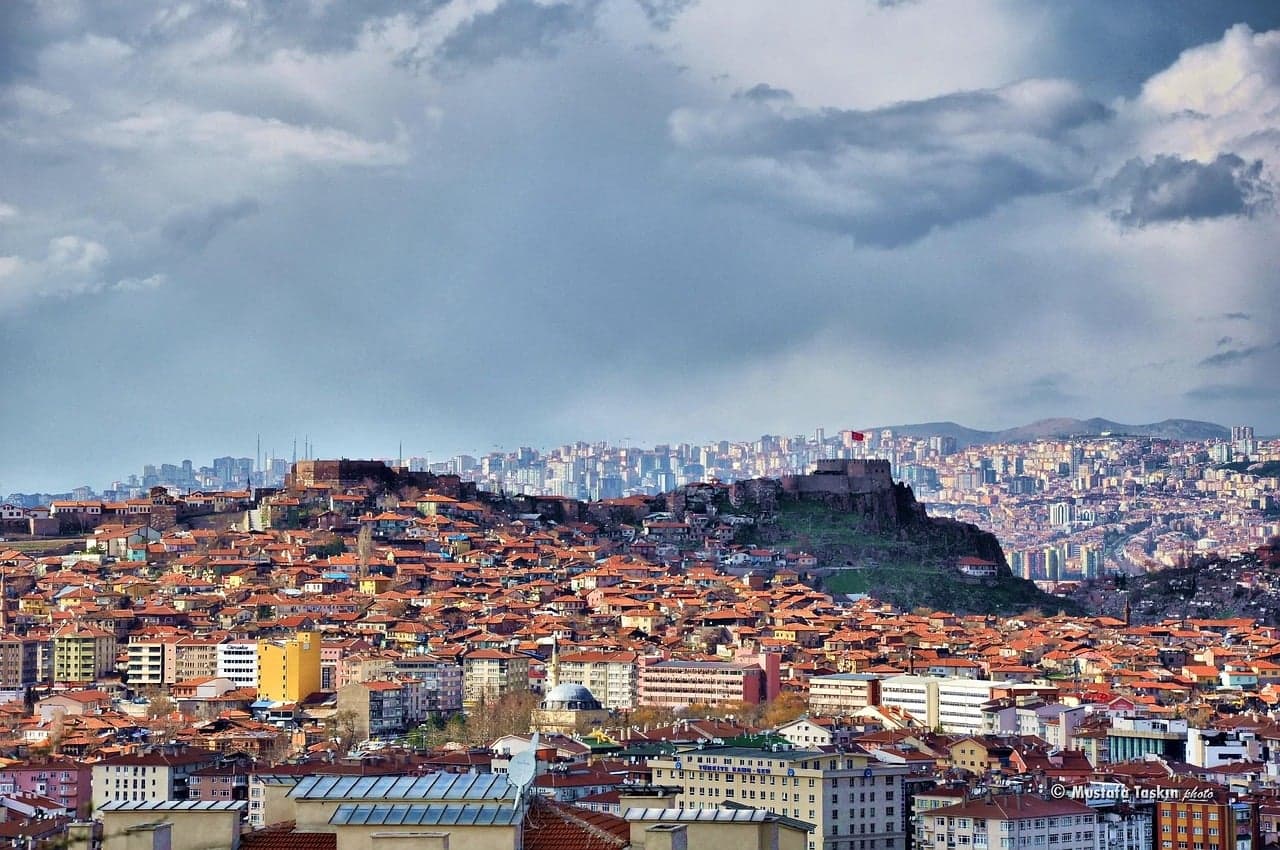
The heart of any Ankara visit is the castle and the old town around it: Ankara Castle, Hamamönü, the Hacı Bayram Mosque with the Temple of Augustus, and the Roman Baths are all within walking distance of each other. The city's modern face shows in the monumental architecture of Anıtkabir and in its contemporary art spaces. Give one more day to Beypazarı or to Gordion, the Phrygian capital, and you will get to know the capital as a whole.
What should first-time visitors see in Ankara?
Ankara Castle
No one knows for certain when the castle was founded; it was used by the Galatians and the Romans, and its inner walls were built in the Byzantine period in the seventh century. It has two parts, the inner and outer castle, and Ottoman-era Ankara houses still stand inside the walls. Go a little before sunset and climb the towers to see the city in all four directions.
The Seljuk mosques around the castle
The Aslanhane Mosque, at the foot of the castle, was built in the late thirteenth century under the Anatolian Seljuks, and with its wooden-pillared interior it is one of the oldest surviving mosques in Anatolia. It takes its name from the ancient marble lion set into the wall of the tomb opposite. The Ahi Elvan Mosque in Koyunpazarı, with its fourteenth-century woodwork, fits into the same walk.
Hamamönü
Hamamönü, between Ulus and Sıhhiye, is a district brought back to life by its restored nineteenth-century Ankara houses. It takes its name from the double bath built by Karacabey, and the Mehmet Akif Ersoy Museum House is here too. In the houses on Sanat Sokağı you can see craft workshops, and in the streets you can browse local producers' stalls.
The Hacı Bayram Mosque and the Temple of Augustus
On this square in Ulus two eras stand side by side: the temple built in honour of the Roman emperor Augustus and the Hacı Bayram Mosque leaning against its wall. The temple was turned into a church in the early Christian period, and the long inscription on its walls is counted among the important documents of the ancient world. In the shops around the square you will find Ankara's traditional flavours and handicrafts.
The Roman Baths and the Column of Julian
The remains of the third-century Roman Baths sit on a mound with a Phrygian-era settlement beneath it. The plan shows that the baths were conceived on an imperial scale rather than as a provincial building. The nearby Column of Julian, with a stork's nest on top, is the most photographed corner of Ulus.
Museum of Anatolian Civilizations
The museum on the southern slope of the castle tells the story of Anatolian archaeology in chronological order, from the Palaeolithic to the Ottomans. The Hittite, Phrygian and Urartian sections are especially rich. The building itself was converted from an Ottoman covered market and inn, so keep an eye on the architecture as you walk through.
Anıtkabir
Anıtkabir, on Rasattepe, is the mausoleum and museum complex built for the founder of the Republic. The Road of Lions, the wide ceremonial square and the symmetrical buildings clad in cut stone are among the best-known examples of modern Turkish architecture. Allow at least two hours to see the museum and gardens inside the complex.
The Ethnography Museum and the Painting and Sculpture Museum
The two buildings standing side by side on Namazgâh Hill reflect the city's early twentieth-century architecture. The Ethnography Museum displays regional costumes, carpets and kilims, calligraphy and tiles from across Anatolia, while its neighbour houses painting and sculpture collections.
CerModern
Converted from old railway maintenance workshops, CerModern is Ankara's contemporary art centre, with exhibition halls and a large courtyard. The conversion, which kept the texture of the industrial building, is worth seeing in its own right.
Beypazarı
Beypazarı, west of Ankara, is the favourite day trip, with its bay-windowed mansions of stone and timber, its silverwork and its local produce. Alaaddin Sokağı and the mansion museums tell the town's past, and the nearby İnözü Valley offers a short nature walk. Beypazarı kurusu, a crisp local biscuit, and carrot lokum are the town's well-known treats.
Gordion
Gordion, near Polatlı, was the capital of the Phrygian kingdom and is on the UNESCO World Heritage List. The archaeological site, the museum beside it and the great burial mounds of the area bring you close to the civilisation associated with King Midas. It is far from the city, so a full day is more comfortable than half a day.
How do you explore Ankara's districts and surroundings?
It helps to think of Ankara in three layers. Ulus and Altındağ are the old town: the castle, the Seljuk mosques, the Roman remains and Hamamönü fit into a morning walk. Kızılay, Kavaklıdere and Çankaya are the modern centre, coming alive in the evening with cafés, bookshops and parks. The surrounding districts each need a day of their own: Beypazarı for historic townscape, Gordion for archaeology, and Soğuksu National Park in Kızılcahamam for nature.
For food, try Ankara tava (a baked meat and rice dish), simit and the local produce sold in the shops around the castle. Stopping for tea in the courtyards of the old houses is a good way to fall into the rhythm of the district.
How many days do you need in Ankara?
Two days is enough for the city centre, and three with the surrounding districts. A sample route:
- Day one: Ankara Castle and the Aslanhane Mosque in the morning, the Museum of Anatolian Civilizations at midday, the Hacı Bayram Mosque, the Temple of Augustus and the Roman Baths in the afternoon, Hamamönü in the evening.
- Day two: Anıtkabir in the morning, the Ethnography Museum and CerModern in the afternoon, a walk through Kızılay and Kavaklıdere in the evening.
- Day three: A day trip to Beypazarı or Gordion.
If you want to visit the museums one by one as a route, see the museum-focused article in City Routes.
When should you go, and how do you get there?
Ankara has a continental climate: summers are hot and dry, winters cold and sometimes snowy. May to June and September to October are the best months for walking and day trips.
Esenboğa Airport lies north of the city and is linked to the centre by bus. Ankara is connected to Istanbul, Eskişehir and Konya by high-speed train, so arriving by rail is easy too. Within the city, the metro and Ankaray lines meet at Kızılay; take the metro to Ulus and walk up to the castle.
What should you keep in mind?
- Museum opening days, hours and ticket prices can change; check their official pages before you go.
- The streets of the castle and Hamamönü are steep and cobbled, so wear comfortable shoes.
- At Anıtkabir, keep quiet in the ceremonial areas and follow the staff's directions.
- It gets dark early in winter, so plan an early return on day trips.
- When visiting mosques, mind the prayer times and dress appropriately.
Frequently asked questions
How many days do you need in Ankara?
Two days is enough for the castle area, Ulus, Anıtkabir and the museums. If you want to see Beypazarı or Gordion, set aside a third day for a day trip.
When is the best time to visit Ankara?
With its continental climate, Ankara has hot summers and cold winters. Late spring and early autumn are the most comfortable seasons for city walks and day trips.
How do you get to Ankara Castle?
Take the metro to Ulus and walk for about fifteen minutes to the castle. Buses on the same route also go to Ulus.
Where can you go on a day trip from Ankara?
Beypazarı, with its bay-windowed mansions and silverwork, Gordion, the Phrygian capital, and Soğuksu National Park in Kızılcahamam are the most popular day trips.
How do you get to Ankara?
You can fly into Esenboğa Airport and take a bus to the centre. The city is also linked to Istanbul, Eskişehir and Konya by high-speed train.
Editorial desk
Stories signed by the Cultvia editorial desk follow our editorial policy; every story lists its sources at the end and errors are fixed under our corrections policy.
Last updated:
What changed?
- : First published
Sources
- Top Things to See in Ankara Guide — Go Türkiye (Türkiye Turizm Tanıtım ve Geliştirme Ajansı)
- Best Routes to Explore Ankara — Go Türkiye (Türkiye Turizm Tanıtım ve Geliştirme Ajansı)
- Ankara Kalesi — Kültür Portalı – T.C. Kültür ve Turizm Bakanlığı
- Hamamönü — Kültür Portalı – T.C. Kültür ve Turizm Bakanlığı
Up next
 City RoutesParis Photo 2026: opening hours, sectors and what to see13 November 2026 · 1 min read


