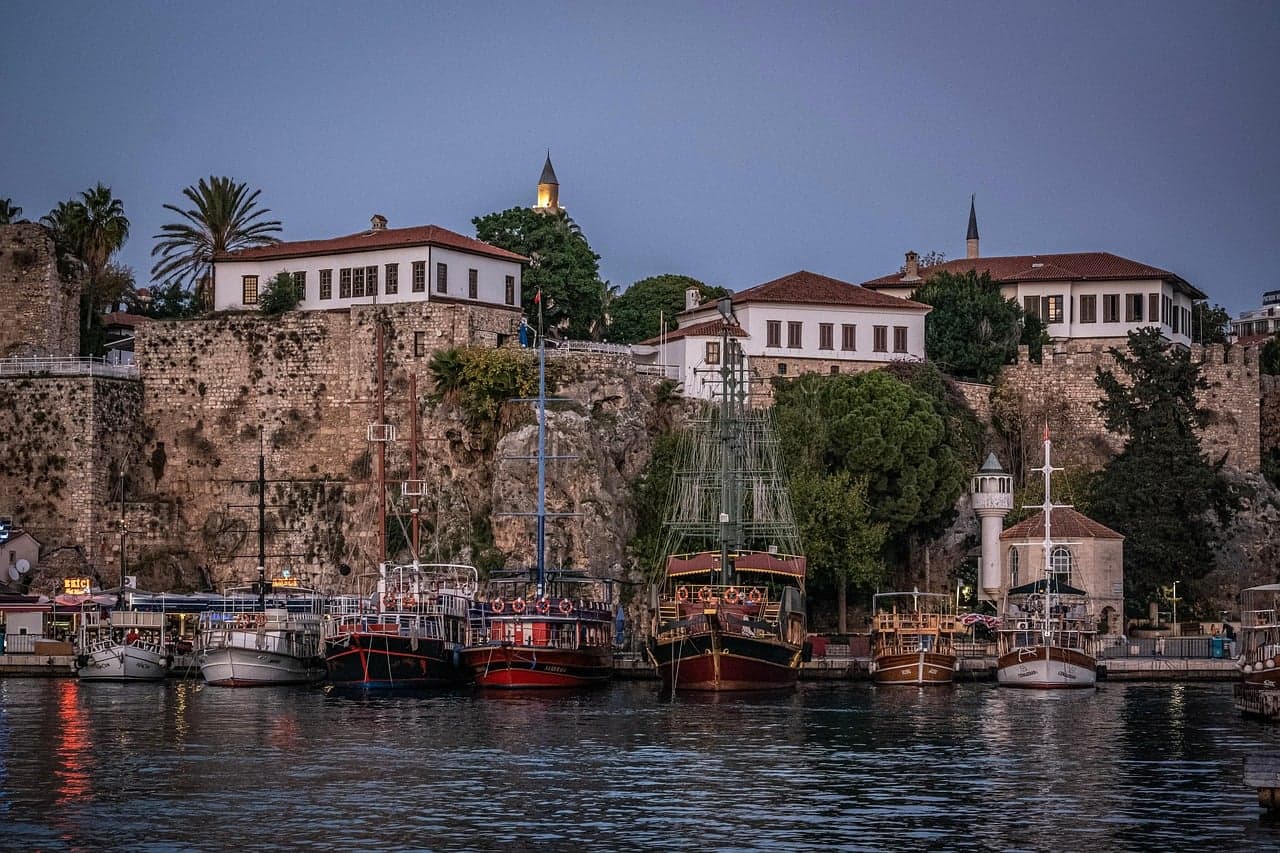
In Antalya, start with walled Kaleiçi and its ancient harbour; Hadrian's Gate, the Yivli Minaret and Hıdırlık Tower are only a few streets apart. Around the city lie ancient cities such as Perge, Aspendos and Termessos, and the Düden and Kurşunlu waterfalls, one of which pours straight into the sea. With four days you can see both the city and the ancient sites without rushing.
What should first-time visitors see in Antalya?
Kaleiçi
Kaleiçi, Antalya's old town, is ringed by walls built by different civilisations over more than two thousand years. Along the narrow streets that run down to the harbour stand traditional two- and three-storey houses, each with one face to the street and the others to a garden. Wandering the bougainvillea-covered lanes without a map is the best way to get to know Kaleiçi.
Hadrian's Gate
The triple-arched gate that marks the entrance to Kaleiçi was built in AD 130 to commemorate the visit of the Roman emperor Hadrian. It is one of the best-preserved ancient structures in Antalya. Look for the ruts left by cart wheels in the paving beneath the arches.
The Yivli Minaret and its surroundings
The Yivli (Fluted) Minaret, a Seljuk-era survivor, is part of the city's skyline thanks to the flutes on its brick shaft. The complex around it brings together a mosque, madrasas, a Mevlevi lodge and tombs; the stonework of the nearby Karatay Madrasa is also worth seeing.
The Old Harbour
The ancient harbour south of Kaleiçi is used today as a marina. Day boats leaving from here follow the cliffs so you can see the Düden waterfall from the sea. The slope down to the harbour becomes the liveliest corner of the city in the late afternoon.
Hıdırlık Tower and Karaalioğlu Park
Hıdırlık Tower, at the south-western corner of the walls, was built in the second century; its lower part is square and its upper part cylindrical. Karaalioğlu Park behind the tower, with terraces overlooking the sea and views of the Beydağları mountains, is the favourite spot for sunset.
Antalya Museum
Thanks to the statues unearthed at Perge, the museum holds one of Türkiye's most important sculpture collections. Pieces from the stage building of the Perge theatre are displayed in a hall of their own. Visiting the museum before heading to the ancient cities makes the ruins far easier to read.
The Düden waterfalls
Upper Düden in Kepez is a karst waterfall where water that has flowed for kilometres underground returns to the surface; the park around it offers a cool walk. Lower Düden, towards Lara, drops straight into the Mediterranean over a travertine ledge about forty metres high. You can see both on the same day.
Kurşunlu Waterfall
In the Aksu district, Kurşunlu falls eighteen metres inside a canyon that links seven small ponds. The area is protected as a nature park and has walking paths and viewing terraces. It makes a good half-day escape from the heat of the city centre.
Perge
Perge, in Aksu, was one of the most regularly planned cities of Roman Anatolia. Its two main streets, a well-preserved theatre and one of the most intact stadiums in Türkiye are all here. The water channel running down the middle of the colonnaded street shows how carefully the city was designed.
Aspendos
Aspendos, near the Köprüçay river (the ancient Eurymedon), has the best-preserved Roman theatre in the Mediterranean world. Its stage building still stands almost complete, and the theatre still hosts concerts and performances from time to time. The remains of the city on the hill and the aqueduct on the plain are part of the same visit.
Termessos
Termessos, set among the mountains inside a national park north-west of the city, is one of the best-preserved ancient cities in Türkiye. Known for resisting Alexander the Great, the city has a theatre that opens onto a mountain panorama. The path is steep and stony, so good walking shoes are a must.
Side
In Side, near Manavgat, the ancient remains are woven into the streets of the present-day town. The columns of the Temple of Apollo on the shore look their best at sunset. You can add the Manavgat waterfall, which lies on the way, to the same day.
Phaselis and Olympos
Phaselis, south of Kemer, combines sea and history with its three ancient harbours and ruins set in a pine forest. Further south, Olympos lies inside the Beydağları-Olympos National Park, right beside Çıralı beach. Both are ideal if you want to swim and explore an ancient city on the same day.
How do you explore Antalya's districts and surroundings?
Kaleiçi and Muratpaşa form the historic centre; the museum, the harbour and the parks are within walking distance. The Lara and Kundu side is known for Lower Düden and long sandy beaches, while Konyaaltı to the west stands out for its pebble beach facing the Beydağları. To the east, the Aksu, Serik and Manavgat line holds Perge, Aspendos, Kurşunlu and Side; to the west, towards Kemer, are Phaselis and Olympos. If you have more time, the Lycian cities of Xanthos and Letoon further west have been on the UNESCO World Heritage List since 1988.
Antalya's cuisine is known for tahini bean salad (tahinli piyaz), şiş köfte and hibeş, a spicy tahini spread; summer fruit and citrus are staples of the markets.
How many days do you need in Antalya?
A day and a half is enough for the city centre, and four days with the ancient cities. A sample route:
- Day one: Antalya Museum in the morning; Hadrian's Gate, Kaleiçi, the Yivli Minaret and the Old Harbour in the afternoon; sunset in Karaalioğlu Park.
- Day two: Perge early in the morning, Aspendos at midday, Kurşunlu Waterfall on the way back.
- Day three: Termessos in the morning, the Upper and Lower Düden waterfalls in the afternoon.
- Day four: Side and Manavgat, or Phaselis and Olympos.
You will find routes for other cities in City Routes.
When should you go, and how do you get there?
The most comfortable months for the ancient cities are March to May and October to November; in summer the sites get very hot, while the sea stays warm enough for swimming until late October. Winter is mild and the crowds thin out.
Antalya Airport lies east of the city and is linked to the centre by tram and bus. Within the city, the tram lines pass close to Kaleiçi. Reaching the ancient cities by public transport can take time, so renting a car or joining a planned day trip makes things easier.
What should you keep in mind?
- Visiting hours and ticket prices at museums and archaeological sites change with the season; check their official pages before you go.
- In summer, visit the ancient cities early in the morning or in the late afternoon, and carry water, a hat and sunscreen.
- The trails at Termessos and Olympos are uneven; wear closed, non-slip shoes.
- Respect the railings and warning signs at the waterfalls, and do not climb onto the rocks.
- Kaleiçi's stone streets are steep, so getting around with a suitcase can be hard.
Frequently asked questions
How many days do you need in Antalya?
Two days is enough for Kaleiçi, the museum and the waterfalls. If you also want to see ancient cities such as Perge, Aspendos, Termessos and Side, plan four days in total.
When is the best time to visit Antalya?
Spring and autumn are the best seasons for exploring the ancient cities. Summer is ideal for the sea but the sites get very hot; winter is mild and quiet.
Which waterfalls are there in Antalya?
The closest to the city are Upper Düden in Kepez, Lower Düden, which pours into the sea towards Lara, and Kurşunlu in Aksu. The Manavgat waterfall lies on the road to Side.
Can you visit Perge and Aspendos on the same day?
Yes. Both lie east of the city in the same direction, so you can see Perge in the morning, Aspendos around midday and stop at Kurşunlu Waterfall on the way back.
Which places near Antalya are on the UNESCO list?
The Lycian cities of Xanthos and Letoon, west of Antalya, have been on the UNESCO World Heritage List since 1988.
Editorial desk
Stories signed by the Cultvia editorial desk follow our editorial policy; every story lists its sources at the end and errors are fixed under our corrections policy.
Last updated:
What changed?
- : First published
Sources
- Top Things to See in Antalya Guide — Go Türkiye (Türkiye Turizm Tanıtım ve Geliştirme Ajansı)
- Kaleiçi — Kültür Portalı – T.C. Kültür ve Turizm Bakanlığı
- Aspendos — Kültür Portalı – T.C. Kültür ve Turizm Bakanlığı
- Düden Şelalesi — Kültür Portalı – T.C. Kültür ve Turizm Bakanlığı
Up next
 City RoutesParis Photo 2026: opening hours, sectors and what to see13 November 2026 · 1 min read


