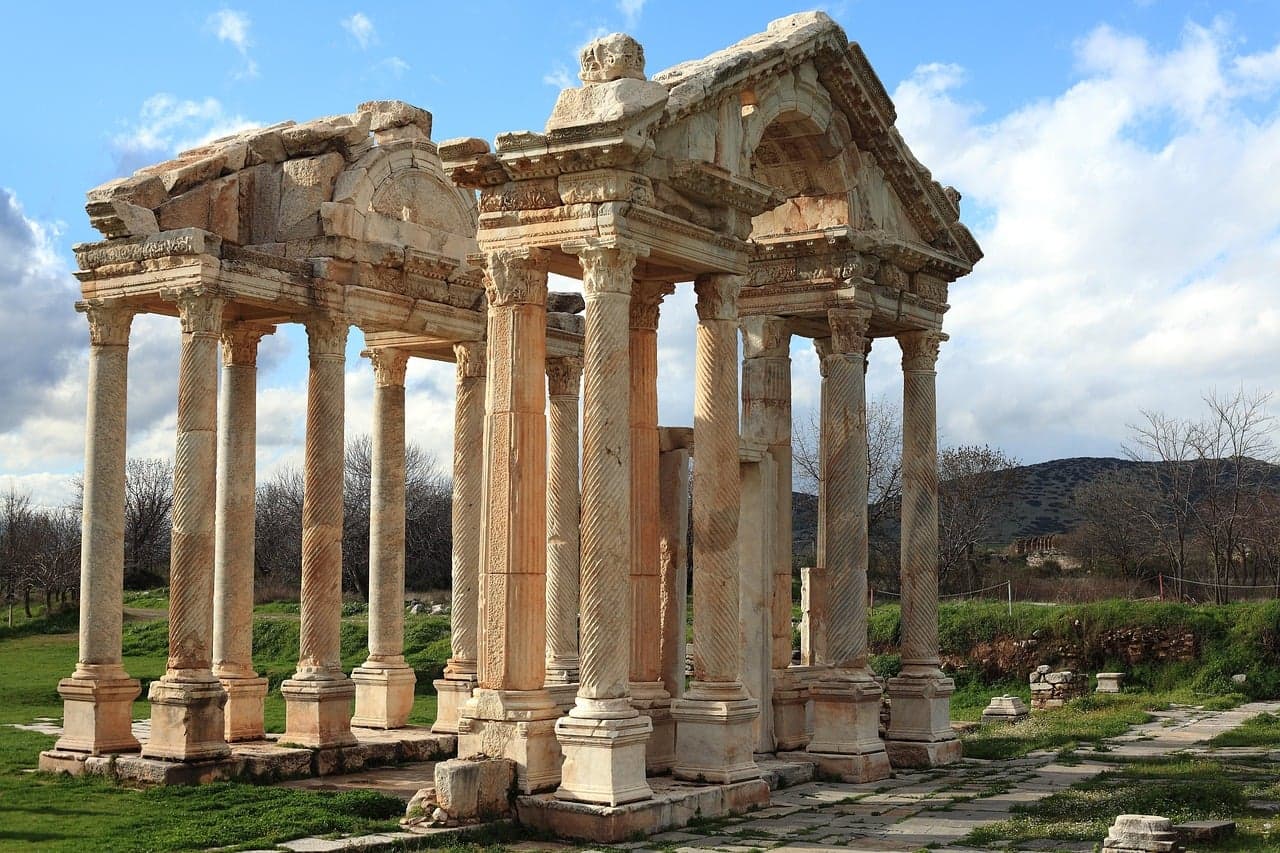
In Aydın, start with UNESCO-listed Aphrodisias, then see Priene, Miletus and Didyma, which stand close together in the Büyük Menderes delta. These four ancient cities make the province one of the densest archaeology routes in Anatolia, while Kuşadası and the Dilek peninsula on the coast and the canyons and highland pastures inland complete the route. The roads through the fig and olive groves of the Menderes plain are part of the journey too.
Which ancient cities in Aydın should you not miss?
The best way to explore Aydın is to follow the Büyük Menderes river. The silt it carried over the centuries has left cities that were once ports kilometres inland today, so each ancient city tells of a different layer of time.
Aphrodisias
Aphrodisias sits in the Geyre neighbourhood of Karacasu, on a plateau about six hundred metres above sea level in the fertile valley of the Dandalaz stream. The real wealth of the city, named after the cult of Aphrodite, was the marble quarries on the nearby slopes of Babadağ; thanks to them a school of sculpture was born whose statues reached the whole Mediterranean. Aphrodisias, together with its ancient marble quarries, joined the UNESCO World Heritage List in 2017. Allow at least half a day for the agora with its pool, the theatre and one of the best-preserved stadiums of the ancient world.
Priene
Priene stands on a steep crag on the southern slope of Samsun Dağı (Mycale), fifteen kilometres south-west of Söke. The city was refounded in the middle of the fourth century BC on the grid plan of Hippodamus of Miletus and is considered the best-preserved example of town planning from antiquity. Because of the columns of the Temple of Athena, the small but impressive council hall known as the bouleuterion and its well-preserved houses, it is called "the Pompeii of Anatolia". The Priene archaeological site was added to the UNESCO World Heritage Tentative List in 2018.
Miletus
This is the city of the first philosophers, such as Thales, Anaximander and Anaximenes, and of the town planner Hippodamus. The great theatre, later crowned with a castle, the well-preserved Baths of Faustina and traces of the agoras can still be seen. Do not forget to look at the finds in the museum right next to the site.
The İlyas Bey Mosque at Balat
In the village of Balat beside Miletus, the mosque built around 1404 was constructed with marble blocks from Miletus. Its pointed-arched stone portal and marble-clad interior are an elegant example of the stonework of the Beylik period.
The Temple of Apollo at Didyma
In the centre of Didim, in the sanctuary of Didyma, the famous oracle centre of antiquity, stands one of the largest temples built in the Ionic order. According to ancient writers it was so large that its roof was never completed. Only on site, walking among the giant column bases, can you grasp its scale.
Tralles
The ancient city in central Aydın was the home of Anthemius, one of the architects of Hagia Sophia, and of the physician Alexander. The arched remains of the gymnasium, which locals call "Üçgözler" (the Three Eyes), are the province's emblem. The Seikilos stele, found near Tralles, carries the earliest known song to survive complete with its words and musical notation.
Magnesia
The city in Germencik was an important trading stop in the middle of the triangle formed by Priene, Ephesus and Tralles. It owes its fame today to the architect Hermogenes, praised by the Roman architectural writer Vitruvius, and the sanctuary of Artemis he designed.
Alinda
Alinda, in Karpuzlu, is a Carian city ringed by remarkably well-preserved walls. The three-storey market building south of the agora is a rare example in Anatolia, and the view over the plain from the hillside theatre is worth the trip.
What is there on the coast and in nature?
Kuşadası and Güvercinada Castle
Kuşadası takes its name from Güvercin Adası (Pigeon Island) at the mouth of the harbour. The castle on the island was built of stone and brick on a natural rock; when Evliya Çelebi came here in 1671, he wrote that a hundred thousand birds came to the island every year. Walking along the causeway to the castle in the late afternoon and watching the bay is a lovely way to end the day.
Dilek Peninsula–Büyük Menderes Delta National Park
The national park between Kuşadası, Söke and Didim is home to the finest examples of maquis in Türkiye and hundreds of bird species. Recognised by the Council of Europe as a biogenetic reserve, the peninsula has coves and walking and cycling paths. Stop at the cool, clear water of Zeus Cave near the entrance too.
Lake Bafa and the Beşparmak Mountains
Bafa, on the border between Aydın and Muğla, is the largest lake in the Aegean region; it is best seen together with the remains of Herakleia on its shore and the strange rock formations of the Beşparmak Mountains, ancient Latmos. The lake is an important wintering ground for water birds, so bring your binoculars.
Arapapıştı (İnceğiz) Canyon
In Bozdoğan, the canyon carved by the Akçay is six kilometres long and in places three hundred and eighty metres high. Boat tours run in the canyon, and you can also explore it on foot along the trails. Remains of Roman and Byzantine settlements lie around it.
The Ahmet Gazi Mosque at Eski Çine
The mosque in the village of Eski Çine near Çine was built in the first half of the fourteenth century and is the oldest known mosque in Aydın. With its dome of about seventeen metres in diameter, it was one of the widest-domed buildings of its time, which is why it is also called the "Ulu Cami" (Grand Mosque).
Paşa Yaylası and Yenipazar
Paşa Yaylası, twenty-five kilometres from the city centre, is a cool escape among pine and juniper forests. Yenipazar to the east is one of the districts that has joined Türkiye's slow town network for preserving its quiet way of life, traditions and food culture.
What is on Aydın's table?
Aydın's cuisine is known for olive-oil dishes, figs, grapes, citrus and Aegean fish. On the governor's office list of local dishes, tarhana and kulak soups, olive-oil fried kırlı, sarmaşık and kedirgen kavurma, keşkek, tandır kebab and paşa böreği, a pastry made with meat stock, stand out. Among salads, black-eyed bean teretor and radish-leaf salad, and among desserts lokma, zerde and pelvize are worth trying. Buying fresh figs from roadside growers in early summer is a habit unique to Aydın.
How many days do you need in Aydın?
Four days is ideal. A sample route:
- Day one: Güvercinada Castle in Kuşadası and the Dilek peninsula.
- Day two: Priene, Miletus, the İlyas Bey Mosque at Balat and Didyma at sunset.
- Day three: Tralles in central Aydın, then Magnesia; Paşa Yaylası in the evening.
- Day four: A full day at Aphrodisias; Eski Çine or Alinda on the way back.
For other cities in the Aegean, take a look at the City Routes page.
When should you go, and how do you get there?
April to June and September to November are the most comfortable months for the ancient cities; in July and August the sites get very hot. Summer is ideal for the sea. Aydın is reached by road and by rail, and the airport in the neighbouring province is close. The sites are spread out, so getting around by car is easiest; Priene can also be reached by public transport from the city centre.
What should you keep in mind?
- Most sites have no shade; bring a hat, water and sunscreen, and spend the midday heat in a museum.
- Do not leave the marked paths at the ancient cities or climb on the ruins.
- Check current hours and ticket prices for archaeological sites and museums on their official pages.
- Keep quiet in bird areas such as Lake Bafa and the delta, and do not approach the birds.
Frequently asked questions
How many days do you need in Aydın?
Allow one day for Kuşadası and the Dilek peninsula, one for Priene, Miletus and Didyma, one for Tralles and Magnesia and one for Aphrodisias, and you can explore comfortably in four days.
When is the best time to visit Aydın?
Spring and autumn are the best seasons for the ancient cities. In July and August the sites get very hot; the summer months are ideal for the sea.
How do you get to Aydın?
Aydın is reached by road and by rail, and the airport in the neighbouring province is close. The sites are spread out, so a car is the easiest way to get around.
Is Aphrodisias on the UNESCO list?
Yes. The ancient city of Aphrodisias was inscribed on the UNESCO World Heritage List in 2017 together with its ancient marble quarries. Priene has been on the Tentative List since 2018.
What should you eat in Aydın?
Paşa böreği, keşkek, tarhana soup, kedirgen and sarmaşık kavurma, black-eyed beans in olive oil, lokma and pelvize stand out. Fresh and dried figs and olives are also the province's emblematic products.
Editorial desk
Stories signed by the Cultvia editorial desk follow our editorial policy; every story lists its sources at the end and errors are fixed under our corrections policy.
Last updated:
What changed?
- : First published
Sources
- Yöresel Yemekler — T.C. Aydın Valiliği
- Afrodisias Antik Kenti — Kültür Portalı – T.C. Kültür ve Turizm Bakanlığı
- Priene — Kültür Portalı – T.C. Kültür ve Turizm Bakanlığı
- Aydın'da Görülecek Yerler — Go Türkiye (Türkiye Turizm Tanıtım ve Geliştirme Ajansı)
Up next
 City RoutesParis Photo 2026: opening hours, sectors and what to see13 November 2026 · 1 min read


