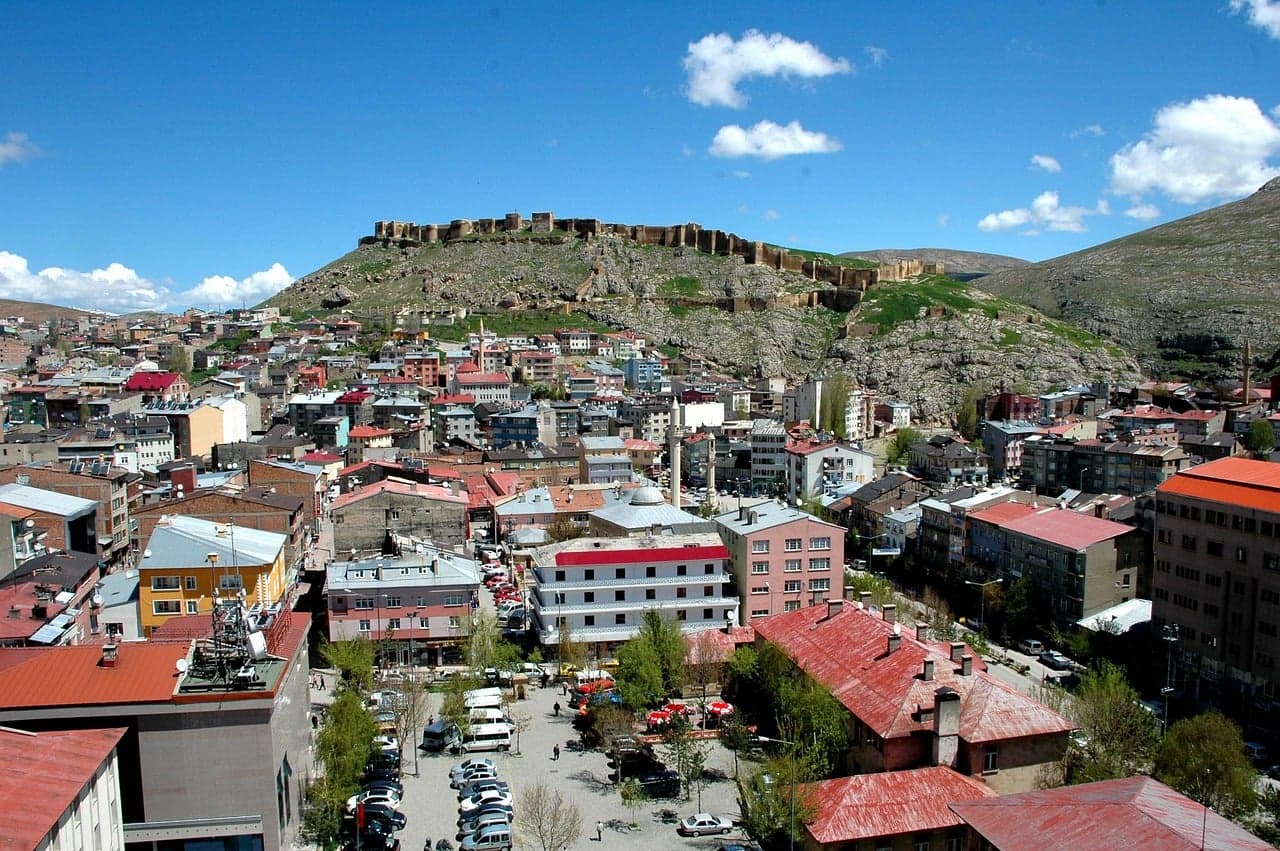
Make your first stop in Bayburt Bayburt Castle, on the rocky hill wrapped on three sides by the Çoruh; from here you see the whole city, and when you come down you walk to the Clock Tower and the Grand Mosque right in front of it. Then add to your route the Baksı Museum, in a village overlooking the Çoruh Valley, the Aydıntepe Underground City, carved into the bedrock, and Kop Dağı, with its snow in winter and its cool air in summer.
What should first-time visitors see in central Bayburt?
Bayburt is a small, walkable city. It was founded on the old trade route linking the Black Sea coast with the Persian Gulf; you can still read this crossroads identity in its castle, its inn and its bridges.
Bayburt Castle
It is not known who first built the castle, set on the sheer rocks north of the city. It saw Roman, Byzantine and Arab rule and was repaired many times in the Turkish period; seventeen of the twenty Arabic inscriptions on its towers date from the Seljuk period, in the time of Tuğrul Şah, the Malik of Erzurum. Because the Seljuks decorated the surfaces of the walls with turquoise, purple and green tiles, the castle was for a time also known as the Çinimaçin Castle. These tiles, lost over time, were reproduced faithfully and put back in place in a restoration that began in 2017. This is also the castle that Bamsı Beyrek set out to conquer in the tales of Dede Korkut. Do not forget to watch the sunset looking down from the castle road.
The Clock Tower
The tower rising right in front of the castle can be seen from almost everywhere in the city centre. Construction began in 1923 and took a year; its clock was brought from Switzerland and is still in good working order. It is a good meeting point for a short photo stop.
The Grand Mosque
Held to have been built between the end of the thirteenth and the beginning of the fourteenth century, in the reign of the Anatolian Seljuk Sultan Mesud II, the mosque was rebuilt in the 1970s according to its original plan. From the first building, two doors opening into the prayer hall, a few of the muqarnas squinches and the minaret, built of glazed, patterned bricks, have survived. Take a close look at the brickwork of the minaret.
The Taşhan
The inn in the centre carries the city's commercial memory. Its construction date is not known for certain; written sources say it existed at the beginning of the seventeenth century. With its domed entrance of cut stone and brick and the pointed arches inside, it frames the fabric of the old bazaar.
The Dede Korkut Kümbet
The building, also known locally as the Ali Baba or Korkut Ata Kümbet, is thought to belong to Dede Korkut, the semi-legendary sage of the Oghuz epics. An international culture and arts festival in the name of Dede Korkut is held in Bayburt every July; if the dates suit you, combine your trip with the festival.
Where should you stop along the Çoruh Valley?
The Baksı Museum
The museum stands on a hill overlooking the Çoruh Valley in Bayraktar village, formerly called Baksı, forty-five kilometres from the city. Sprouting in 2000 as the dream of the Bayburt-born artist and academic Hüsamettin Koçan, the museum opened in 2010; the Depot Museum was added in 2012. It brings contemporary art and traditional crafts together under one roof; with its exhibition halls, workshops, library and guesthouse, it spreads over an area of forty dönüms. According to the governorship, the museum also runs production and education projects for women and children in the area. Check the current hours on the museum's official page.
The Korgan Bridge
On the route of the historic Silk Road, the two-arched bridge with pointed arches over the Çoruh is known locally as the Meliğin Köprüsü. You can see Seljuk stonework dated to the thirteenth and fourteenth centuries even on a short stop.
The Pulur Mosque and Madrasa
The mosque in Pulur (Gökçedere), in the Demirözü district, was built in 1517 by Ferahşat Bey, according to written sources; the madrasa building next to it completes this historic setting. It is a quiet and simple corner; explore it without hurrying.
The Demirözü Dam Lake and Büyüktepe Höyük
The wide water surface of the dam on the Lori stream, built between 1996 and 2003 for irrigation, offers a calm stop for a walk and the sunset. Excavations at Büyüktepe Höyük showed that settlement in the area began around 3500 BC and continued until the Roman period; handmade pottery from the Early Bronze Age was found.
What is there beneath the ground and on the mountain top?
The Aydıntepe Underground City
It consists of galleries and rooms carved into the bedrock two to five metres below the surface, without using any building materials. It has not yet been fully explored. Some think it belonged to the city of Chaldia, others that it was a refuge of the early Christians. The galleries are cool; take a light cardigan.
The Kop Dağı Winter Sports Tourism Centre
Behind Kartal Tepesi, at the centre with ten separate runs starting from two thousand nine hundred and fifty metres, the snow starts to settle in December and lasts until the end of May. Its clean air, scented with juniper and flowers, promises a calm ski day away from the crowds.
Kop Dağı Historical National Park
Kop Dağı, between Bayburt and Erzurum, was given the status of a historical national park in 2016. The trenches and monuments left from the First World War let you read the past while on a nature walk.
What should you eat in Bayburt?
Bayburt cuisine is made up of the simple but filling flavours of the highlands and the steppe. Galacoş, made with lentils, meat, onions, pide and minced meat and served hot, is one of the city's most special dishes. Ekşi lahana, cooked with kavurma, bulgur and cabbage, is made in every season of the year. Lor dolması, prepared with lor cheese and wild chard (evelik), has become synonymous with Bayburt. Many kinds of yalancı dolma, süt böreği with its light and distinctive taste, the laborious but famous tel helvası and tatlı çorba, rich in ingredients and offered to guests during the holidays, are also part of the table.
How many days do you need in Bayburt?
Two days is enough for the centre and its surroundings; in the winter months, add a day for Kop Dağı. A sample route:
- Day one: Bayburt Castle in the morning, followed by the Clock Tower, the Grand Mosque and the Taşhan; the Dede Korkut Kümbet and the Korgan Bridge in the afternoon.
- Day two: the Baksı Museum in the morning; on the way back, the Pulur Mosque and sunset at the Demirözü Dam Lake.
- Day three: the Aydıntepe Underground City and Kop Dağı; skiing in winter, walking in the national park in summer.
For other cities in the eastern Black Sea and Eastern Anatolia, take a look at the City Routes page.
When should you go, and how do you get there?
The summer months are the most comfortable time for trips to the castle, the museum and the valley; the Dede Korkut festival is held in July. December to the end of May suits skiing. Bayburt is reached by road; roads crossing the Zigana and Kop mountains link the city to the Black Sea coast and to Erzurum. For the Baksı Museum, Pulur and Kop Dağı you need a vehicle.
What should you keep in mind?
- Check the current hours and fees of museums and archaeological sites on their official pages.
- Bayburt is a high-altitude province; evenings are cool even in summer, so dress in layers.
- In winter there may be snow and ice on the mountain passes; check the weather and road conditions before you set off.
- Do not touch the castle's tiles and inscriptions; do not leave the marked paths at historic sites.
Frequently asked questions
How many days do you need in Bayburt?
With one day for the castle, the Clock Tower, the Grand Mosque and the Taşhan and one for the Baksı Museum, Pulur and Demirözü, you see the main sights in two days. You can add a third day for the Aydıntepe Underground City and Kop Dağı.
Where is the Baksı Museum?
The Baksı Museum is on a hill overlooking the Çoruh Valley in Bayraktar village, formerly called Baksı, about forty-five kilometres from Bayburt. You need a vehicle to get there; check the current visiting hours on the museum's official page.
When is the best time to visit Bayburt?
The summer months are the best time for the castle, the museum and valley trips; the Dede Korkut Culture and Arts Festival takes place in July. December to the end of May suits skiing on Kop Dağı.
How do you get to Bayburt?
Bayburt is reached by road; roads crossing the Zigana and Kop mountains link the city to the Black Sea coast and to Erzurum. The buildings in the centre are within walking distance, and you need a vehicle for the surroundings.
What should you eat in Bayburt?
Galacoş, made with lentils, meat and pide, lor dolması prepared with lor cheese and evelik, ekşi lahana, süt böreği, tel helvası and the tatlı çorba made during the holidays stand out.
Editorial desk
Stories signed by the Cultvia editorial desk follow our editorial policy; every story lists its sources at the end and errors are fixed under our corrections policy.
Last updated:
What changed?
- : First published
Sources
- Gör Bayburt — Go Türkiye (Türkiye Turizm Tanıtım ve Geliştirme Ajansı)
- Baksı Müzesi — T.C. Bayburt Valiliği
- Bayburt Kalesi — Kültür Portalı – T.C. Kültür ve Turizm Bakanlığı
- Tat Bayburt — Go Türkiye (Türkiye Turizm Tanıtım ve Geliştirme Ajansı)
Up next
 City RoutesParis Photo 2026: opening hours, sectors and what to see13 November 2026 · 1 min read


