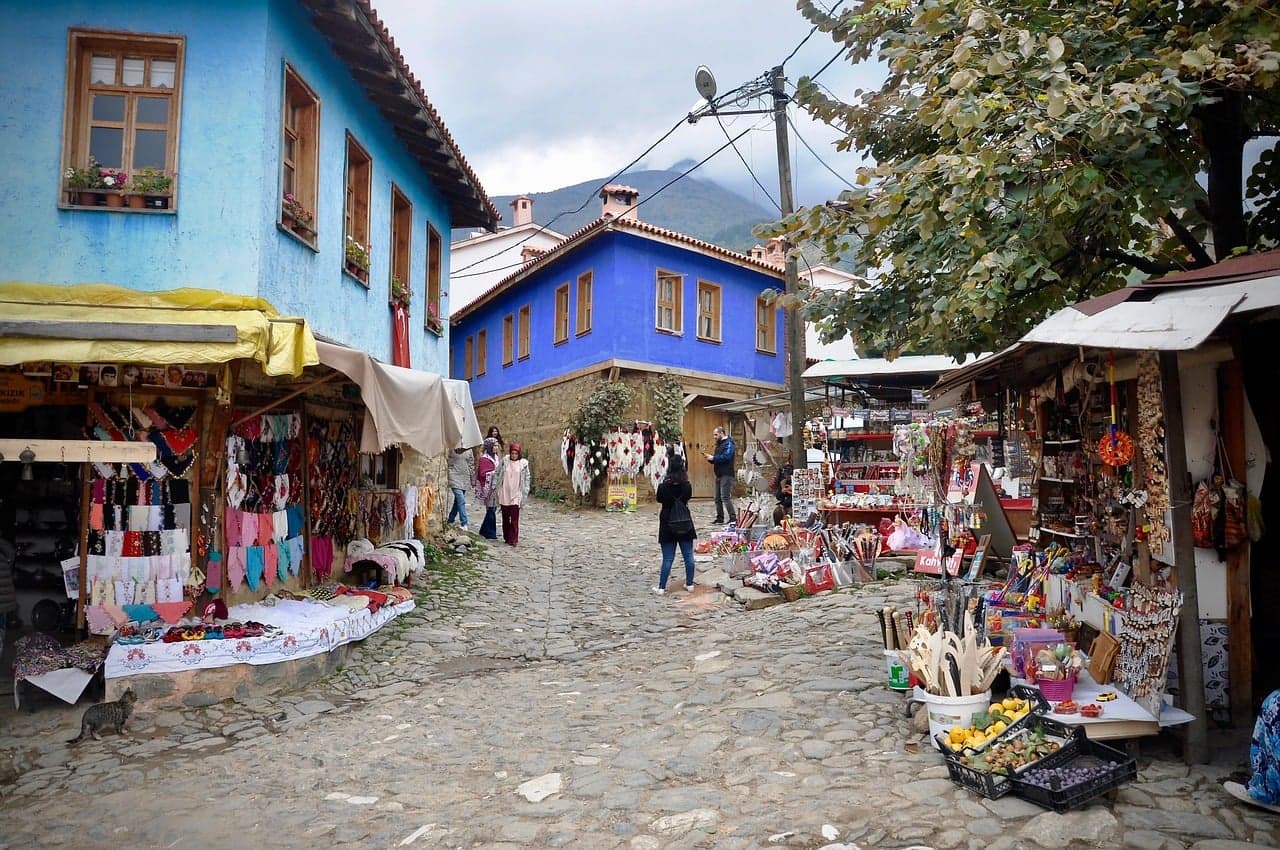
In Bursa, the first places to see are the mosque complexes from the founding years of the Ottoman state, the Inns District and the village of Cumalıkızık; since 2014 these have been on the UNESCO World Heritage List as "Bursa and Cumalıkızık: the Birth of the Ottoman Empire". Uludağ, rising right above the city, opens up a second world, with skiing in winter and walking in summer. With two days you can comfortably see both the historic centre and the mountain.
What should first-time visitors see in Bursa?
The Grand Mosque (Ulu Camii)
Built between 1396 and 1400 under Bayezid I, the Grand Mosque, with its twenty domes and twelve great piers, is considered the first of the multi-domed monumental buildings of the early Ottoman period. The real treasure inside is the calligraphy panels covering the walls, signed by many calligraphers from different eras. The rhythm of the domes is best understood from inside rather than from the courtyard.
The Inns District and Koza Han
The Inns District (Hanlar Bölgesi), right beside the Grand Mosque, has been the city's trading centre for centuries. Its best-known building, Koza Han, was built in 1490–1491 to provide income for the complex of Bayezid II in Istanbul. In the middle of its two-storey arcaded courtyard stands a small kiosk mosque raised on eight piers, and the monumental gate on the north side is decorated with turquoise tiles. It is still full of shops selling silk and silk goods, and a tea break in the courtyard is a local classic. The Kubbeli Han from the time of Orhan Gazi is another early example nearby.
The Green Mosque and the Green Tomb
The Green Mosque (Yeşil Camii), built for Mehmed I in 1419, is one of the most elegant Ottoman buildings with an "inverted T" plan. Its muqarnas portal is a high point of stone carving, and its tiled mihrab, more than ten metres tall, one of the peaks of early Ottoman tile art. You can see the Green Tomb (Yeşil Türbe) opposite on the same visit; together the two buildings give the district its name.
The Muradiye Complex
Completed in 1425–1426 under Murad II, the complex consists of a mosque, a madrasa, a soup kitchen, a bath and tombs set in a large garden. The tiles and painted decoration of the tombs in the garden promise a calm half-hour away from the crowds. In the surrounding streets of Muradiye you can still read the fabric of old Bursa houses.
Tophane and the tombs of Osman Gazi and Orhan Gazi
The Tophane ridge, site of Bursa Castle, became the first seat of government after the Ottomans took the city in 1326. Today the tombs of Osman Gazi and Orhan Gazi stand side by side in Tophane Park, next to the Tophane Clock Tower, which took its present form in 1905. The viewpoint in the park gives a wide panorama over the city and the plain.
Cumalıkızık
Cumalıkızık, on the northern slopes of Uludağ, is one of the endowment villages founded when the Ottomans settled in the region. The village has around 270 houses, some still lived in and some under restoration; built of rubble stone, timber and mud brick, most are three storeys high and lean out over narrow cobbled lanes with their bay windows. The seventeenth-century mosque with a wooden portico on the square, the monumental plane trees at the entrance and the small museum displaying the village's old objects are worth seeing. Weekday mornings let you explore the streets more quietly.
Uludağ National Park
Uludağ, about thirty-six kilometres south of the city, is Bursa's emblem with its 2,543-metre summit. Declared a national park in 1961, the mountain has seen skiing since 1933; in summer the area around Sarıalan and Çobankaya becomes a camping and walking ground. Taking the cable car up to Sarıalan via Kadıyayla is the easiest way to see the mountain. The higher reaches hold glacial lakes and rock formations shaped by glaciers.
Irgandı Bridge
Irgandı Bridge over the Gökdere stream is one of the rare Ottoman bridges lined with shops on both sides. Today it houses small craft workshops, and it lies on your way as you walk from Yeşil to the Inns District.
What is there around Bursa?
Leave the centre and Bursa's lake and coastal side begins.
- İznik: This historic town on the lakeshore is known for its tile craft. The Süleyman Paşa Madrasa is now used as the Tile Makers' Bazaar, and in its workshops you can watch traditional İznik tiles being made.
- Gölyazı: This old settlement on a peninsula reaching into Lake Uluabat is known for its stone streets, the lake view from Zambaktepe and its rowing-boat tours. The lake is an important bird habitat.
- Tirilye: This coastal town near Mudanya is a protected conservation area with stone mansions among olive groves and narrow streets.
Bursa's table is known for İskender kebab, pideli köfte (meatballs on pide), candied chestnuts and İnegöl köfte; the area around the Inns District is a natural place to start tasting them.
How many days do you need in Bursa?
One day for the historic centre and one for Uludağ or the surroundings is ideal. A sample two-day route:
- The Grand Mosque and the Inns District in the morning, with a break in the courtyard of Koza Han.
- The tombs of Osman Gazi and Orhan Gazi at Tophane in the afternoon, then the Green Mosque and the Green Tomb.
- Irgandı Bridge and the Muradiye Complex in the late afternoon.
- Cumalıkızık on the morning of day two; in the afternoon, the cable car up Uludağ or sunset at Gölyazı.
If you have a third day, plan İznik as a separate trip.
When should you go, and how do you get there?
Spring and autumn are the most comfortable seasons for exploring the city on foot. Winter is the time for skiing, while late summer suits mountain walks and the glacial lakes. You can reach Bursa from Istanbul by road, or by sea via Mudanya; the city also has its own airport. Buses and minibuses from the centre go to Cumalıkızık, and you can go up Uludağ by cable car or by road.
What should you keep in mind?
- Check current visiting hours and prices for museums, tombs and the cable car on the relevant official pages.
- When visiting mosques, choose times outside prayers and wear clothes that cover your shoulders and knees.
- The weather on Uludağ can change very quickly; take a warm layer even in summer.
- Most houses in Cumalıkızık are still lived in; do not walk into courtyards uninvited, and respect people's privacy when taking photos.
For other cities, browse City Routes.
Frequently asked questions
How many days do you need in Bursa?
One day for the historic centre and another for Cumalıkızık and Uludağ lets you see the city comfortably. If you want to add İznik or Gölyazı, plan a third day.
Which parts of Bursa are on the UNESCO World Heritage List?
The site "Bursa and Cumalıkızık: the Birth of the Ottoman Empire", inscribed in 2014, covers the Inns District, the Orhan Gazi, Hüdavendigâr, Yıldırım, Yeşil and Muradiye complexes and the village of Cumalıkızık.
When is the best time to visit Bursa?
Spring and autumn are the most comfortable seasons for exploring the city on foot. Winter suits skiing, while late summer is better for walking on Uludağ and seeing its glacial lakes.
How do you get to Cumalıkızık?
The village is close to central Bursa; you can get there by buses from the centre or by minibuses along the Ankara road. Weekday mornings are quieter.
How do you get up Uludağ?
The easiest way is the cable car: it runs from the city via Kadıyayla to Sarıalan, and from there you continue by road to the hotel area. Check current timetables on official sources.
Editorial desk
Stories signed by the Cultvia editorial desk follow our editorial policy; every story lists its sources at the end and errors are fixed under our corrections policy.
Last updated:
What changed?
- : First published
Sources
- Top Things to See in Bursa — Go Türkiye (Türkiye Turizm Tanıtım ve Geliştirme Ajansı)
- Cumalıkızık Köyü — Kültür Portalı – T.C. Kültür ve Turizm Bakanlığı
- Koza Han — Kültür Portalı – T.C. Kültür ve Turizm Bakanlığı
- Uludağ Milli Parkı — Kültür Portalı – T.C. Kültür ve Turizm Bakanlığı
Up next
 City RoutesParis Photo 2026: opening hours, sectors and what to see13 November 2026 · 1 min read


