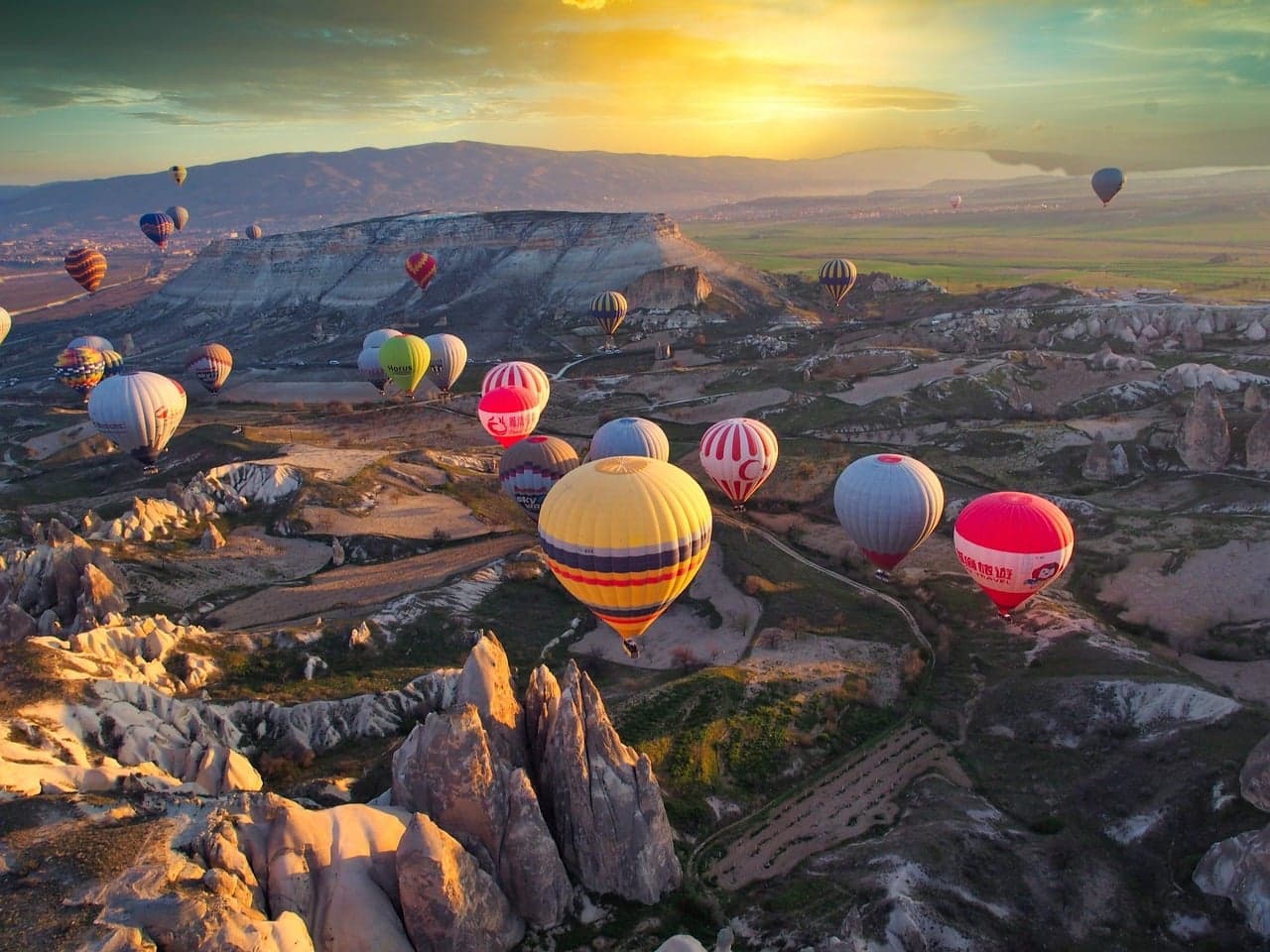
At the heart of any Cappadocia route are the rock-cut churches of the Göreme Open-Air Museum, Uçhisar Castle and the valleys full of fairy chimneys; underground cities such as Derinkuyu and Kaymaklı are among the region's most distinctive stops. Göreme National Park and the Rock Sites of Cappadocia have been on the UNESCO World Heritage List since 1985. With three days you can walk the valleys, go below ground and watch the balloons fill the sky at dawn.
What should first-time visitors see in Cappadocia?
Göreme Open-Air Museum
This cluster of churches, chapels and monastic buildings carved into soft tuff rock is the region's most important stop. The Dark Church, dated to the late eleventh or early twelfth century, receives so little light that its frescoes have kept their vivid colours. Do not miss the Tokalı Church a little below the museum entrance, with its wall paintings on a deep blue ground.
Uçhisar Castle
This huge rock mass on one of the highest points in the region is a natural castle hollowed out into rooms. The view from the top, across Göreme, Mount Erciyes and the valleys, explains Cappadocia's geography at a glance. It is best climbed towards sunset.
Pigeon Valley
Running down from Uçhisar to Göreme, Güvercinlik (Pigeon) Valley is one of the region's best-loved walks, lined with dovecotes carved into the rock and passages cut by the stream. For centuries the dovecotes were used to supply fertiliser for the vineyards. The walk takes about an hour and a half and is mostly downhill.
Paşabağ
On the road that turns off the Göreme–Avanos road towards Zelve, Paşabağ is known for its capped fairy chimneys with more than one stem. The shape formed because the hard rock cap protects the soft tuff below from erosion. One of the chimneys holds a hermit's cell and a small chapel.
Zelve
Made up of three valleys, Zelve is where fairy chimneys are at their densest. It was lived in for a long time, and rock-cut houses, churches and the remains of a mill can still be seen. An early-morning walk is ideal for both the cool air and the light.
Devrent Valley and the Three Beauties
Devrent is also called the "Valley of Imagination" for its rock formations that look like animals; there are no churches or dwellings here, only nature's sculptures. At the entrance to Ürgüp, the Three Beauties (Üç Güzeller), a row of three capped fairy chimneys, are one of the region's emblems.
Kızılçukur and Güllüdere valleys
Kızılçukur, between Çavuşin and Ortahisar, takes its name from the tuff cliffs that turn red at sunset. Walked together with Güllüdere, these valleys hold rock churches dated between the first and tenth centuries. Try to reach the viewing terrace a little early for the sunset.
Çavuşin
On the rock face above Çavuşin, a village a few minutes from Göreme, stands the Church of St John the Baptist, counted among the oldest and largest churches in the region. Wandering among the rock-cut houses in the old part of the village shows how everyday life was arranged in Cappadocia.
Avanos
Avanos, with the Kızılırmak river running through it, is known for pottery made from the river's red clay, a tradition that goes back to the Hittites. Trying the potter's wheel in one of the workshops or strolling along the river makes a good break after the valleys.
Ortahisar and Mustafapaşa
Ortahisar is a quiet town with a rock castle rising in its centre and storerooms carved into the rock; in 2026 it joined the Cittaslow network of slow towns. Mustafapaşa, south of Ürgüp, was once called Sinasos; its mansions decorated with fine stonework and the nineteenth-century Church of Constantine and Helena are worth seeing.
Derinkuyu Underground City
Thanks to Cappadocia's geology, this eight-level underground city was carved into the rock; with food stores, ventilation shafts, wine presses, churches and wells, it was designed to shelter a large community. The huge stone doors used to seal the tunnels are still in place. The city opened to visitors in 1965, and only a small part of it can be explored.
Kaymaklı and Özkonak underground cities
Kaymaklı, on the Nevşehir–Niğde road, is a close relative of Derinkuyu with its narrow passages and many levels; you can visit both on the same day. Özkonak, near Avanos, is a less crowded alternative.
How do balloon flights in Cappadocia work, and what should you know?
Commercial balloon flights in Cappadocia are supervised by Türkiye's Directorate General of Civil Aviation (SHGM). Balloon operators are licensed by SHGM, and pilots must have region-specific training and renew their emergency training regularly. Under the slot instruction published for the Nevşehir Cappadocia balloon flight area, operators file their flight plans with the Slot Service Centre the day before and get take-off clearance before launching; the morning flight period begins shortly before sunrise.
The weather assessment decides whether flights go ahead. A green, yellow or red flag is declared for each sector of the area: under a green flag, flights may take place at the discretion of the operator and the pilot in command; under a yellow flag, everyone waits for conditions to change; under a red flag, there are no flights. Cancellations because of wind or visibility are therefore routine, and it is wise to build a spare morning into your plan.
- Before booking, ask whether the operator holds an SHGM licence.
- Listen carefully to the pilot's safety briefing before take-off, and especially learn the landing position.
- If you are pregnant, have had recent surgery or have limited mobility, ask your doctor first.
- Dawn is chilly; dress in layers and wear flat, closed shoes.
If you would rather not fly, watching the balloons from the viewpoints in Göreme and Uçhisar is just as memorable.
How many days do you need in Cappadocia?
Three days is enough for the main sights. A sample route:
- Day one: The Göreme Open-Air Museum and the Tokalı Church in the morning, a walk through Pigeon Valley in the afternoon, Uçhisar Castle at sunset.
- Day two: A balloon or a viewpoint at dawn, then Paşabağ, Zelve, Devrent and Avanos; sunset at Kızılçukur.
- Day three: Derinkuyu and Kaymaklı in the morning, then Ortahisar, Ürgüp, the Three Beauties and Mustafapaşa in the afternoon.
For similar routes, browse City Routes.
When should you go, and how do you get there?
The best seasons for walking in the valleys are April to June and September to October. Summer days are hot and nights cool; in winter the fairy chimneys under snow make a different picture, but the trails can be slippery.
The nearest airports are in Nevşehir and Kayseri. Intercity buses reach Nevşehir and Göreme. The valleys and the underground cities are spread out, so renting a car or joining a planned day tour makes things easier.
What should you keep in mind?
- Visiting hours and ticket prices at museums and archaeological sites can change; check their official pages before you go.
- Photography is not allowed in some churches at the Göreme Open-Air Museum to protect the frescoes; follow the staff's instructions.
- The tunnels in the underground cities are narrow and low; if you struggle in enclosed spaces, do not go down to the deepest levels.
- On valley walks, stay on the marked trails and take water and a hat.
- Climbing the fairy chimneys is dangerous and damages this fragile heritage.
Frequently asked questions
How many days do you need in Cappadocia?
Three days is enough to see Göreme, Uçhisar, the valleys and the underground cities. If you are planning a balloon flight, add one more morning in case the weather cancels it.
When is the best time to visit Cappadocia?
Spring and autumn are the best seasons for walking in the valleys. Summer days are hot; in winter the snowy landscape is striking, but the trails can be slippery.
Are balloon flights in Cappadocia safe?
Commercial balloon flights are supervised by the Directorate General of Civil Aviation; operators must be licensed and pilots must have region-specific training. A weather assessment is made every morning, and flights are not allowed in unsuitable conditions. Ask about the operator's licence before booking.
Why are balloon flights cancelled?
A green, yellow or red flag is declared for each sector of the flight area. If the wind or visibility is not suitable, a red flag is raised and there are no flights that morning.
How do you get to Cappadocia?
The nearest airports are in Nevşehir and Kayseri, and intercity buses reach Nevşehir and Göreme. Renting a car makes it easier to move between the valleys.
Can you visit Derinkuyu and Kaymaklı on the same day?
Yes. Both underground cities lie on the Nevşehir–Niğde road close to each other, so you can easily see them in the same morning or the same day.
Editorial desk
Stories signed by the Cultvia editorial desk follow our editorial policy; every story lists its sources at the end and errors are fixed under our corrections policy.
Last updated:
What changed?
- : First published
Sources
- Top Things to See in Cappadocia — Go Türkiye (Türkiye Turizm Tanıtım ve Geliştirme Ajansı)
- Derinkuyu Yeraltı Şehri — Kültür Portalı – T.C. Kültür ve Turizm Bakanlığı
- Nevşehir Kapadokya Balon Uçuş Sahası Slot Uygulama Talimatı (SHT-BALON-SLOT) — Sivil Havacılık Genel Müdürlüğü
- Balon uçuşlarına yeni düzenleme — Sivil Havacılık Genel Müdürlüğü
Up next
 City RoutesParis Photo 2026: opening hours, sectors and what to see13 November 2026 · 1 min read


