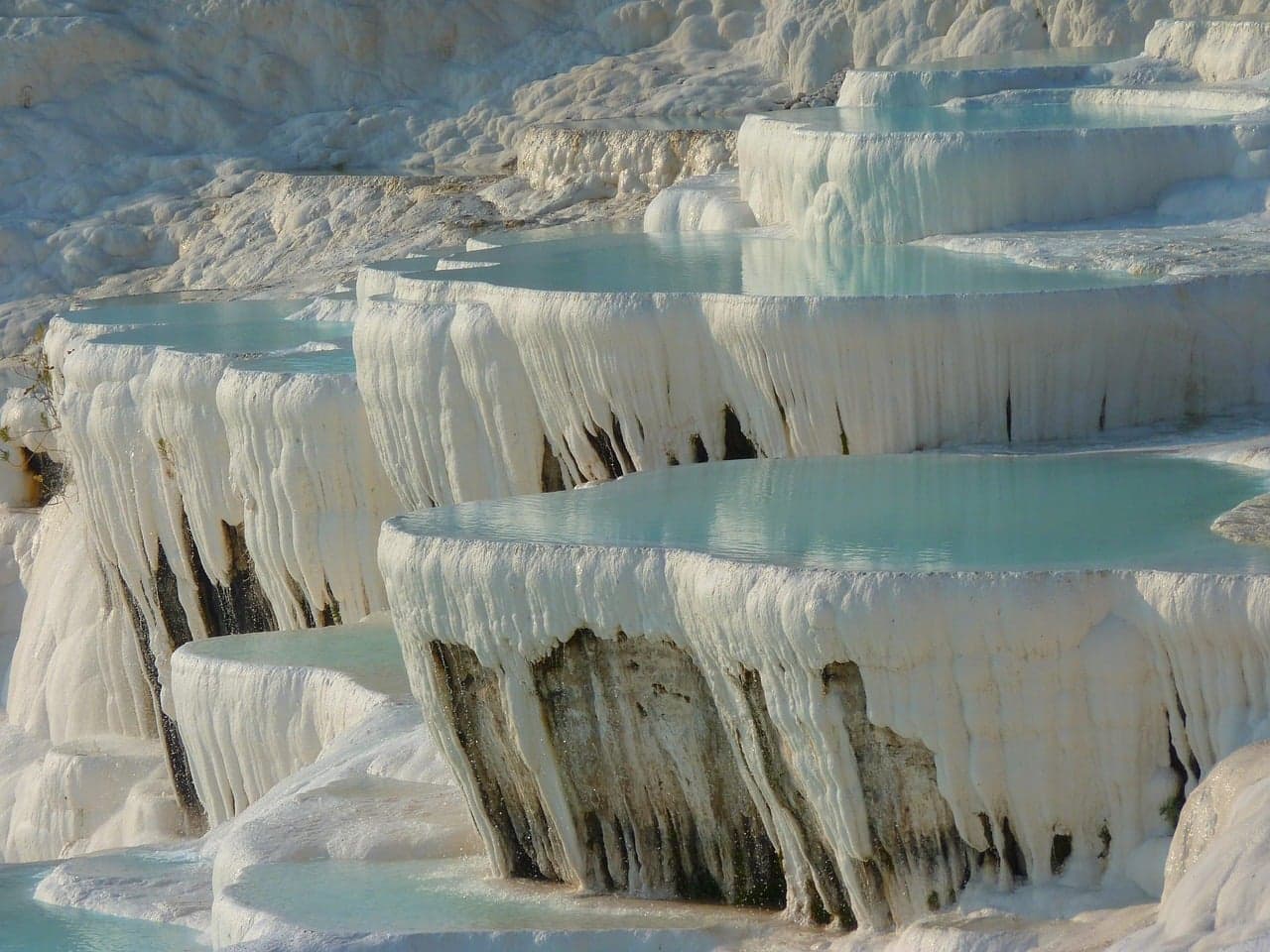
Make your first stop in Denizli Hierapolis and Pamukkale, rising above the brilliant white travertines; this UNESCO World Heritage site tells a story of thermal bathing culture that goes back more than two thousand years. Laodicea, just outside the city, with the largest stadium in Anatolia, is your second great ancient stop. Village mosques with painted interiors, the weaving town of Buldan and Lake Acıgöl, where flamingos gather, make Denizli much more than a day trip to Pamukkale.
What should you see at Pamukkale and the ancient cities?
Denizli's fame is tied to water. Warm, mineral-rich springs rising in the Lycus (Çürüksu) Valley have built white calcite terraces over thousands of years, and the ancient cities grew up around this water.
The Pamukkale travertines
As the limestone-rich water flows down the slope, the calcite it leaves behind forms pools step by step. The surface can be slippery in places as you walk the terraces, so take your time. At sunset the white surface takes on different colours; you can also see the site from above on a balloon ride or a paragliding flight.
Hierapolis
The city just above the travertines was founded in the early second century BC by Eumenes II, king of Pergamon; its name is thought to come from Hiera, wife of Telephus, the legendary founder of Pergamon. In Hierapolis, an important spa city in the Roman and Byzantine periods, you can see the remains of baths, temples and the ancient theatre. The city was a bishopric in the Byzantine period, and the Martyrion built in honour of St Philip can also be visited. The site is very large, so bring comfortable shoes, a hat and water.
The Antique Pool and the Hierapolis Archaeology Museum
In the Antique Pool, also known as Cleopatra's Pool, you can swim in warm thermal water. The city's old Roman baths now house the Hierapolis Archaeology Museum, where finds from Hierapolis and nearby excavations are displayed in halls built of travertine blocks. Check current hours and prices on the museum's official page.
The Plutonion (Gate of Hell)
The sacred area brought to light in excavations at Hierapolis was built around a cave that releases thermal water and carbon dioxide. In this place, regarded in antiquity as an entrance to the underworld, a marble statue of three-headed Cerberus and a snake statue guarding the cave entrance were found. Excavators also realised that the main source of the water feeding the Pamukkale travertines lies here.
Laodicea
Laodicea, on the road to Pamukkale, takes its name from Laodice, wife of the Seleucid king Antiochus II. The site has the largest stadium in Anatolia, two theatres, baths, agoras and monumental streets. The Church of Laodicea, one of the Seven Churches of Anatolia, was uncovered in the excavations. The city is on the UNESCO World Heritage Tentative List. One more detail concerns the city's name: the place called Lâdik in the Turkish period gradually became Denizli.
Tripolis
Tripolis, within the boundaries of Buldan on the bank of the Büyük Menderes river, was first called Apollonia. Founded where the regions of Phrygia, Caria and Lydia meet, the city takes its name from bringing together the people of the three regions. With its theatre, bath and agora, it is a good choice if you want an outing away from the crowds.
Why do the painted mosques deserve their own route?
In Denizli's villages and small towns there are timber-supported mosques that look plain from outside but are decorated inside with colourful wall paintings. These buildings are among the rare examples of the tradition of wall painting that developed in Anatolia in the eighteenth and nineteenth centuries.
The Old Mosque of Baklan Boğaziçi
The mosque in the Boğaziçi neighbourhood of Baklan is thought to have been built around the second half of the eighteenth century. Its ceiling and wooden pillars are decorated with plant and geometric motifs, and the architectural scenes on the walls show the painting taste of the period.
The Savranşah (Serbanşah) Mosque and the Cevher Paşa Mosque
Inside the Savranşah Mosque in Çivril, plant motifs in shades of green, blue, red and brown and stained-glass windows catch the eye. The Cevher Paşa Mosque, at the Tabae archaeological site on the Denizli–Muğla road, is a fine nineteenth-century example of a painted, timber-supported mosque.
What do the weaving towns and nature areas of Buldan, Babadağ and Acıgöl offer?
The houses of Buldan and Babadağ
In Buldan, one of the deep-rooted centres of Turkish weaving, the ground floors of houses were once loom workshops. The bay-windowed, wide-eaved houses of mud brick and timber are set along the slope so that none blocks another's view, and the historic fabric is protected as an urban conservation area. The colourful historic houses of Babadağ, which shares the weaving tradition, and the small workshops beneath them are also worth seeing.
The red travertines of Karahayıt
At Karahayıt in the Pamukkale district, thermal water containing metal oxides leaves red, green and white layers. After seeing the white travertines, these colourful formations offer an interesting comparison.
Kaklık Cave
The cave in Honaz is also called "Little Pamukkale" because of its travertine steps. Inside is clear, colourless thermal water with a distinctive smell, and the moss and creepers on the sunlit walls take on different shades of green during the day.
Lake Acıgöl and Mount Honaz
Lake Acıgöl, between Denizli and Afyonkarahisar, is a breeding ground for flamingos and many other water birds; you can watch them from the observation tower near Gemiş. Mount Honaz, the highest point of the Aegean region, is a national park suited to walking and camping, and the ancient city of Colossae lies within its boundaries.
What is on Denizli's table?
The tandır kebab that bears Denizli's name is made from lamb cooked slowly over a wood fire. In a cuisine known mostly for its vegetable dishes, toplu tarhana soup, stuffed dried aubergines and biber tatarı (a pepper spread) stand out. Tavas baklava, Kale pepper, Serinhisar roasted chickpeas and Çameli beans are among the registered local products. Keşkek, a must at weddings and ceremonies in Babadağ, is celebrated every year with a festival.
How many days do you need in Denizli?
Two days is ideal. A sample route:
- Day one: Laodicea in the morning; Hierapolis, the Plutonion and the museum in the afternoon; sunset on the travertines.
- Day two: Kaklık Cave or Karahayıt in the morning; the weaving streets of Buldan and Tripolis in the afternoon.
- If you can spare another day, go to Baklan and Çivril for the painted mosques and to Acıgöl for birdwatching.
For other routes in the Aegean and Central Anatolia, take a look at the City Routes page.
When should you go, and how do you get there?
Spring and autumn are the most comfortable seasons for walking on the travertines and around the large ancient cities; midday in summer gets very hot. If you want to photograph the flamingos at Acıgöl, May to October is the right time. If you love winter sports, the ski resort on Bozdağ near Tavas is open from December to April. You can reach Denizli by road or through the airport at Çardak; minibuses run from the city centre to Pamukkale.
What should you keep in mind?
- On the travertines, walk only on the paths open to visitors and follow the staff's instructions about shoes and pool use.
- Check current visiting hours and ticket prices for archaeological sites and museums on their official pages.
- Visit the painted mosques outside prayer times; keep quiet inside and do not use flash.
- Do not neglect sun protection in summer; there is little shade at the ancient cities.
Frequently asked questions
How many days do you need in Denizli?
One day for Pamukkale, Hierapolis and Laodicea and another for Buldan, Karahayıt and Kaklık Cave lets you explore comfortably in two days. You can add a third day for the painted mosques and Acıgöl.
Are Pamukkale and Hierapolis the same place?
Pamukkale is the name of the white calcite travertines formed by thermal water; Hierapolis is the ancient city built just above them. Both are visited on the same site and are on the UNESCO World Heritage List together.
When is the best time to visit Denizli?
Spring and autumn are the most comfortable seasons for walking on the travertines and around the ancient cities. May to October suits seeing the flamingos at Acıgöl, and December to April skiing on Bozdağ.
How do you get to Pamukkale?
Pamukkale is about twenty kilometres north of central Denizli. You can go by minibuses from the Denizli bus station or by car; Laodicea is on the same road.
What should you eat in Denizli?
Denizli kebab cooked over a wood fire, toplu tarhana soup, stuffed dried aubergines, biber tatarı and keşkek stand out. Tavas baklava, Kale pepper, Serinhisar roasted chickpeas and Çameli beans are registered local products.
Editorial desk
Stories signed by the Cultvia editorial desk follow our editorial policy; every story lists its sources at the end and errors are fixed under our corrections policy.
Last updated:
What changed?
- : First published
Sources
- Gör Denizli — Go Türkiye (Türkiye Turizm Tanıtım ve Geliştirme Ajansı)
- Hierapolis — T.C. Denizli Valiliği
- Laodikeia Antik Kenti — Kültür Portalı – T.C. Kültür ve Turizm Bakanlığı
- Taste the Flavors of Denizli Guide — Go Türkiye (Türkiye Turizm Tanıtım ve Geliştirme Ajansı)
Up next
 City RoutesParis Photo 2026: opening hours, sectors and what to see13 November 2026 · 1 min read


