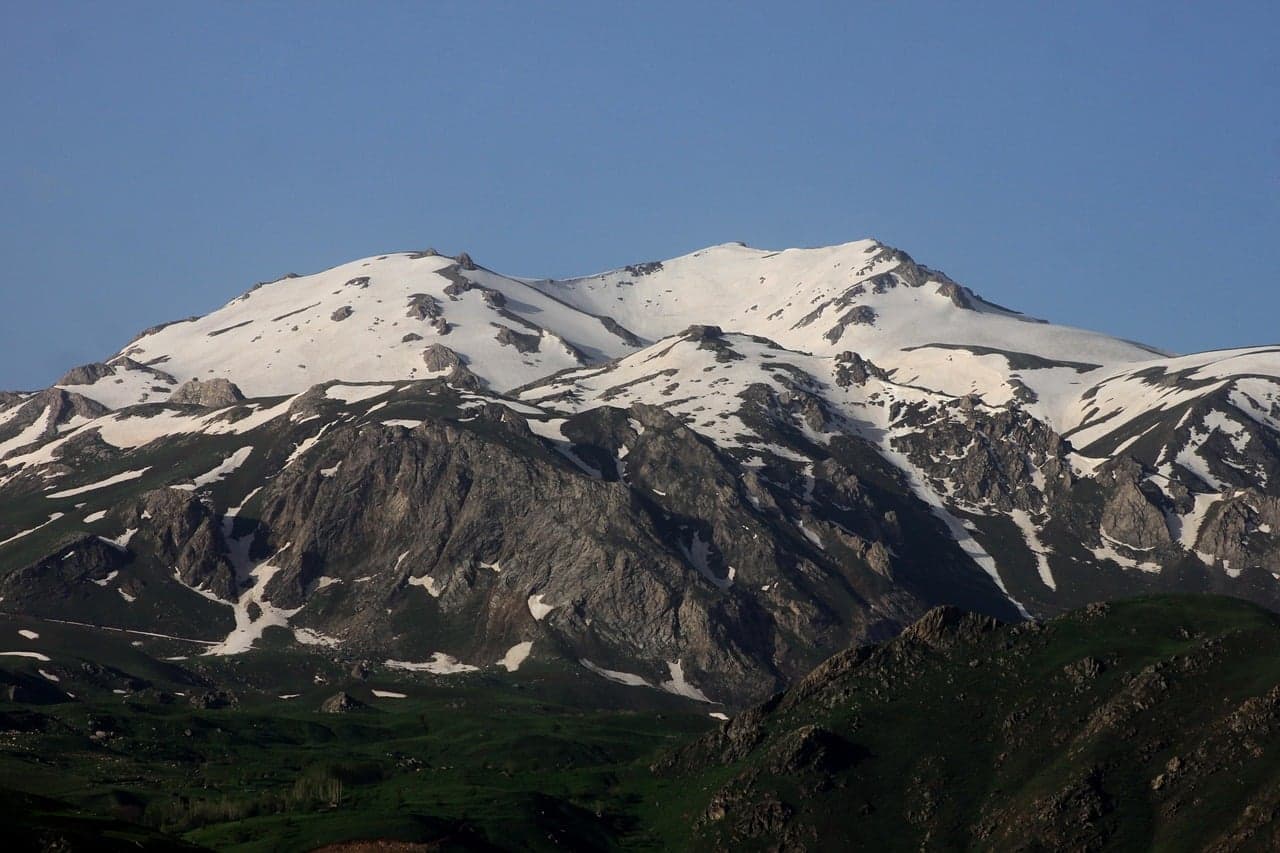
Let the mountains be your first stop in Hakkâri: the Cilo-Sat Mountains with their glaciers, glacial lakes and Reşko, Türkiye's second-highest peak, the Berçelan Yaylası just north of the city and the Zap river foaming at the bottom of the valleys. In the city centre, the Ottoman-era Meydan Madrasa and the mysterious Hakkâri Stelae at the foot of the castle tell the thousands-of-years-old story of this rugged land. Devin soup, herbed cheese and Çukurca tahini are the flavours of the mountain table.
Why are Hakkâri's mountains so special?
Hakkâri is a mountain country at the eastern end of the Southeastern Taurus, shaped within the Alpine-Himalayan fold system. Karadağ in the north-west of the province, the glaciated Cilo mountains in its centre and the Sat mountains in the south are counted among Türkiye's most important areas for mountaineering. Here, a journey is measured less by the map than by the difference in altitude.
Cilo-Sat Mountains National Park
At the summit level of the national park, in the İkiyaka Mountains in Yüksekova, there are cirque and glacial lakes, permanent snowfields and glaciers. The mountains offer climbing routes of different levels of difficulty and also host scientific research climbs. The park is about 37 kilometres from Hakkâri city centre. Summit climbs require experience; set off with a guide who knows the area and with route information obtained in advance.
Reşko Peak
At 4,168 metres, Reşko in the glaciated Cilo mountains is Türkiye's second-highest summit. Even if you do not climb to the top, seeing the snowy ridges and glacier tongues from the surrounding valleys is one of the most unforgettable views in the province.
The Cilo Dağı rock paintings
Near the summit of Cilo Dağı there are rock paintings of animal, human and symbolic figures. Who made them, and exactly when, is still unknown; they are one of the most intriguing surprises of high-mountain walks.
What are the highland pastures, glacial lakes and snow like?
The cool yaylas where flocks graze in summer welcome skiers with deep snow in winter. Hakkâri is one of the provinces that opens the ski season earliest and closes it latest.
Berçelan Yaylası
About 18 kilometres north of the city centre, this is a highland pasture where local people go up with their animals in the summer months and live in traditional black tents. It is suitable for mountaineering, skiing and nature walks; its flowering meadows are at their most colourful at the end of spring. As you pass between the black tents, do not forget to ask permission before taking photographs.
The Seyithan and Lis glacial lakes
The Seyithan and Lis glacial lakes around Berçelan add a beauty of their own to the yayla. A walk to these small lakes at the foot of the snowy peaks gives you the calmest hours of the day.
Golan Yaylası
Golan Yaylası, west of Berçelan, is reached by a road of about 15 kilometres. With its wide, snowy slopes, it is a candidate to become the area's ski field.
Mergabütan Ski Centre
About 12 kilometres from the city centre, the ski centre is on the city's north face. In Hakkâri, where snow can reach four metres deep in places, there are runs for both beginners and experienced skiers; the season usually lasts until the end of April.
Which historic sites are in the city and the valleys?
According to the governorship's sources, Hakkâri's history goes back to the 7000s BC. Stone is the common language of every period here.
The Meydan Madrasa
According to the inscription on its entrance gate, the madrasa was built in 1700–1701; it is rectangular in plan, two storeys high and arranged around a courtyard. Built in the Ottoman period and surviving with its original structure largely intact, it is one of the city's most important monuments.
The Hakkâri Stelae
The thirteen standing stones found at the north-western foot of Çölemerik Castle, in today's Dağgöl neighbourhood, are dated, though not with certainty, to the middle of the 2000s BC. Their front faces are covered with human, animal and weapon figures worked in relief and incised lines; on eleven of them a naked male figure stands out. Who made the stelae is still a mystery. If you want to see them, ask the provincial directorate of culture and tourism where they are on display before your visit.
Bay Castle
South of the city, seven or eight kilometres from the centre, the castle sits on a steep hill 2,025 metres above sea level. Pottery fragments scattered around show that there was settlement here from the Iron Age to the end of the Middle Ages. If you enjoy climbing, you can go up to the castle from the north or the south.
The stone houses of Çukurca
Twenty-six stone houses in Çukurca, thought to be about four hundred years old, are the emblem of the district with their castle-like silhouette. Leaning against the slope, these houses are among the finest examples of local stonework.
The Nehri Stone Bridge
On the Şemdinli stream, about 13 kilometres from the district centre, both piers of the bridge rest on rocks. The bridge, eleven metres high and twenty-one metres long, is thought to have been built in the early twentieth century; its setting deep in the valley is wonderful for photographs.
What is rafting on the Zap river like?
The Zap, the province's largest river, crosses Hakkâri roughly from north to south. One of the fastest-flowing rivers in Türkiye, it has a long rafting course; part of the course suits beginners and part suits experienced paddlers. Only go rafting with a certified guide and with equipment such as a life jacket and a helmet.
What is on the table in Hakkâri?
Harsh mountain conditions have made Hakkâri's cuisine nourishing and filling: meat, eggs, flour, butter and milk are the basis of the table. Devin soup, made with bulgur, flour and red meat, gulul, cooked with yoghurt and rice, doğaba, prepared with wheat and lamb, and keledoş, made with dried wild greens, are the standout dishes. At breakfast, try otlu peynir, the cheese made with local herbs, and çirek, Yüksekova's spiral-shaped cheese. Girara huluga, which has a geographical indication, and Çukurca tahini, roasted over an oak fire and ground in a stone mill, are the pride of this table; do not miss lalapet, the sweet sold in bakeries during Ramadan.
How many days do you need in Hakkâri?
Two days is enough for the city centre and its immediate surroundings; add several more if you are planning a mountain climb. A sample route:
- Day one: The Meydan Madrasa and the city centre in the morning; Berçelan Yaylası and Lake Seyithan in the afternoon.
- Day two: A short climb to Bay Castle, then a scenic drive along the Zap valley or rafting.
- If you have time, add a day for the stone houses of Çukurca or the Nehri Stone Bridge in Şemdinli.
For other routes in Eastern Anatolia, take a look at the City Routes page.
When should you go, and how do you get there?
According to the governorship, the best time for summer trips and climbs in the Cilo and Sat mountains is from early June to the end of September; February and March are recommended for winter climbs, while the avalanche risk is high in the other months. July and August are ideal for the yaylas and glacial lakes; plan December to April for skiing. You can reach Hakkâri by road or via the airport in Yüksekova; be prepared for winter conditions on the mountain roads.
What should you keep in mind?
- Go on high-mountain walks with a local guide and get route information in advance from official sources.
- The weather changes very quickly in the mountains; carry warm clothes, a raincoat and water even in summer.
- On the yaylas the black tents are people's homes; do not approach them or take photographs without permission.
- Check the current opening hours of museums and visitor sites on their official pages.
Frequently asked questions
How many days do you need in Hakkâri?
Two days is enough for the city centre, the Meydan Madrasa, Berçelan Yaylası and Bay Castle. Add another day for Çukurca or Şemdinli, and set aside several more days if you are planning a Cilo-Sat climb.
When is the best time to visit Hakkâri?
Early June to the end of September is the best time for the highland pastures and mountain walks. December to April is recommended for skiing, and February and March for winter climbs.
Where is Berçelan Yaylası?
Berçelan Yaylası is about eighteen kilometres north of Hakkâri city centre. It is visited in the summer months together with the nearby Seyithan and Lis glacial lakes.
Can you go rafting on the Zap?
Yes. The Zap, one of the fastest-flowing rivers in Türkiye, has courses suitable for both beginners and experienced paddlers. Go rafting only with a certified guide and full equipment.
What should you eat in Hakkâri?
Devin soup, gulul, doğaba, keledoş, doleme and Hakkâri kebab stand out. At breakfast try herbed cheese and çirek cheese, and lalapet as a sweet; Çukurca tahini and girara huluga have a geographical indication.
Editorial desk
Stories signed by the Cultvia editorial desk follow our editorial policy; every story lists its sources at the end and errors are fixed under our corrections policy.
Last updated:
What changed?
- : First published
Sources
- Gör Hakkâri — Go Türkiye (Türkiye Turizm Tanıtım ve Geliştirme Ajansı)
- Turizm — T.C. Hakkâri Valiliği
- Taste the Flavors of Hakkari Guide — Go Türkiye (Türkiye Turizm Tanıtım ve Geliştirme Ajansı)
Up next
 City RoutesParis Photo 2026: opening hours, sectors and what to see13 November 2026 · 1 min read


