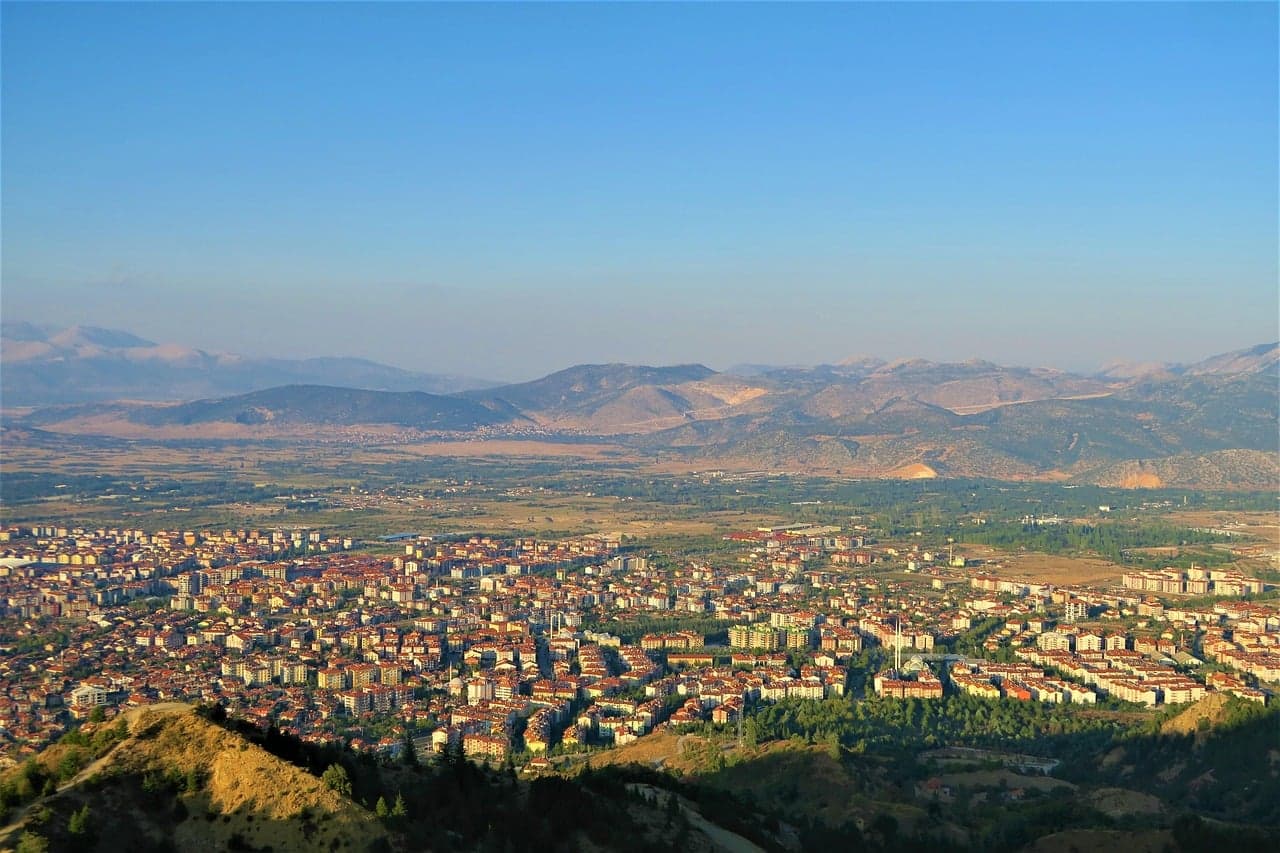
Make your first stops in Isparta Lake Eğirdir, which changes colour throughout the day, and the castle, the madrasa and Yeşil Ada (Green Island) on its shore. Then explore the ancient city of Pisidian Antioch and its museum in Yalvaç, and walk through the Yazılı Kanyon in Sütçüler in the south. Rose sherbet, rose jam and Eğirdir apples carry the taste of Isparta, "the city of roses and apples".
What should you see on the shore of Lake Eğirdir?
Most travellers get to know Isparta through its lake. Lake Eğirdir, between the Sultan and Karakuş mountains, lies right in the middle of the province; Eğirdir, the district on its shore, is one of Isparta's two cittaslow towns, together with Yalvaç.
Lake Eğirdir
Taking on a different blue at every hour of the day, the lake, with the apple orchards around it, is the symbol of the province. Watch the sunset from Eğirdir's peninsula; a walk along the lakeshore in the late afternoon is the town's finest habit. Fish from the lake are also part of the local table.
Eğirdir Castle
Although the construction date of this structure, made up of an inner and an outer castle, is not known for certain, today's remains are known to date from the Byzantine period. The walls, built with alternating courses of brick and stone, stand on the peninsula reaching into the lake; the houses built on top of the walls turn the castle into a living neighbourhood.
The Dündarbey Madrasa and the Hızırbey Mosque
The madrasa was built as an inn in 1237, in the reign of the Seljuk Sultan Gıyaseddin Keyhüsrev II, and converted into a madrasa in 1301 by Dündar Bey of the Hamidids. Thirty cells surround the courtyard of the two-storey building; take a close look at the geometric Seljuk decoration on its portal. On the roof of the Hızırbey Mosque right next to it, also known locally as the Grand Mosque, there is a section left open so that the snow piling up in winter can be thrown off, and inside there is a snow well; the mosque was rebuilt in keeping with its old style after the fire of 1814.
Yeşil Ada and the Church of Aya Stefanos
Yeşil Ada, about one and a half kilometres from the centre of Eğirdir, used to be known as Nis. With its wooden houses on stone foundations, narrow streets and small fishing harbour, it keeps its original fabric; home guesthouses are a long-standing tradition here. The three-nave Church of Aya Stefanos on the island was built in the second half of the nineteenth century; the white marble blocks around its windows and the plaster decoration inside are striking. Can Ada, the small island between Yeşil Ada and Eğirdir, is a green islet with no buildings.
The Ertokuş Han in Gelendost
On the eastern side of the lake, on the old caravan route linking Eğirdir with Konya, the inn was built in 1203–04 by Mübarizeddin Ertokuş, according to the inscription on its portal. Made up of a courtyard and a covered shelter section, it is a fine stop to round off a tour of the lake.
How do you explore the ancient world in Yalvaç?
Yalvaç, north-east of the lake, is Isparta's open-air museum, with a history of settlement going back thousands of years. The ancient city, the sanctuary and the museum can easily be seen in a single day.
The ancient city of Pisidian Antioch
The city, one kilometre north of Yalvaç, was founded in the Hellenistic period and holds remains from the Roman and Byzantine periods. The Temple of Augustus, the theatre, the Roman baths, the Tiberius Square, the monumental fountain, the colonnaded street and the aqueducts have survived in part. There is also a church dedicated to St Paul in the city; St Paul is held to have given his first recorded sermon here. Check the current hours and fees of the archaeological site on its official page.
The Sanctuary of Men
About five kilometres south-east of Antioch lies the sanctuary of Men, the moon god and one of the most revered deities of the Phrygia and Pisidia regions. In the middle of the area, enclosed by a temenos wall with moon reliefs and inscriptions, are the remains of the temple of Men, whose roots go back to the 4000s BC.
Yalvaç Museum
Founded for the finds from the excavations at Antioch, the museum has welcomed visitors since 1966. Besides the objects displayed in its prehistory, classical, ethnography and St Paul halls, the garden holds column capitals, altars and sarcophagi. If you stop at the museum before touring the ancient city, you will read the remains much more easily.
Where should you go for mountains and canyons?
Isparta's south opens onto the Taurus Mountains and its west onto the high plains of the Lakes Region. Snow in winter and the cool of the canyons in summer are the two faces of this landscape.
Davraz Ski Centre
At the ski centre on Mount Davraz, close to the city, the season starts in December and lasts until May; the busiest months are January and February. From the runs and from the café terrace at about 1,950 metres, you can watch Lake Eğirdir changing colour below. In summer it is also popular for paragliding, mountain biking, hiking and climbing; the summit, Ulparçukuru Tepesi, is 2,635 metres high.
Yazılı Kanyon Nature Park
The canyon, about 20 kilometres from Sütçüler, was registered as a nature park in 1989. On the walls of the canyon, which is up to four hundred metres deep in places, are Byzantine-era places of worship and altars; it takes its name, "the inscribed canyon", from a rock inscription reached after crossing an iron bridge on a narrow path. You walk along the banks of the Göksu stream through a canyon crossed by the historic King's Road and the waymarked St Paul Trail. Because the route requires wading where the paths end, it is advisable to finish your walk before that point.
The ancient city of Adada
The name of Adada in Sütçüler appears in an inscription recording a treaty with Termessos, dated to the second century BC. The city had its heyday in the Roman Imperial period; the Temple of Trajan, one of the best-known temples in Pisidia, the theatre and the stepped assembly place can still be seen. It is an ancient city in the middle of the forest, far from the crowds.
Uluborlu and the Cirimbolu Aqueducts
In Uluborlu, known as Apollonia from the Phrygian period to the end of Byzantium, traces of the ancient city are in the district centre. The Cirimbolu Aqueducts, built in 1869–1872 to carry the water of Kavil Pınarı into the castle, and the remains of Uluborlu Castle are worth seeing.
What is on the table of roses and apples?
The roses of Isparta, regarded as Türkiye's rose garden, were turned into rose sherbet in the Ottoman palace kitchen. Today rose jam, rose lokum and the rose-shaped Yalvaç kesmik güllacı carry on this tradition. One in every four apples grown in Türkiye comes from Isparta, and a third of Isparta's apples come from Eğirdir. Kabune pilavı, cooked in copper pots and served on copper plates on special occasions, Uluborlu banağı, Yalvaç hamursuzu and yufka bread cooked on a griddle are also must-tries.
How many days do you need in Isparta?
Three days is ideal. A sample route:
- Day one, Eğirdir: the castle, the Dündarbey Madrasa, the Hızırbey Mosque, Yeşil Ada and sunset on the lakeshore.
- Day two, Yalvaç: the museum, Pisidian Antioch and the Sanctuary of Men; the Ertokuş Han in Gelendost on the way back.
- Day three: south to the Yazılı Kanyon and Adada; in winter, skiing on Davraz instead.
For other routes in the Lakes Region and the Mediterranean, take a look at the City Routes page.
When should you go, and how do you get there?
The rose gardens bloom in late spring and early summer; this period is also very good for trips to the lake and the ancient cities. Choose autumn if you want to see the apple harvest, and December to May for skiing. You can reach Isparta by road or via the airport in Isparta; regular vehicles leave the city for Eğirdir and Yalvaç.
What should you keep in mind?
- In the Yazılı Kanyon, do not leave the marked path, and do not attempt the water crossings on rainy days.
- There may be avalanche risk on Davraz's winter climbing routes; go to the summit with an experienced guide.
- Check the current opening hours and fees of museums and archaeological sites on their official pages.
- Rose gardens and apple orchards are private property; do not enter without permission or pick the flowers.
Frequently asked questions
How many days do you need in Isparta?
With one day for Eğirdir and Yeşil Ada, one for the ancient city and museum in Yalvaç and one for the Yazılı Kanyon and Adada, you can see Isparta comfortably in three days. In winter you can spend the third day skiing on Davraz.
When is the best time to visit Isparta?
Late spring and early summer, when the rose gardens bloom, is the finest time. Autumn suits the apple harvest, and December to May suits skiing on Davraz.
Where is the Yazılı Kanyon?
Yazılı Kanyon Nature Park is within the boundaries of Çandır village, about twenty kilometres from the Sütçüler district. It is reached by following the signs on the road that branches off the Isparta–Antalya highway towards Sütçüler.
When is the season at Davraz Ski Centre?
According to the governorship, the ski season starts in December and lasts until May. The busiest months are January and February; in summer Davraz is popular for paragliding and hiking.
What should you buy in Isparta?
Rose jam, rose lokum and rose sherbet are the best-known gifts. Eğirdir apples and the local Yalvaç hamursuzu are also worth packing for the journey home.
Editorial desk
Stories signed by the Cultvia editorial desk follow our editorial policy; every story lists its sources at the end and errors are fixed under our corrections policy.
Last updated:
What changed?
- : First published
Sources
- Gör Isparta — Go Türkiye (Türkiye Turizm Tanıtım ve Geliştirme Ajansı)
- Davraz Kayak Merkezi — T.C. Isparta Valiliği
- Yazılı Kanyon Tabiat Parkı — Kültür Portalı – T.C. Kültür ve Turizm Bakanlığı
- Taste the Flavors of Isparta Guide — Go Türkiye (Türkiye Turizm Tanıtım ve Geliştirme Ajansı)
Up next
 City RoutesParis Photo 2026: opening hours, sectors and what to see13 November 2026 · 1 min read


