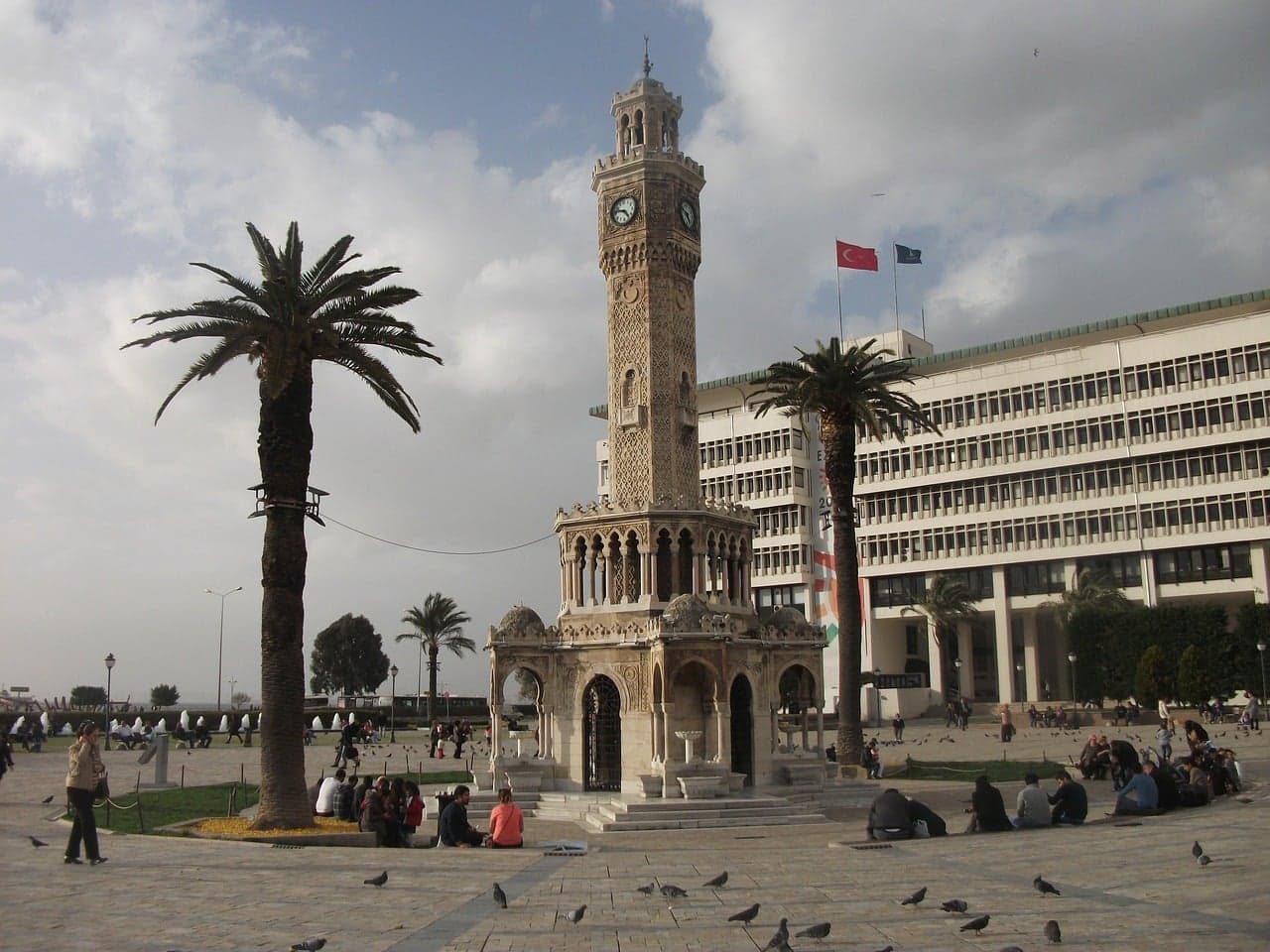
The centre of any İzmir route is the Kemeraltı bazaar, the Clock Tower on Konak Square and the Kordon promenade along the sea; the Agora of ancient Smyrna and Kadifekale sit right in the middle of the city too. An hour away in Selçuk you will find Ephesus, on the UNESCO World Heritage List since 2015, and the hillside village of Şirince. With three days you can see both the city and the area around Ephesus at an easy pace.
What should first-time visitors see in İzmir?
Kemeraltı Bazaar
Stretching from Mezarlıkbaşı to Konak Square, Kemeraltı takes its name from streets that were once covered by vaults. The curve of its main street follows the shore of an inner harbour that lay here centuries ago and gradually silted up. Losing your way among inn courtyards, coppersmiths, coffee roasters and tile shops is the pleasure of the visit, so do not hesitate to turn into the side streets.
Kızlarağası Han
Built in 1744 inside Kemeraltı, Kızlarağası Han is one of the few Ottoman inns in İzmir that survive today. Its two-storey arcaded courtyard and two small covered markets make it the most photogenic corner of the bazaar. A Turkish coffee in the courtyard is a good pause in a Kemeraltı walk.
Konak Square and the Clock Tower
İzmir's emblem, the Clock Tower, was built in 1901 and stands out for its octagonal plan, horseshoe arches and decoration inspired by North African architecture. Together with the tiled Konak Mosque right beside it, it makes the square's postcard view. The ferry pier is here too, a great starting point for crossing to Karşıyaka or the other side of the bay.
The Agora
Between Kemeraltı and Kadifekale, the Agora was the Hellenistic and Roman civic centre of ancient Smyrna. Most of the remains date to the second century AD, and it is considered one of the largest and best-preserved agoras of the Ionian world. The vaulted corridors of the basement help you grasp the three-storey scale of the building.
Kadifekale
Kadifekale, on the hill that was Mount Pagos in antiquity, is said in legend to have witnessed the city's refounding in the time of Alexander the Great. The surviving northern and eastern walls and a Byzantine cistern can be seen. The real reward is the view across the whole bay and city.
The Historic Elevator
The elevator tower in the Karataş district was built in 1907 to link two streets with a fifty-metre difference in height. The view of the bay is enjoyed from the upper terrace, and Dario Moreno Street nearby keeps the stepped fabric of old İzmir.
Kordon and Alsancak
The Kordon, running from Konak to Alsancak, is the waterfront where people in İzmir meet the sea. Sitting on the grass at sunset and looking across the bay is the city's best-loved ritual. The back streets of Alsancak are lined with Levantine houses, bookshops and cafés.
Ancient Smyrna, Bayraklı
The first Smyrna settlement, on the Bayraklı mound, is one of the best examples of an Archaic-period city plan in western Anatolia. The temple uncovered here is known as the oldest temple of Athena in Türkiye. It is a quiet stop, away from the crowds, for anyone interested in archaeology.
Ephesus
Ephesus, in the Selçuk district, is a port city that was inhabited continuously for about nine thousand years. Its UNESCO listing has four components: Çukuriçi Höyük, Ayasuluk Hill, the ancient city of Ephesus and the House of the Virgin Mary. The Library of Celsus, the Great Theatre and Curetes Street are its best-known sights; there is little shade, so go early in the morning.
Ayasuluk Hill and Selçuk
Ayasuluk Hill in central Selçuk brings together Selçuk Castle, the Basilica of St John and the fourteenth-century İsa Bey Mosque. At the foot of the hill stands the single column of the Temple of Artemis, counted among the seven wonders of the ancient world. Add the museum in Selçuk to your route to see finds from Ephesus.
Şirince
Set on a hill eight kilometres from Selçuk, Şirince, with its red-tiled stone houses and cobbled lanes, is the natural continuation of a visit to Ephesus. The village is surrounded by orchards and vineyards, and olive oil, soap and handicrafts are everywhere. It can be crowded at weekends, so try a weekday morning.
Bergama
Bergama, north of İzmir, carries the legacy of ancient Pergamon, which joined the UNESCO World Heritage List in 2014. The theatre set into the steep slope of the acropolis and the Asclepion below deserve a separate day trip.
How do you explore İzmir's districts and surroundings?
Konak and Kemeraltı form the historic core; the Agora, Kadifekale and the Historic Elevator are close by. Alsancak and the Kordon are ideal for late-afternoon walks. Taking the ferry across the bay to Karşıyaka is the easiest way to see the city from the water. Beyond the city there are three main directions: Selçuk, Ephesus and Şirince to the south, Çeşme and Alaçatı to the west, and Bergama to the north.
İzmir's food is part of the trip too: boyoz pastry and gevrek (the local simit) in the morning, a kumru sandwich at lunch, and olive-oil dishes made with Aegean wild greens in the evening.
How many days do you need in İzmir?
A day and a half is enough for the city, and three days with the area around Ephesus. A sample route:
- Day one: Konak Square and the Clock Tower, Kemeraltı and Kızlarağası Han in the morning; the Agora and Kadifekale in the afternoon; sunset on the Kordon.
- Day two: Ephesus early in the morning, Ayasuluk Hill and the Temple of Artemis at midday, Şirince in the afternoon.
- Day three: The Historic Elevator and Alsancak, then the ferry to Karşıyaka in the afternoon; or give this day to Bergama or Alaçatı.
We have prepared similar routes for other cities too; take a look at City Routes.
When should you go, and how do you get there?
Summers in İzmir are long and hot; April to June and September to November are the best months for exploring the ancient sites in comfort. Winter is mild but rainy.
The city's airport lies south of the centre and is linked to it by suburban train. The same rail line also runs towards Selçuk, so you can reach Ephesus by train and continue on foot or by local transport. Within the city, the metro, trams and bay ferries all use a shared card.
What should you keep in mind?
- Visiting hours and ticket prices at archaeological sites and museums change with the season; check their official pages before you go.
- There is little shade at Ephesus and Bergama; carry a hat, water and sunscreen.
- Some side streets of Kemeraltı close early in the evening, so plan the bazaar for daytime.
- Keep quiet and dress appropriately at places of worship such as the House of the Virgin Mary and mosques.
- The roads to Çeşme and Şirince are busy in summer, so set off early in the morning.
Frequently asked questions
How many days do you need in İzmir?
A day and a half is enough for Kemeraltı, Konak, the Agora, Kadifekale and the Kordon. If you also want to see Ephesus, Selçuk and Şirince, plan three days in total.
When is the best time to visit İzmir?
Spring and autumn are the best seasons for exploring the ancient sites without suffering in the heat. Summer is lovely for the sea, but there is little shade at the archaeological sites.
How do you get from İzmir to Ephesus?
You can take the suburban train to Selçuk and reach Ephesus from there by local transport or a short ride. By car the journey takes about an hour.
What does the UNESCO-listed area of Ephesus include?
The area listed in 2015 has four components: Çukuriçi Höyük, Ayasuluk Hill (Selçuk Castle, the Basilica of St John, the İsa Bey Bath, the İsa Bey Mosque and the Artemision), the ancient city of Ephesus and the House of the Virgin Mary.
How far is Şirince from Ephesus?
Şirince sits on a hill about eight kilometres from central Selçuk. You can easily see it on the same afternoon after visiting Ephesus.
Editorial desk
Stories signed by the Cultvia editorial desk follow our editorial policy; every story lists its sources at the end and errors are fixed under our corrections policy.
Last updated:
What changed?
- : First published
Sources
- Top Things to See in İzmir — Go Türkiye (Türkiye Turizm Tanıtım ve Geliştirme Ajansı)
- Efes Antik Kenti — Kültür Portalı – T.C. Kültür ve Turizm Bakanlığı
- Kemeraltı — Kültür Portalı – T.C. Kültür ve Turizm Bakanlığı
- Agora Ören Yeri — Kültür Portalı – T.C. Kültür ve Turizm Bakanlığı
Up next
 City RoutesParis Photo 2026: opening hours, sectors and what to see13 November 2026 · 1 min read


