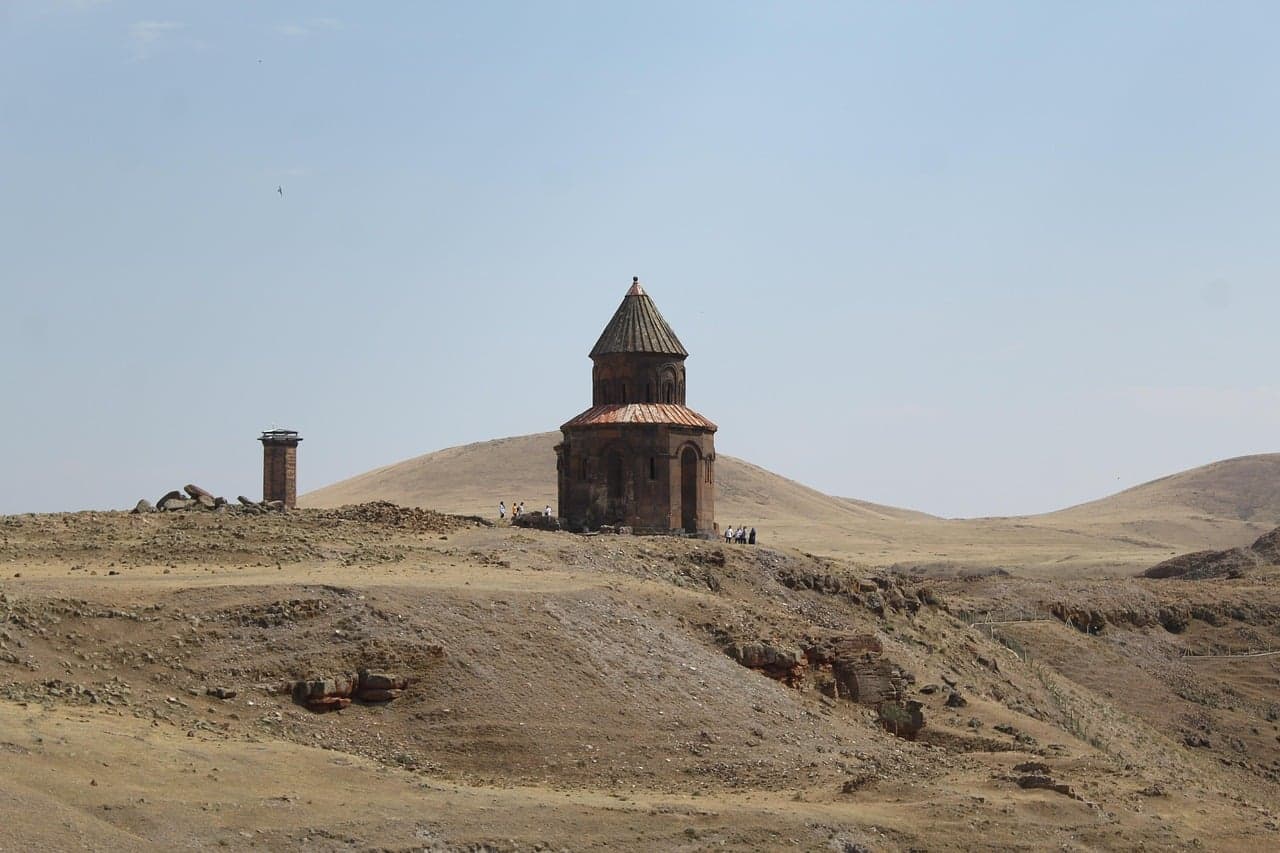
The first place to see in Kars is the archaeological site of Ani, forty-two kilometres from the city: a medieval city founded at the gateway where the Silk Road entered Anatolia from the Caucasus, and on the UNESCO World Heritage List since 2016. In the city centre, Kars Castle of basalt and the Baltic-style buildings wait for you, and around it Lake Çıldır and the forests of Sarıkamış. Give it three days and you can enjoy Kars to the full, along with a table rich in kaşar and gruyère cheese.
What should first-time visitors see in Kars?
The archaeological site of Ani
Built on a volcanic plateau west of the Arpaçay river, Ani has been home to many civilisations since prehistoric times. Thanks to the Silk Road it became the region's cultural and trading centre in the Middle Ages, lost its importance as new trade routes opened and was completely abandoned in the seventeenth century. With the remains of walls, churches, mosques, a palace, a caravanserai, a bath and a bridge, it is one of the rare places where you can see medieval urbanism all together. The site is large and shadeless; allow at least half a day and bring a hat and water.
The Ebu'l Menuçehr Mosque
According to its inscription, the mosque south of the road to the citadel at Ani was built in the late eleventh century, and it is regarded as the first Turkish mosque in Anatolia. With its tuff stone body and its position overlooking the Arpaçay valley, it is one of the most photographed buildings at the site.
Ani Cathedral
Begun in the late tenth century and completed in 1010, the cathedral is the grandest surviving building at Ani. Its cross-plan interior, the sturdy piers carrying the arches and the reliefs on the facade are typical of eleventh-century architecture. Because it was converted into a mosque in the second half of the eleventh century, it is also known as the Fethiye Mosque.
The Church of Tigran Honents and the Seljuk Palace
The small church where the Mığmığ stream joins the Arpaçay was built in the early thirteenth century by a merchant of Ani; it stands out for the frescoes covering its inner walls and dome. The Seljuk Palace in the west of the site, with its star-patterned portal, is counted among the finest examples of Seljuk stonework.
The Silk Road bridge and caravanserai
The lower level of the two-storey bridge over the Arpaçay was reserved for caravans and the upper level for people on foot; today only its piers remain. The caravanserai in the middle of the site was built in the early twelfth century on the floor of an older church, and its entrance gate is in the Seljuk style.
Kars Castle
The castle looking down over the city was built of basalt in the mid-twelfth century under the Saltukids. Although much of its walls have crumbled over time, it still looks imposing from the city. Inside the castle is the tomb of Celal Baba, who lived in the thirteenth century. From the top you see the Kars stream, the stone bridges and the old neighbourhoods together.
Taşköprü
The three-arched basalt bridge at the foot of the castle, where the Kars stream narrows, was built in the late sixteenth century. After it was destroyed by a flood, it was rebuilt in the early eighteenth century. With the old bathhouses and stone houses around it, it is one of the most photogenic corners of Kars.
The Church of the Holy Apostles (Kümbet Mosque)
The building in the Kaleiçi neighbourhood south of the castle was built as a church in the first half of the tenth century and converted into a mosque in the eleventh. With its conical-capped dome and the figure reliefs on its exterior, it is one of the oldest buildings in the city.
The Baltic-style buildings
Buildings put up while Kars was under Russian rule between 1878 and 1918 stand out immediately from the other architecture of the region. On the grid-plan streets of the Yusufpaşa, Ortakapı and Cumhuriyet neighbourhoods, mansions with cut-basalt facades and tall windows line up. The Fethiye Mosque in Ortakapı was built as a church in this period, used for many years as a sports hall and then converted into a mosque. Wandering these streets without a plan is the best way to understand Kars.
Kars Museum
Founded in 1959, the museum's archaeology and ethnography halls hold objects ranging from Bronze Age pottery to Lydian coins, and finds from the Ani excavations are displayed here too. Take a separate look at the ram- and horse-shaped gravestones in the garden. Check current hours and prices on the museum's official page.
Lake Çıldır
Çıldır, where Kars and Ardahan meet, is the second-largest lake in eastern Anatolia and its largest freshwater lake. In winter its surface freezes over completely; walking on the ice, horse-drawn sleigh rides and "Eskimo-style" fishing through holes cut in the thick ice are the symbols of the season. In summer there are lakeside walks, boat trips and birdwatching; the lake lies on a migration route, and there is an observation tower on its shore.
Sarıkamış
Sarıkamış, covered in Scots pine forests, is home to a ski resort known for its dry, powdery "crystal snow", similar to that of the Alps. The forests reduce the avalanche risk on the slopes, making them a safe choice for skiers. In summer the same forests are ideal for walking, and the Katerina Hunting Lodge, built in the Baltic style in the late nineteenth century, is among the district's historic buildings.
What is on the table in Kars?
The milk of animals grazing on the high plateaus of Kars has given the city's cheeses their name. Kars kaşar, which has geographical indication status, gruyère, çeçil and tulum cheese are all produced here; cheesemaking in the region began in 1926 in the village of Kümbetli near the city. The cheese museum in the village of Boğatepe tells the story of this tradition up close. In winter, goose is served as a special dish, and hangel, kete, katmer and kuymak are also worth trying. Kars honey, from plateaus where more than sixteen hundred flowering plant species grow, is another product with geographical indication status.
How many days do you need in Kars?
Three days is ideal. A sample route:
- Day one: Kars Castle and Taşköprü in the morning; the Church of the Holy Apostles, Kars Museum and the streets of Baltic-style buildings in the afternoon.
- Day two: A full day at Ani; a cheese tasting on the way back.
- Day three: Lake Çıldır or Sarıkamış depending on the season; in winter, add another day if you want to see both.
For other stops in eastern Anatolia, see the City Routes page.
When should you go, and how do you get there?
May to October is the most comfortable time for Ani and the city; even in summer, evenings are cool. For frozen Lake Çıldır and skiing at Sarıkamış, choose December to March. You can reach Kars by air or by road; trains from Ankara are also a favourite for those who want to see eastern Anatolia slowly. You can get to Ani by buses from the city centre, tour vehicles or your own car; check current timetables in advance.
What should you keep in mind?
- Kars is a high plateau with very harsh, long winters. On a winter trip, dress in layers, bring boots with non-slip soles and check road conditions before setting off.
- The Ani site is close to the border; do not leave the marked paths and the visitor area.
- Only go out onto the ice of Lake Çıldır at the times and places local guides and operators consider safe.
- Check current hours and prices for the archaeological site and museums on official sources.
Frequently asked questions
How many days do you need in Kars?
Allow one day for the city centre, one for the Ani site and one for Lake Çıldır or Sarıkamış, and you can explore comfortably in three days.
How do you get to Ani?
Ani is forty-two kilometres from central Kars. You can go by buses leaving from the city centre, by tour vehicle or by car; check current timetables in advance.
When is the best time to visit Kars?
May to October is comfortable for Ani and the city. For frozen Lake Çıldır and skiing at Sarıkamış, choose December to March.
Is Lake Çıldır in Kars?
Lake Çıldır lies where Kars and Ardahan meet. It is the second-largest lake in eastern Anatolia and its largest freshwater lake; it freezes in winter and is known for horse-drawn sleigh rides.
What should you eat in Kars?
Kars kaşar, gruyère, çeçil and tulum cheese, goose in winter, hangel, kete, katmer and kuymak. Kars honey is also a regional product with geographical indication status.
Editorial desk
Stories signed by the Cultvia editorial desk follow our editorial policy; every story lists its sources at the end and errors are fixed under our corrections policy.
Last updated:
What changed?
- : First published
Sources
- Ani Ören Yeri — Kültür Portalı – T.C. Kültür ve Turizm Bakanlığı
- Top Things to See in Kars — Go Türkiye (Türkiye Turizm Tanıtım ve Geliştirme Ajansı)
- Taste the Flavors of Kars — Go Türkiye (Türkiye Turizm Tanıtım ve Geliştirme Ajansı)
- Çıldır Gölü — Kültür Portalı – T.C. Kültür ve Turizm Bakanlığı
Up next
 City RoutesParis Photo 2026: opening hours, sectors and what to see13 November 2026 · 1 min read


