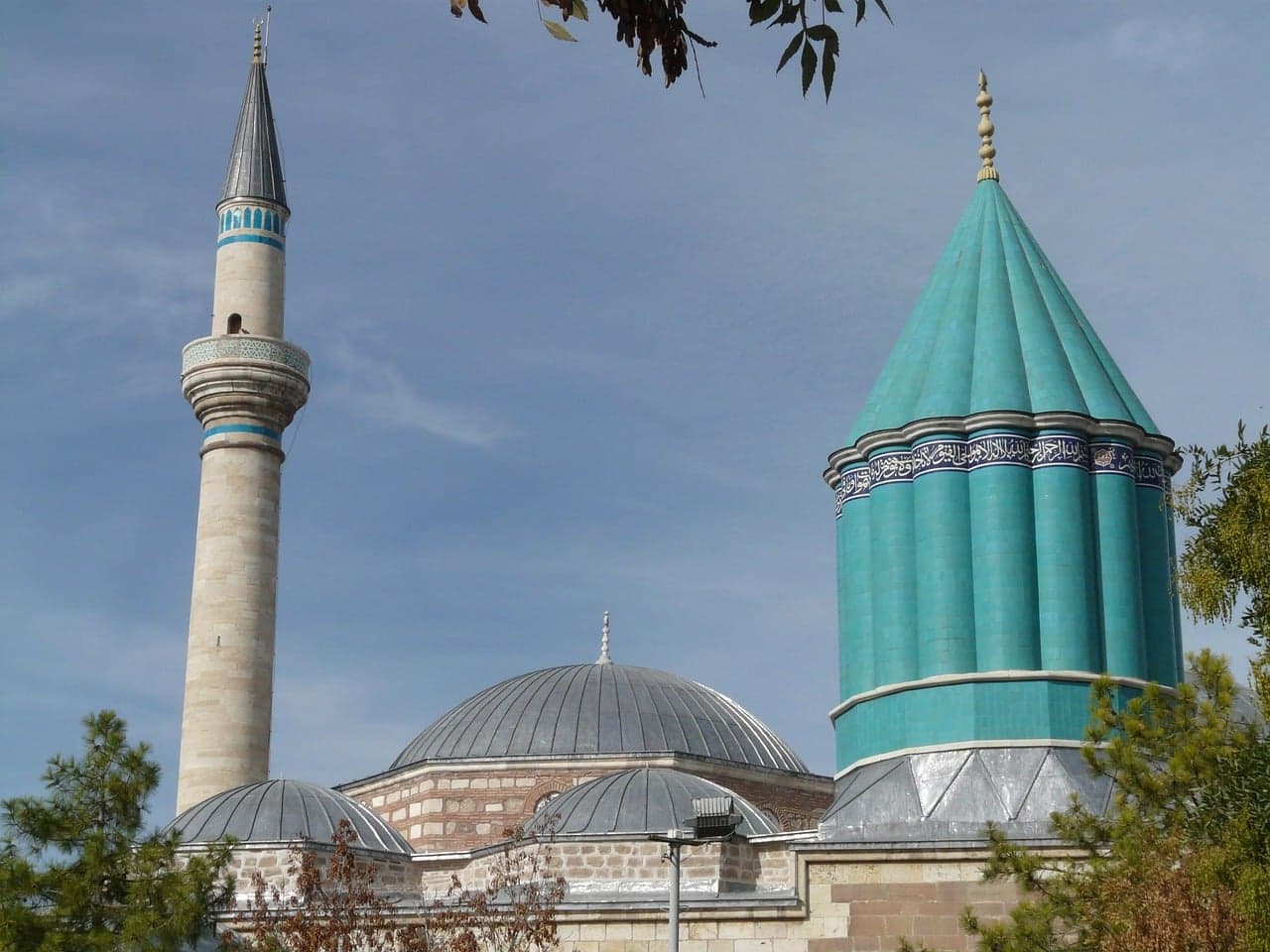
In Konya, start with the centre, where the Seljuk legacy is concentrated: the Mevlâna Museum with its green dome, Alaeddin Hill, the tiled Karatay Madrasa and the carved stone of the İnce Minareli Madrasa are all within walking distance. Outside the city, Neolithic Çatalhöyük, on the UNESCO World Heritage List, and the stone village of Sille in its valley complete the route. Two days is a good length for seeing Konya without rushing.
What should first-time visitors see in Konya?
The Mevlâna Museum
The Mevlâna Lodge in the Karatay district opened to visitors as a museum in 1926 and took its present name in 1954. The complex was built on what is known to have been the rose garden of the Seljuk palace. At its core is the tomb raised on four massive piers in 1274 and known as the "Kubbe-i Hadra", the Green Dome; this tiled dome is the first thing you notice on the city's skyline. You enter the courtyard through the Dervishes' Gate, and the dervish cells to the north and west, the kitchen, the hall for the sema ceremony and the ablution fountain show how a lodge worked. The museum displays manuscripts, calligraphy panels, lamps and musical instruments, and its specialist library, founded in the nineteenth century, holds thousands of manuscripts.
Alaeddin Hill and the Alaeddin Mosque
The green hill in the middle of the city is a mound that has been settled since prehistoric times. The Alaeddin Mosque on top was built in the Seljuk period on the site of the city's old citadel and still stands at the centre of Konya's skyline. Remains of the Seljuk palace can be seen beside the mosque. Today the hill is a place to walk and relax, and a good spot for a tea break.
The Karatay Madrasa Tile Museum
The madrasa right across from Alaeddin Hill was built in 1251 by Emir Celâleddin Karatay. In this closed-courtyard building, the walls are of Sille stone and the dome and vaults of brick. The turquoise, cobalt and black mosaic tiles inside are among the best-preserved examples of Seljuk tile art. It has been used as the Tile Museum since 1955; do not forget to look up at the dome.
The İnce Minareli Madrasa
Also known as the Museum of Stone and Wood Works, the building was commissioned in 1264 by the vizier Sâhib Ata Fahreddin Ali. It takes its name from the slender minaret at its north-eastern corner. The thing to see is its monumental portal woven with bands of inscription, one of the rare facades in Seljuk stonework where script is used so densely.
Konya Archaeological Museum
Here you will find finds from the Neolithic through the Hittite, Phrygian, Roman and Byzantine periods. Objects from the excavations at Çatalhöyük, Canhasan and Alaeddin Hill and Roman-era sarcophagi are highlights of the collection. Stop here before going to Çatalhöyük and you will read the site much better.
Konyanüma Panorama Museum
Within walking distance of the Mevlâna Museum, the panorama museum tells the story of everyday life in thirteenth-century Konya and of Mevlevi culture through a large panoramic painting. Models in the open-air section introduce Mevlevi lodges in different parts of the world, and it works well for visits with children.
The Aziziye Mosque and the Bedesten Bazaar
Built of Gödene stone and rebuilt in 1867, the Aziziye Mosque is an interesting example of the Turkish Baroque style; you notice straight away that its windows are larger than its doors. The inns and narrow streets of the Bedesten Bazaar around the mosque keep the city's old trading fabric alive.
What is there around Konya?
Çatalhöyük Neolithic Site
Çatalhöyük, in the Çumra district, consists of two mounds. The East Mound holds eighteen Neolithic settlement layers dated between 7400 and 6200 BC, while the West Mound belongs to the Chalcolithic period. The houses are built wall to wall, there are no streets and people entered their homes through the roofs: this layout is what makes Çatalhöyük unique. Wall paintings, reliefs and figurines carry traces of the shift to settled life. The site was added to the UNESCO World Heritage List in 2012.
Sille
Sille, close to the city centre and built on both sides of a deep, narrow valley, is a settlement where different periods overlap, with stone houses, rock-cut chapels, mosques, a bath and a bridge. Its best-known building is the Church of St Helena, which goes back to the Byzantine period and has reached the present day through centuries of repair. Take a short walk towards the caves carved into the valley's southern slopes.
Kilistra
Kilistra, in the village of Gökyurt in the Meram district, has rock-cut structures that recall Cappadocia. A rock church, chapels, a watchtower and traces of an ancient road are here, and it is close to Lystra on the Roman Via Sebaste.
The Eflatunpınar Hittite Spring Monument
Near Beyşehir, this monument consists of a rectangular pool built of large stone blocks, with relief figures rising on its northern wall. Fed by a nearby spring, the pool is a rare example of Hittite stonework; it was added to the UNESCO World Heritage Tentative List in 2014.
How many days do you need in Konya?
One full day for the centre and another for Çatalhöyük and Sille is ideal. A sample two-day route:
- The Mevlâna Museum and the Konyanüma Panorama Museum in the morning.
- The Aziziye Mosque and the Bedesten Bazaar at midday; the Karatay Madrasa and Alaeddin Hill in the afternoon.
- The portal of the İnce Minareli Madrasa in the late afternoon.
- Konya Archaeological Museum on the morning of day two, then Çatalhöyük.
- Sille towards sunset on the way back.
Make Konya's cuisine part of the route: etli ekmek, a long flatbread topped with minced meat; fırın kebabı, an oven-roasted lamb dish going back to the Seljuk period; okra soup, a must at wedding feasts; meaty wedding pilaf; and tirit are the city's well-known dishes.
When should you go, and how do you get there?
Spring and autumn are the most comfortable seasons; in spring the tulip fields on the steppe bloom briefly. Summers are hot and dry, winters cold. The city fills up during the Şeb-i Arûs commemoration ceremonies in the first half of December, so book accommodation early if you are going then. You can reach Konya by air, by road and by high-speed train; for Çatalhöyük you need a car or a day tour.
What should you keep in mind?
- Check the current visiting hours and ticket prices of museums and archaeological sites on their official pages.
- Follow the visiting rules at the Mevlâna Museum and at mosques still in use, and wear clothes that cover your shoulders and knees.
- Çatalhöyük is an open site; in summer go early in the morning and take water and a hat.
- To protect the objects, do not use flash in museums, and stay on the marked walkways.
You can find other city routes on the City Routes page.
Frequently asked questions
How many days do you need in Konya?
One full day for the museums and madrasas in the centre and another for Çatalhöyük and Sille makes for a comfortable trip. If you also want to see Kilistra and Eflatunpınar, add a third day.
When is the best time to visit Konya?
Spring and autumn are the best seasons. The city gets very crowded during the Şeb-i Arûs commemoration ceremonies in the first half of December; if you go then, book accommodation early.
How do you get to Konya?
You can reach Konya by air, by road and by high-speed train. The sights in the centre are close together and can be explored on foot; for Çatalhöyük you need a car or a day tour.
Where is Çatalhöyük and why is it important?
Çatalhöyük is in Konya's Çumra district. The site, made up of two mounds, is considered one of the most important pieces of evidence for the shift to settled life and from village to urban living, and it is on the UNESCO World Heritage List.
What should you eat in Konya?
Etli ekmek (a long flatbread with minced meat), fırın kebabı, okra soup, meaty wedding pilaf and tirit are the best-known dishes of Konya's cuisine.
Editorial desk
Stories signed by the Cultvia editorial desk follow our editorial policy; every story lists its sources at the end and errors are fixed under our corrections policy.
Last updated:
What changed?
- : First published
Sources
- Konya'da Görülecek Yerler — Go Türkiye (Türkiye Turizm Tanıtım ve Geliştirme Ajansı)
- Konya Cuisine & Local Flavors Guide — Go Türkiye (Türkiye Turizm Tanıtım ve Geliştirme Ajansı)
- Mevlâna Müzesi — Kültür Portalı – T.C. Kültür ve Turizm Bakanlığı
- Çatalhöyük Neolitik Kenti — Kültür Portalı – T.C. Kültür ve Turizm Bakanlığı
Up next
 City RoutesParis Photo 2026: opening hours, sectors and what to see13 November 2026 · 1 min read


