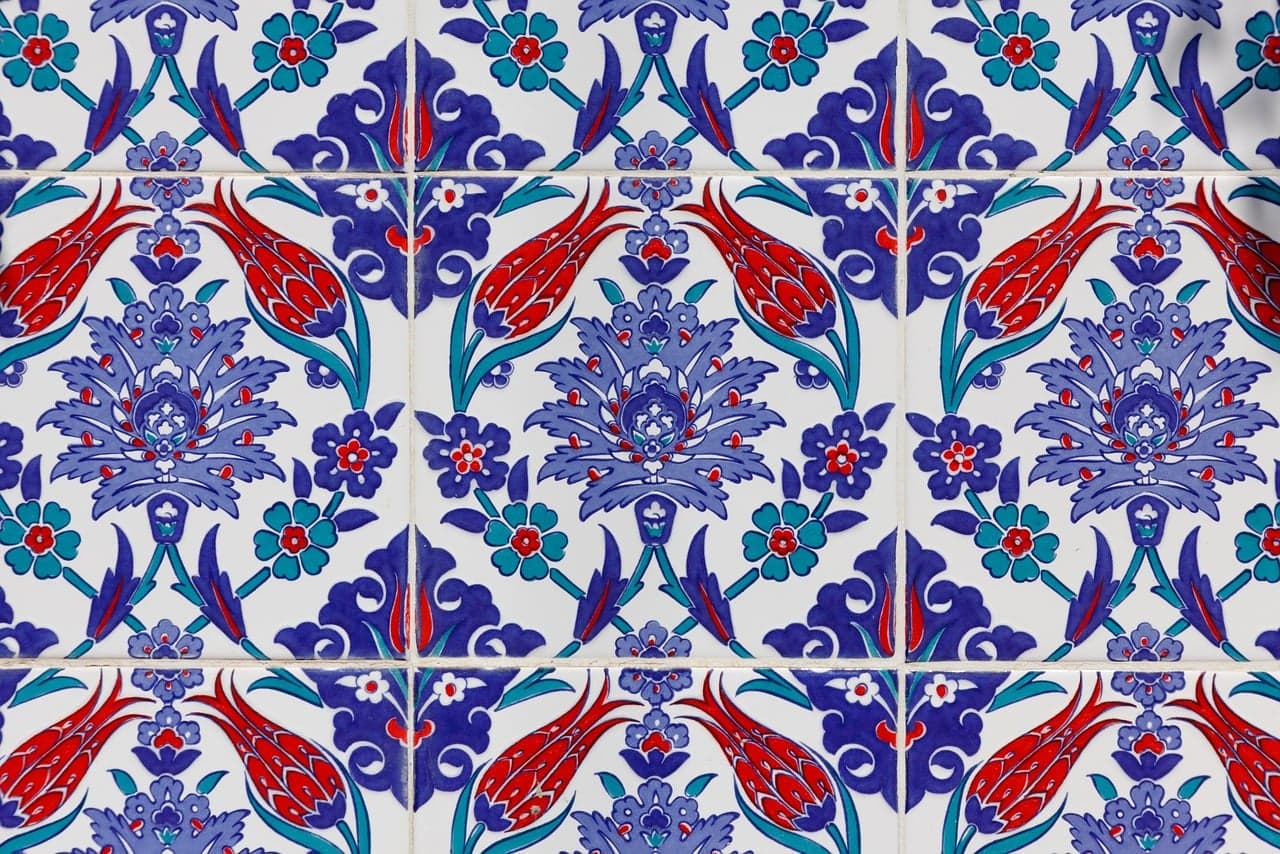
Make your first stops in Kütahya the Tile Museum and the Çinili Mosque, covered in blue tiles; the city is known for the tile-making craft it has kept alive for centuries. The next day, go to Aizanoi in Çavdarhisar: Anatolia's best-preserved Temple of Zeus and a stadium joined to a theatre are here. The rock monuments of the Phrygian Valley, the ski runs of Murat Dağı that meet thermal water, and the wooden houses of Germiyan Sokağı complete the route.
Where can you see tiles in Kütahya?
What sets Kütahya apart from other cities is the way it works clay. You come across Kütahya tiles in the city's mosques, on its inscriptions and even on its street fountains, so starting your trip with tiles is the shortest way to understand the city.
The Tile Museum
In Türkiye's first and only tile museum, tile inscriptions, panels, vases, plates and household objects made in Kütahya and İznik are displayed in chronological order. The giant stone inscription in Ottoman Turkish at the entrance is known as the second-largest stone inscription in the world. Check the current hours and fees on the museum's official page.
The Çinili Mosque
Built in 1973 by the painter and ney player Ahmet Yakupoğlu, the mosque, with its octagonal plan and single dome, carries traces of Central Asian Turkic architecture. Its exterior is covered with specially made blue Kütahya tiles and its interior with hand-painted decoration. In daylight the blue of the facade takes on different shades; choose the afternoon for photographs.
The Grand Mosque (Ulu Cami)
Also known as the Yıldırım Bayezid Mosque, this is the largest mosque in the city. It is known to have been repaired by the architect Sinan during the Rhodes campaign in the reign of Süleyman the Magnificent. The large columns inside were brought from Aizanoi; the tile panel depicting the Kaaba to the right of the mihrab is another detail you should not miss.
What else is there in central Kütahya?
Kütahya Castle
The walls built by the Byzantines in the fifth century were repaired and strengthened in the Seljuk, Germiyanid and Ottoman periods. According to Evliya Çelebi, the castle, made up of three parts, the upper, inner and lower castles, had seventy-two towers. When you reach the top, you can see the city's red-tiled roofs in a single frame.
The Kütahya Archaeology Museum (Vacidiye Madrasa)
In the museum set up in the Germiyanid-era Vacidiye Madrasa, objects ranging from the Late Miocene to the Ottoman period are on display. The star of the collection is one of the best preserved of the few Amazon sarcophagi in the world.
The Dönenler Mosque (Mevlevihane)
Built in the fourteenth century as the semahane, or ceremonial hall, of a Mevlevi lodge, the building is Kütahya's first Mevlevihane. In the building, used as a mosque today, the dervish cells and the nineteenth-century tile inscription above the entrance can still be seen.
The Evliya Çelebi House and Germiyan Sokağı
The house where the famous traveller Evliya Çelebi was born is visited today as a culture and arts house; his grandfather's tomb is in its garden. When you leave the house, walk along Germiyan and Ahierbasan streets: nineteenth-century Kütahya houses, two or three storeys high, with projecting upper floors on wooden brackets and wide eaves, stand in rows with white, off-yellow or indigo facades.
Why does Aizanoi need a day of its own?
Aizanoi, in Çavdarhisar about fifty kilometres from Kütahya, is a Roman city contemporary with Ephesus, Pergamon and Side. It had its heyday in the second century AD. It was rediscovered by European travellers in 1824, the first excavations were carried out in 1926, and digging has continued every year since 1970. The city has been on the UNESCO World Heritage Tentative List since 2012.
The Temple of Zeus
Near the Penkalas (Kocaçay) river, in the middle of a courtyard surrounded by colonnaded galleries, the temple is the best-preserved temple of Zeus in Anatolia. The staircase down to the underground sacred chamber and the busts of Zeus and Cybele on the pediment acroteria are its most intriguing details.
The theatre-stadium complex and the macellum
Aizanoi is the only place in the ancient world where a theatre and a stadium were designed as a single adjoining structure. The city's macellum is regarded as one of the world's first exchange buildings; on its walls survives the inscription in which Emperor Diocletian set, in AD 301, the prices of goods sold in the markets. Do not miss the two Roman bridges still standing over the Kocaçay either.
What can you do in the Phrygian Valley and on Murat Dağı?
The Phrygian Valley and the Phrygian Way
The Phrygians lived on the uplands between Kütahya, Afyonkarahisar and Eskişehir between the ninth and sixth centuries BC; open-air sanctuaries dedicated to Cybele, rock tombs and castles carved into the rock survive from this period. The Phrygian Way, waymarked in red and white and linking these valleys, is a walking and cycling route of about five hundred kilometres; its Kütahya section starts at Yenice Çiftliği in Ahmetoğlu village.
Murat Dağı Thermal Ski Centre
On Murat Dağı in Gediz, which rises above two thousand three hundred metres, there is thermal water at a temperature of forty-one degrees at about one thousand four hundred and fifty metres, and ski runs higher up. It is promoted as the only place in Türkiye offering thermal water and ski runs together. The two old bathhouses at the hot springs are thought to date from the Germiyanid period; in summer it also suits highland walks and camping.
What is on the Kütahya table: cimcik, sıkıcık and köpük helva?
Cimcik mantı, rolled so small that forty pieces fit on a spoon, sıkıcık soup made with hand-rolled bulgur, gözleme with poppy seeds and küp kebabı, cooked for hours in an earthenware pot, are the highlights of Kütahya cuisine. For dessert, köpük helva, made by beating sugar and soapwort root for a long time, is among the registered products. On your way home, do not forget to buy Tavşanlı leblebi (roasted chickpeas) and Şaphane sour cherries, which have a geographical indication.
How many days do you need in Kütahya?
Two days is enough; you can add a third day for the Phrygian Valley or Murat Dağı. A sample route:
- Day one, morning: the Tile Museum, the Grand Mosque and the Archaeology Museum.
- In the afternoon, the Dönenler Mosque, the Evliya Çelebi House and Germiyan Sokağı; the castle at sunset.
- Day two: go to Çavdarhisar for the Temple of Zeus, the theatre-stadium and the macellum; the Çinili Mosque on the way back.
- Day three, depending on the season: a walk in the Phrygian Valley, or skiing and thermal water on Murat Dağı.
For other routes in the Aegean and Central Anatolia, take a look at the City Routes page.
When should you go, and how do you get there?
Spring and autumn are the most comfortable seasons for exploring Aizanoi and the Phrygian Valley; at midday in summer it gets hot at the archaeological site. The winter months suit skiing on Murat Dağı, and nights on the mountain are cool even in summer. You can reach Kütahya by road and rail; the centre is within walking distance, Aizanoi is reached by Çavdarhisar buses, and the Phrygian Valley and Murat Dağı by car.
What should you keep in mind?
- Check the current visiting hours and fees of the museums and the Aizanoi archaeological site on their official pages.
- If you want to buy tiles, watch them being made in the workshops and ask the master about the difference between handmade and printed pieces.
- On the Phrygian Way, do not leave the waymarks, carry enough water and arrange village accommodation in advance.
- Visit mosques outside prayer times and in suitable clothing.
Frequently asked questions
How many days do you need in Kütahya?
With one day for the tile sights, the castle and Germiyan Sokağı in the city centre and one day for Aizanoi, you can see Kütahya comfortably in two days. You can add a third day for the Phrygian Valley or Murat Dağı.
How far is Aizanoi from Kütahya?
Aizanoi is in the Çavdarhisar district, about fifty kilometres from central Kütahya. You can get there on Çavdarhisar district buses or on buses heading towards Emet and Gediz.
When is the best time to visit Kütahya?
Spring and autumn are the most comfortable times for Aizanoi and the Phrygian Valley. If you want to ski on Murat Dağı, choose the winter months; summer nights on the mountain are cool too.
How do you get to Kütahya?
You can reach Kütahya by road and rail. The museums and historic streets in the city centre are within walking distance; for the Phrygian Valley and Murat Dağı you need a vehicle.
What should you eat in Kütahya?
Cimcik mantı, sıkıcık soup, gözleme with poppy seeds, küp kebabı and sini mantısı stand out. For dessert there is köpük helva, and to take home, Tavşanlı leblebi and Şaphane sour cherries are favourites.
Editorial desk
Stories signed by the Cultvia editorial desk follow our editorial policy; every story lists its sources at the end and errors are fixed under our corrections policy.
Last updated:
What changed?
- : First published
Sources
- Gör Kütahya — Go Türkiye (Türkiye Turizm Tanıtım ve Geliştirme Ajansı)
- Aizanoi Antik Kenti — Kültür Portalı – T.C. Kültür ve Turizm Bakanlığı
- Türkiye'nin İlk ve Tek Termal Kayak Merkezi Murat Dağı'nda — T.C. Kütahya Valiliği
- Tat Kütahya — Go Türkiye (Türkiye Turizm Tanıtım ve Geliştirme Ajansı)
Up next
 City RoutesParis Photo 2026: opening hours, sectors and what to see13 November 2026 · 1 min read


