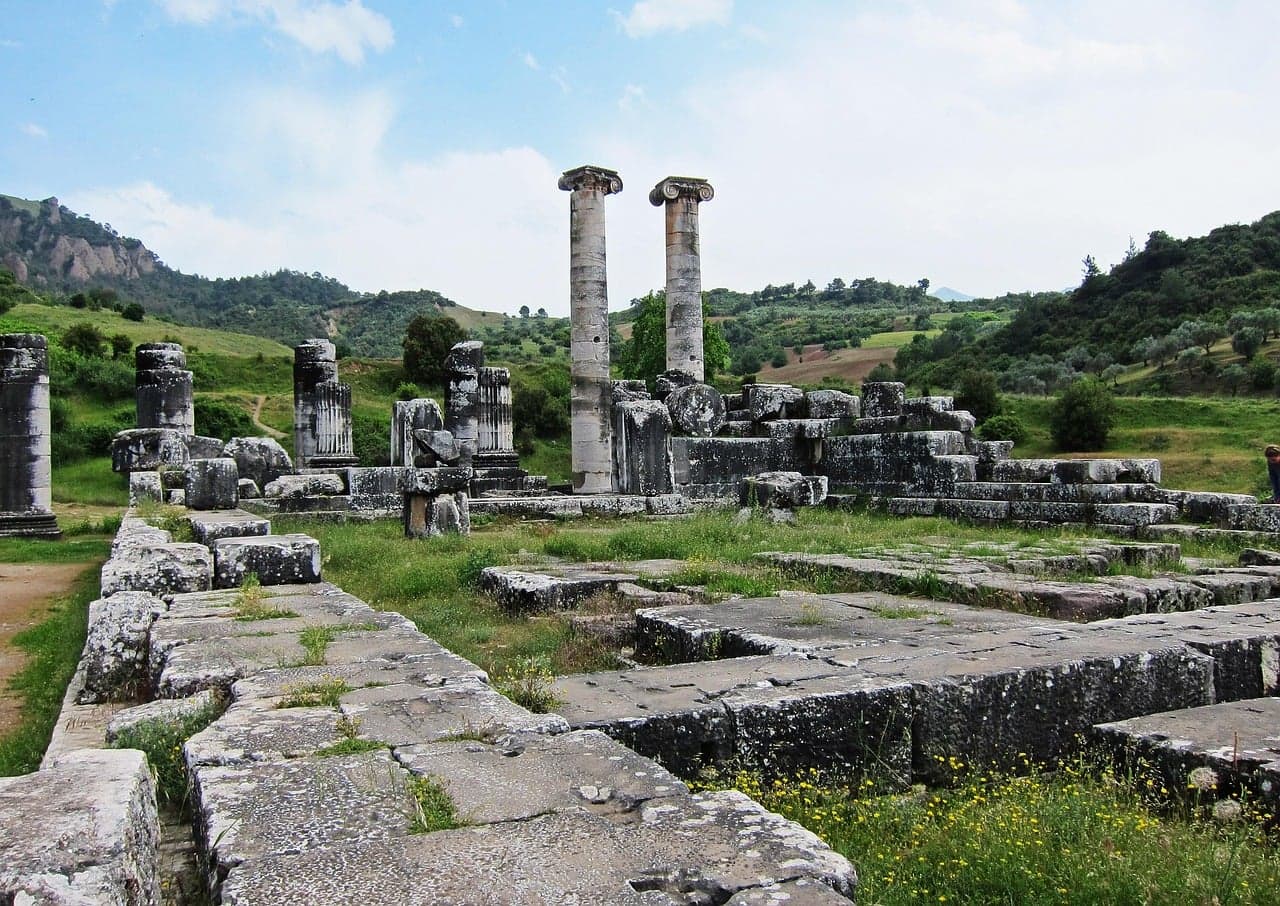
Make your first stop in Manisa Sardis, which joined the UNESCO World Heritage List in 2025 together with the Bin Tepe tumuli; the capital of the Lydian Kingdom, it is known as the birthplace of coinage. In the city centre you can see the mesir macunu tradition around the Sultan Mosque, and on Spil Dağı the weeping rock of Niobe and the wild tulips. The extinct volcanoes and wooden houses of Kula make Manisa far more than a day trip to an ancient city.
Why should Sardis come first?
Sardis, at Sart in the Salihli district, was the capital of the Lydian Kingdom, which ruled western Anatolia in the sixth century BC. The gold carried by the Pactolus (Sart) stream is regarded as the source of the fortune of King Croesus, known in Turkish as Karun, remembered for his legendary wealth. The first known coins were also struck here.
The ancient city of Sardis
The city was surrounded by the largest defensive wall outside Mesopotamia. The grandest structures you will see today are the monumental bath-gymnasium complex, the synagogue right next to it, regarded as the largest in the ancient world, and the arched shops along the edge of these two buildings. A little further on, the Temple of Artemis is one of the most impressive surviving temples of the Ionic order; take time to stand in front of its giant columns and feel their scale. Check the current visiting hours of the archaeological sites on the official page.
Bin Tepe (the Lydian tumuli)
North of Sardis, on the plain stretching towards Lake Marmara, Bin Tepe ("a thousand hills") is the largest tumulus field in the world, where Lydian kings and nobles were buried. Large mounds such as the Tumulus of Gyges can be picked out on the plain from afar. Since it was inscribed together with Sardis as a single World Heritage site, it makes sense to see both on the same day.
What can you see in central Manisa?
The Sultan Mosque and Complex
Built in the name of Ayşe Hafsa Sultan, mother of Sultan Süleyman the Magnificent, the complex forms Manisa's best-loved square. Its inscription shows that the complex's darüşşifa, the medical institution, was built in 1539–1540. According to tradition, Merkez Efendi prepared a paste of forty-one herbs and spices to restore Hafsa Sultan's health, and the sultana asked for this mesir paste to be distributed to the people every year. Ever since, during the week of Nevruz, the paste has been scattered to the crowds from the minarets and domes of the mosque. The Mesir Macunu Festival was inscribed on UNESCO's Representative List of the Intangible Cultural Heritage of Humanity in 2012.
The Muradiye Complex and the Grand Mosque
The madrasa and soup-kitchen buildings of the Muradiye Complex housed the Manisa Museum for many years; check on its official page before you go which parts of the museum are open. The Grand Mosque and Complex at the foot of Spil is one of the city's oldest groups of buildings, dating back to the period of the Saruhanids; thanks to its position on the slope, its courtyard opens onto a wide view of the plain.
Spil Dağı National Park
Rising just south of the city to more than one thousand five hundred metres, this limestone massif, with its canyons, doline lakes and more than a hundred and twenty endemic plant species, is a museum of nature. The rock of Niobe, who in mythology is said to have turned to stone while mourning her children, the Taş Suret carved into a niche in a granite surface, and the remains of Manisa Castle on the northern slope are all on the same mountain. The Manisa tulips, which bloom between April and May, are protected; do not pick them, only photograph them.
What are the volcanoes and wooden houses of Kula and Salihli like?
Kula-Salihli UNESCO Global Geopark
The volcanic land between Kula and Salihli joined the UNESCO Geoparks Network in 2013. The ancient geographer Strabo called this land "the Burnt Country". Black basalt lava flows, the young volcanic cones that local people call "divlit" and the pastel-toned Kula fairy chimneys in the Gediz Valley are the most photographed corners of the geopark.
The Kula houses
The nineteenth-century wooden houses of Kula are well-preserved examples of Ottoman civil architecture. Walking the streets that keep the town's nineteenth-century fabric is a good way to end the day calmly after a volcano trip.
What is there in the other ancient cities?
Aigai (Nemrut Kale)
Aigai, near Köseler in the Yunusemre district, is one of the twelve Aeolian cities listed by Herodotus and was founded on a rocky hill of Yunt Dağı. Excavations date its founding to the eighth century BC. With its three-storey agora, terraced stadium and theatre, it is a very good trip away from the crowds.
Thyateira and Philadelphia
Thyateira, in the centre of Akhisar, was a weaving and dyeing centre in antiquity; among the remains, inscriptions belonging to a guild of craftsmen who produced purple dye were found. Philadelphia in Alaşehir takes its name from King Attalus II Philadelphus of Pergamon, and in the Roman period it was called "Little Athens" because of its many temples and festivals.
What should you eat in Manisa?
Manisa kebabı, made with minced meat flavoured with onion and sumac, is the city's signature dish. Alaşehir kapaması, stuffed lamb neck (gerdan dolması) and oven-baked kabak sinkonta are also part of the local table. In Kula, try the sweet pide with dark tahini fresh from the oven, and for dessert höşmerim, made with unsalted cheese. Aegean sultana grapes, Akhisar olives and the Kırkağaç melon, the only melon with a geographical indication, are the area's famous products.
How many days do you need in Manisa?
Two days is enough; you can add another day for Aigai or Akhisar. A sample route:
- Day one: the Sultan Mosque, Muradiye and the Grand Mosque in the morning; Spil Dağı National Park, Niobe and the Taş Suret in the afternoon.
- Day two: the gymnasium, the synagogue and the Temple of Artemis at Sardis in the morning; Bin Tepe at midday.
- In the afternoon, move on to Kula: volcanic cones, fairy chimneys and wooden houses.
- Day three, if you wish: Aigai or Thyateira in Akhisar.
For other routes in the Aegean, take a look at the City Routes page.
When should you go, and how do you get there?
If you want to be there when the mesir paste is scattered, choose the week of Nevruz; to see the tulips on Spil, choose April to May. Spring and autumn are the most comfortable seasons for walking at Sardis and Kula; summer afternoons on the Gediz plain are very hot. Thanks to its closeness to İzmir, Manisa is easy to reach by road and rail; Sardis and Kula lie on the same route via Salihli.
What should you keep in mind?
- Check the current visiting hours and fees of archaeological sites and museums on their official pages.
- On Spil, do not pick tulips or endemic plants, and do not leave the marked paths.
- Kula's lava fields have sharp-edged basalt blocks; wear shoes with sturdy soles.
- The square gets very crowded on mesir days; keep your valuables safe and your children close.
Frequently asked questions
How many days do you need in Manisa?
With one day for the city centre and Spil Dağı and one for Sardis, Bin Tepe and Kula, you can see Manisa comfortably in two days. You can add a third day for Aigai or Akhisar.
Where is Sardis, and is it far from central Manisa?
Sardis is at Sart in Manisa's Salihli district. Because it lies on the road towards Salihli, it can be fitted into the same day as a trip to Kula.
When is mesir macunu distributed?
Every year, during the festival held in the week of Nevruz, mesir macunu is scattered to the people from the minarets and domes of the Sultan Mosque. Check the festival dates in official announcements before you go.
When is the best time to visit Manisa?
April to May suits the tulips on Spil Dağı, and the week of Nevruz suits the mesir festivities. Spring and autumn are the most comfortable times for walking at Sardis and Kula.
What should you eat in Manisa?
Manisa kebabı, Alaşehir kapaması, gerdan dolması and kabak sinkonta stand out. The sweet pide of Kula, höşmerim, Kırkağaç melon and sultana grapes are also flavours worth trying.
Editorial desk
Stories signed by the Cultvia editorial desk follow our editorial policy; every story lists its sources at the end and errors are fixed under our corrections policy.
Last updated:
What changed?
- : First published
Sources
- Sardes Antik Kenti ve Bin Tepeler Lidya Tümülüsleri — Kültür Portalı – T.C. Kültür ve Turizm Bakanlığı
- Şifa Şehri Manisa, Uluslararası Mesir Macunu Festivali — T.C. Manisa Valiliği
- Gör Manisa — Go Türkiye (Türkiye Turizm Tanıtım ve Geliştirme Ajansı)
- Tat Manisa — Go Türkiye (Türkiye Turizm Tanıtım ve Geliştirme Ajansı)
Up next
 City RoutesParis Photo 2026: opening hours, sectors and what to see13 November 2026 · 1 min read


