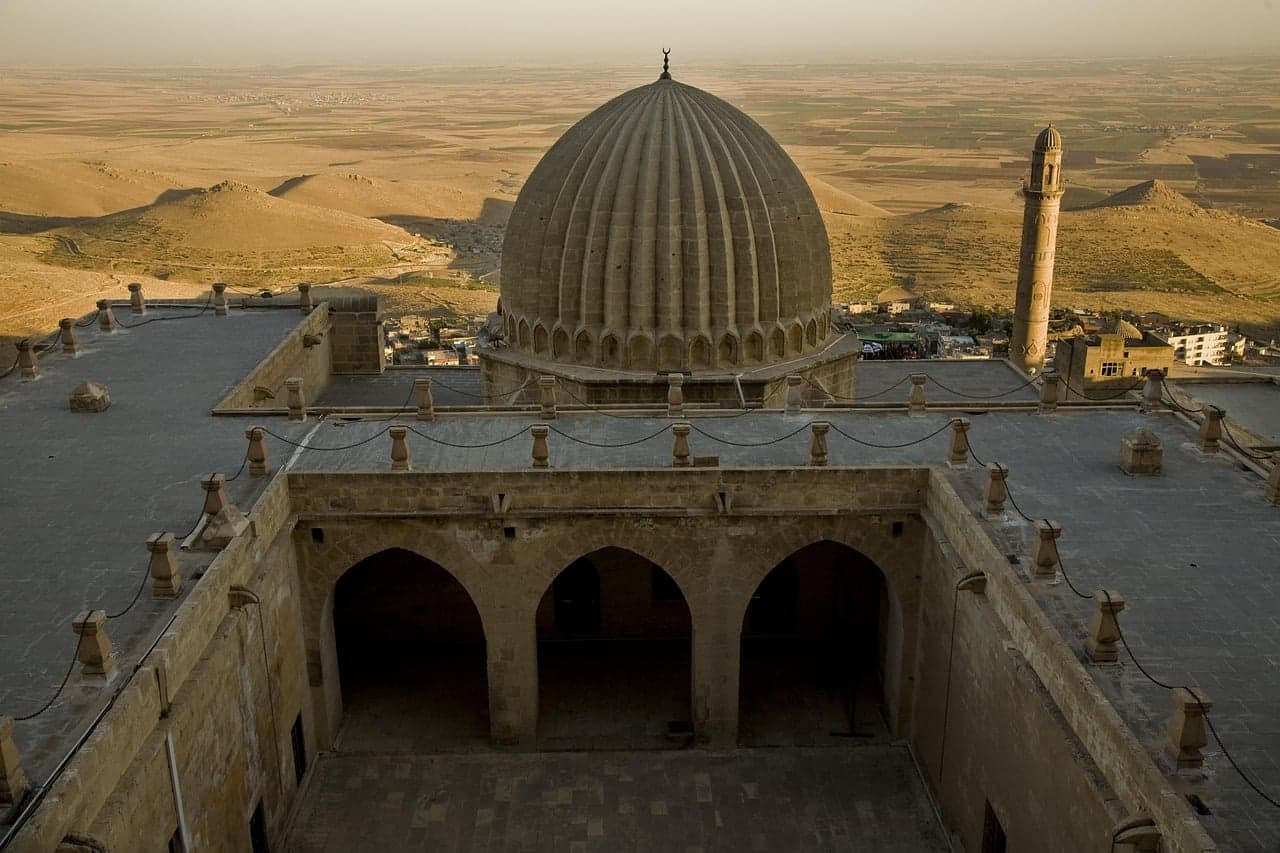
The first thing to see in Mardin is the stone old town itself, stepping down a hillside that looks out over the Mesopotamian plain: the Grand Mosque, the Zinciriye and Kasımiye madrasas, the Mardin Museum and the arched abbaras over the narrow lanes are all part of this fabric. Outside the city, the ancient city of Dara and the stone mansions of Midyat complete the route. Two days is a good length for seeing both the old town and its surroundings.
What should first-time visitors see in Mardin?
The old town and its abbaras
Mardin's real museum is its streets. The houses, built of pale limestone, sit on the slope in such a way that one house's roof is often the next one's terrace. The arched passages that cover the lanes and link the houses are called abbaras; they provide both shade and coolness. Getting lost in the stepped side streets climbing up from the main road is the best way to see the stonework up close.
The Grand Mosque
Built in the Artuqid period in the twelfth century, the Grand Mosque (Ulu Camii) is one of the city's oldest and best-known buildings. With its ribbed dome and a minaret visible from almost everywhere in town, it is the emblem of Mardin's skyline. The decorated cylindrical minaret you see today was renewed in the nineteenth century. You reach it by walking through the bazaar.
The Zinciriye (Sultan İsa) Madrasa
This madrasa, just below the citadel, was built in 1385 for the Artuqid ruler Melik İsa. With its two courtyards, its finely carved portal and its ribbed domes, it is one of the finest examples of Mardin stonework. From the upper courtyard you see the old town's roofs and the plain together; spend some time here at sunset.
The Kasımiye Madrasa
The Kasımiye Madrasa, a little lower down on the south-west side of town, is a large building begun in the fifteenth century and completed at the end of that century. Built of cut stone and brick, with a two-storey arcaded courtyard and a great iwan, it is one of the largest buildings in Mardin. The water that reaches the courtyard pool through a narrow channel is explained to visitors as a metaphor for the stages of human life.
The Mardin Museum
Housed in a historic building, the museum has a wide collection running from the Bronze Age to the Ottoman period. Among the ceramics, seals, coins and jewellery, the jars full of gold and silver coins found in Kızıltepe draw special attention. Stopping here at the start of your visit is a good way to understand the layers of the old town.
Deyrulzafaran Monastery
The monastery a few kilometres east of the city is a group of buildings whose roots go back to Late Antiquity. Its domes, arched porticoes, wood carving and the stonework on its inner and outer walls are among the important examples of the region's architecture. The two-courtyard complex is also known for having housed one of the first printing presses in the region.
Kırklar Church
This building inside the old town dates to the sixth century. With its rectangular plan set at the east end of a long courtyard, its centuries-old wooden doors, its bell tower and its lace-like carved stone niches, it is one of the historic buildings woven into Mardin's everyday fabric.
The bazaars
The Kayseriye Bazaar, the Coppersmiths' Bazaar, the Jewellers' Bazaar and the old markets are still busy. Follow the narrow streets running down below the main road to see the coppersmiths and the stalls selling sugared almonds and spices.
What is there around Mardin?
The ancient city of Dara
Dara, in the village of Oğuz about thirty kilometres south-east of Mardin, was founded in the early sixth century as an Eastern Roman garrison city to guard the empire's eastern frontier. The remains are interwoven with the village houses, and the city was once protected by a wall four kilometres long. The huge cisterns beneath the city, the large necropolis carved into the bedrock and the cave dwellings are its most impressive parts. Excavations under way since 2008 make the site a little more visible every year; wear comfortable shoes as you walk through the necropolis.
Midyat
Midyat, about an hour from Mardin, is on the UNESCO World Heritage Tentative List. With its cut-stone mansions, courtyard houses and historic bazaar, it offers an urban fabric with medieval traces. From the terrace of the three-storey Midyat Guesthouse you look out over the town's stone roofs. In the bazaar you can watch telkari, filigree work made with fine silver wire, at the craftsmen's benches.
How many days do you need in Mardin?
One full day for the old town and another for Dara and Midyat is ideal. A sample two-day route:
- The Mardin Museum and the Grand Mosque in the morning, then a walk through the bazaars.
- Kırklar Church and the side streets with their abbaras in the afternoon; the Zinciriye Madrasa at sunset.
- The ancient city of Dara in the cool of the morning on day two.
- Midyat's stone mansions and filigree workshops in the afternoon; the Kasımiye Madrasa or Deyrulzafaran Monastery on the way back.
Add Mardin's cuisine to the route too: bitter, dark mırra coffee, the fried stuffed meatballs called irok and the boiled ones called ikbebet, stuffed lamb ribs (kaburga dolması), kiliçe pastries and sugared almonds are the city's best-known flavours.
When should you go, and how do you get there?
Summers are very hot, so spring and autumn are the best seasons; in April and May especially, the plain turns green. You can reach Mardin by air through the city's airport, or by road from the direction of Diyarbakır or Şanlıurfa. For Dara and Midyat, renting a car or taking a day tour helps you use your time well.
What should you keep in mind?
- Check the current visiting hours and ticket prices of museums, madrasas and archaeological sites on their official pages.
- The streets of the old town are steep and stepped; choose comfortable, non-slip shoes.
- Follow the visiting rules in mosques, churches and monasteries still in use, wear clothes that cover your shoulders and knees, and ask before taking photos inside.
- In summer, visit open sites such as Dara early in the morning or in the late afternoon, and take water and a hat.
You can find other city routes on the City Routes page.
Frequently asked questions
How many days do you need in Mardin?
One full day for the old town and another for Dara and Midyat makes for a comfortable trip. If you want to enjoy the sunsets without rushing, adding a third day is a good idea.
When is the best time to visit Mardin?
Summers are very hot, so spring and autumn are the best seasons. In April and May the plain turns green, and walking in the old town is more pleasant.
Where is the ancient city of Dara?
Dara is in the village of Oğuz, about thirty kilometres south-east of Mardin. The remains are interwoven with the village houses; the cisterns, the wall remains and the rock tombs draw the most interest.
Can you visit Midyat from Mardin?
Yes, Midyat is about an hour's drive away and can be visited as a day trip. Allow more than half a day for its stone mansions, historic bazaar and filigree workshops.
What should you eat in Mardin?
Mırra coffee, the stuffed meatballs called irok and ikbebet, stuffed lamb ribs, kiliçe pastries and sugared almonds are the best-known flavours of Mardin's cuisine.
Editorial desk
Stories signed by the Cultvia editorial desk follow our editorial policy; every story lists its sources at the end and errors are fixed under our corrections policy.
Last updated:
What changed?
- : First published
Sources
- Top Things to See in Mardin — Go Türkiye (Türkiye Turizm Tanıtım ve Geliştirme Ajansı)
- Taste the Flavors of Mardin — Go Türkiye (Türkiye Turizm Tanıtım ve Geliştirme Ajansı)
- Dara Antik Kenti — Kültür Portalı – T.C. Kültür ve Turizm Bakanlığı
- Kasımiye Medresesi — Kültür Portalı – T.C. Kültür ve Turizm Bakanlığı
Up next
 City RoutesParis Photo 2026: opening hours, sectors and what to see13 November 2026 · 1 min read


