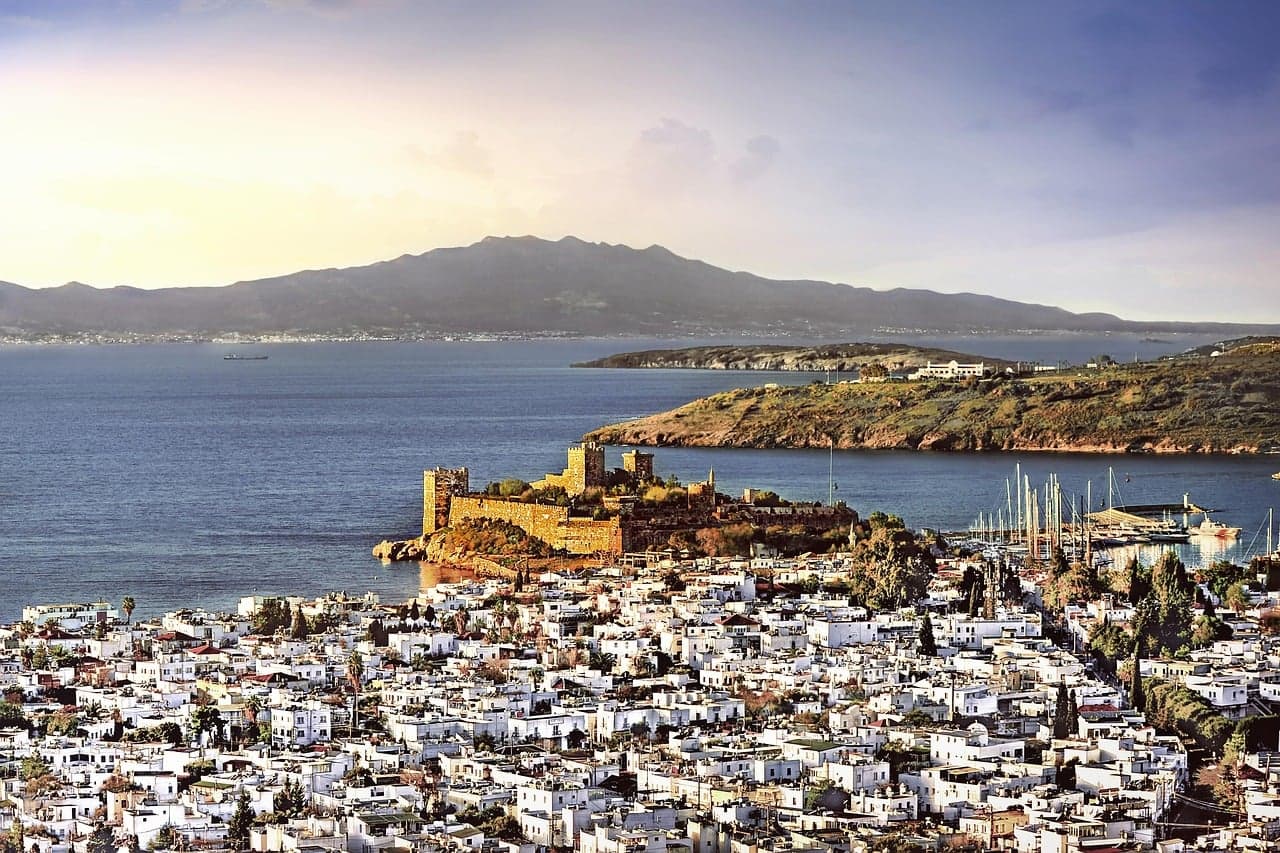
Muğla is not one city but a string of very different towns along the coast where the Aegean meets the Mediterranean: the knights' castle in Bodrum, the Ölüdeniz lagoon and Saklıkent Canyon near Fethiye, the rock tombs of Kaunos at Dalyan and Knidos at the tip of the Datça peninsula. That is why the best way to see Muğla is not from a single centre but region by region, from two or three bases.
What should you see in Bodrum?
Bodrum Castle and the Museum of Underwater Archaeology
The castle, built on the peninsula known in antiquity as Zephyrion, was begun in 1406 by the Knights of St John, who were based in Rhodes. Stones taken from the ruined Mausoleum were used in the walls of this building, which carries traces of Gothic architecture. Today the castle houses Türkiye's only museum of underwater archaeology: one of the richest amphora collections in the eastern Mediterranean, the Uluburun and Serçe Limanı shipwrecks and Islamic glassware are all here. Wandering between the towers easily fills half a day.
The Mausoleum
The monumental tomb built for Mausolus, the Carian satrap, was counted among the seven wonders of the ancient world. It stood for centuries until an earthquake brought it down; today you can see the foundations, scattered architectural pieces and a small exhibition area. Knowing that the word "mausoleum" comes from here gives the stones on the ground a different meaning.
The Ancient Theatre and Gümüşlük
The theatre on the southern slope of Göktepe dates from the fourth century BC and is one of the oldest structures surviving from Halicarnassus; climb up towards sunset for the view of the bay. Gümüşlük, at the western tip of the peninsula, is a quiet fishing village built on top of the ancient city of Myndos and is also known for its tangerine orchards.
What is there around Fethiye, Ölüdeniz and Saklıkent?
Ölüdeniz
Ölüdeniz, a protected natural lagoon near Fethiye, is one of the most photographed coasts in Türkiye with its shades of blue and green. Its calm water is ideal for swimming and snorkelling, and paragliders taking off from Babadağ behind it land on the beach. It gets crowded in summer; early mornings are more peaceful.
Kayaköy
On a hillside south of Fethiye, Kayaköy is a village of stone houses built in the nineteenth and early twentieth centuries and later abandoned. The houses are arranged so that none blocks the view or light of another, and each has a cistern that collected rainwater. Walk slowly along the slope between the chapels and the two large churches.
The Tomb of Amyntas
The temple-fronted rock tombs carved into the steep slope above Fethiye are the emblem of ancient Telmessos. The best preserved is the Tomb of Amyntas, named after the inscription on it and dated to the fourth century BC. You climb up by steps from the town centre, and the facade stands out more clearly in the late-afternoon light.
Saklıkent Canyon
The canyon, running through the middle of a national park about fifty kilometres from Fethiye, reaches a depth of about three hundred metres and a length of eighteen kilometres. Once the snowmelt from the Taurus Mountains has receded, part of the canyon becomes walkable; in winter the water is too high to get through. The water is very cold even in summer, so bring shoes you do not mind getting wet.
Letoon
Letoon, on the edge of Muğla province, was the sacred centre of ancient Lycia; the temples of Leto, Apollo and Artemis stand side by side. Together with neighbouring Xanthos, it has been on the UNESCO World Heritage List since 1988. It is worth an hour on the way back from Saklıkent.
Why do Dalyan and Kaunos need a day of their own?
Kaunos
Kaunos, on the west bank of the Dalyan river that links Lake Köyceğiz to the sea, was once a trading city with a harbour that could be closed off; the harbour gradually filled with silt and the city ended up inland. The temple-fronted royal tombs you see from Dalyan are its most striking face. Also see the theatre, the Roman baths and the basilica remains at the foot of the acropolis. Kaunos has been on the UNESCO World Heritage Tentative List since 2014.
İztuzu Beach
İztuzu, a long, narrow sandy beach where fresh water meets the sea, is one of the nesting grounds of the loggerhead sea turtle, Caretta caretta. During the nesting season the beach is closed to visitors at night, and no permanent buildings are allowed. Going by boat from Dalyan through the reed beds makes the journey part of the trip.
What do Marmaris, Datça and Akyaka offer?
Marmaris Castle and bazaar
The medieval castle overlooking the harbour and marina is home to Marmaris's only museum, an archaeological museum; Hellenistic, Roman and Byzantine amphorae, glassware and coins from the excavations at Knidos, Hisarönü and Burgaz are displayed here. Browse the spice and handicraft stalls in the historic bazaar at the foot of the castle, then explore the coves towards the Bozburun peninsula and the Temple of Hemithea at Hisarönü.
Sedir Island
The island in the Gulf of Gökova sits on the site of the ancient city of Kedreai; its name comes from the cedar tree, though no cedars grow there today. Inside the walled area are the remains of a theatre, a sanctuary of Apollo, a large basilica and an agora. It is also popularly called Cleopatra Island. Boats leave from Akyaka and from the village of Çamlı near Marmaris; follow the protection rules on the island's beach.
Knidos and the Datça peninsula
Knidos, founded on Cape Tekir at the very tip of the Datça peninsula, was an ancient coastal city with two harbours. As you walk among the remains of the round temple, the theatre and the sundial, remember that Praxiteles' famous statue of Aphrodite once stood here. The road is long and winding, so do not leave the drive back until after sunset.
Akyaka
Akyaka, in the north-eastern corner of the Gulf of Gökova, is ideal for a short stop with its quiet streets and views of the bay. Near the town lie the remains of the ancient city of Idyma, with tombs carved into the rock in the shape of houses; the boats to Sedir Island also leave from here.
Why shouldn't you skip the town of Muğla?
Saburhane and the Muğla houses
The provincial centre, away from the coast, is an urban conservation area with hundreds of listed houses, narrow streets and inns. What sets Muğla houses apart from others in the region are their distinctive chimneys, capped to keep out wind and rain; these chimneys are the symbol of the town. Stop for tea in the plane-shaded courtyard of the Yağcılar Han in the Arasta.
How many days do you need in Muğla?
Allow at least four days to see Muğla well, and choose two bases: one in Bodrum and one in Fethiye or Dalyan. A sample route:
- Day one: Bodrum Castle and the Museum of Underwater Archaeology, then the Mausoleum and the ancient theatre in the afternoon.
- Day two: Stop at Gümüşlük, then drive to the town of Muğla to explore Saburhane and the Arasta.
- Day three: Kaunos and İztuzu by boat from Dalyan.
- Day four: Saklıkent Canyon and Letoon; Ölüdeniz or Kayaköy in the evening.
It is worth adding a separate day for Datça and Knidos, and seeing Marmaris and Akyaka on the way.
When should you go, and how do you get there?
June to September is the best time for the sea; spring and autumn are more comfortable for the ancient cities and walks. The walkable part of Saklıkent opens in summer, once the snowmelt has receded. You can reach the region through the airports near Bodrum and at Dalaman. Distances between the districts are long, so renting a car makes things easier.
What should you keep in mind?
- Check the current visiting hours and ticket prices of museums and archaeological sites on their official pages.
- On turtle beaches such as İztuzu, put up your umbrella only in the marked areas, and do not use lights or light fires at night.
- At Saklıkent the water is cold and slippery; if you are with children, stay within the guided section.
- In summer, visit open-air sites early in the morning or in the late afternoon, and carry water and a hat.
You can find our other city articles on the City Routes page.
Frequently asked questions
How many days do you need in Muğla?
Allow at least four days for the highlights. Using Bodrum and Fethiye or Dalyan as bases means less time on the road; adding a separate day for Datça and Knidos is a good idea.
When is the best time to visit Muğla?
June to September is the best time for the sea. Spring and autumn are cooler and more comfortable for the ancient cities, Kayaköy and walking routes.
How do you get to Muğla?
The airports near Bodrum and at Dalaman are the region's two main gateways. Distances between the districts are long, so renting a car or joining day tours makes things easier.
When can you walk Saklıkent Canyon?
Part of the canyon becomes walkable once the snowmelt from the Taurus Mountains recedes; summer is the best time. In winter the water is too high to get through.
How do you get to Kaunos?
Kaunos is on the west bank of the Dalyan river. You can reach it by the boats that cross from Dalyan or by road; the boat trip gives you the best view of the rock tombs.
Editorial desk
Stories signed by the Cultvia editorial desk follow our editorial policy; every story lists its sources at the end and errors are fixed under our corrections policy.
Last updated:
What changed?
- : First published
Sources
- Muğla'da Görülecek Yerler — Go Türkiye (Türkiye Turizm Tanıtım ve Geliştirme Ajansı)
- Top Things to See in Marmaris Guide — Go Türkiye (Türkiye Turizm Tanıtım ve Geliştirme Ajansı)
- Saklıkent Canyon — Go Türkiye (Türkiye Turizm Tanıtım ve Geliştirme Ajansı)
- Kaunos Antik Kenti — Kültür Portalı – T.C. Kültür ve Turizm Bakanlığı
Up next
 City RoutesParis Photo 2026: opening hours, sectors and what to see13 November 2026 · 1 min read


