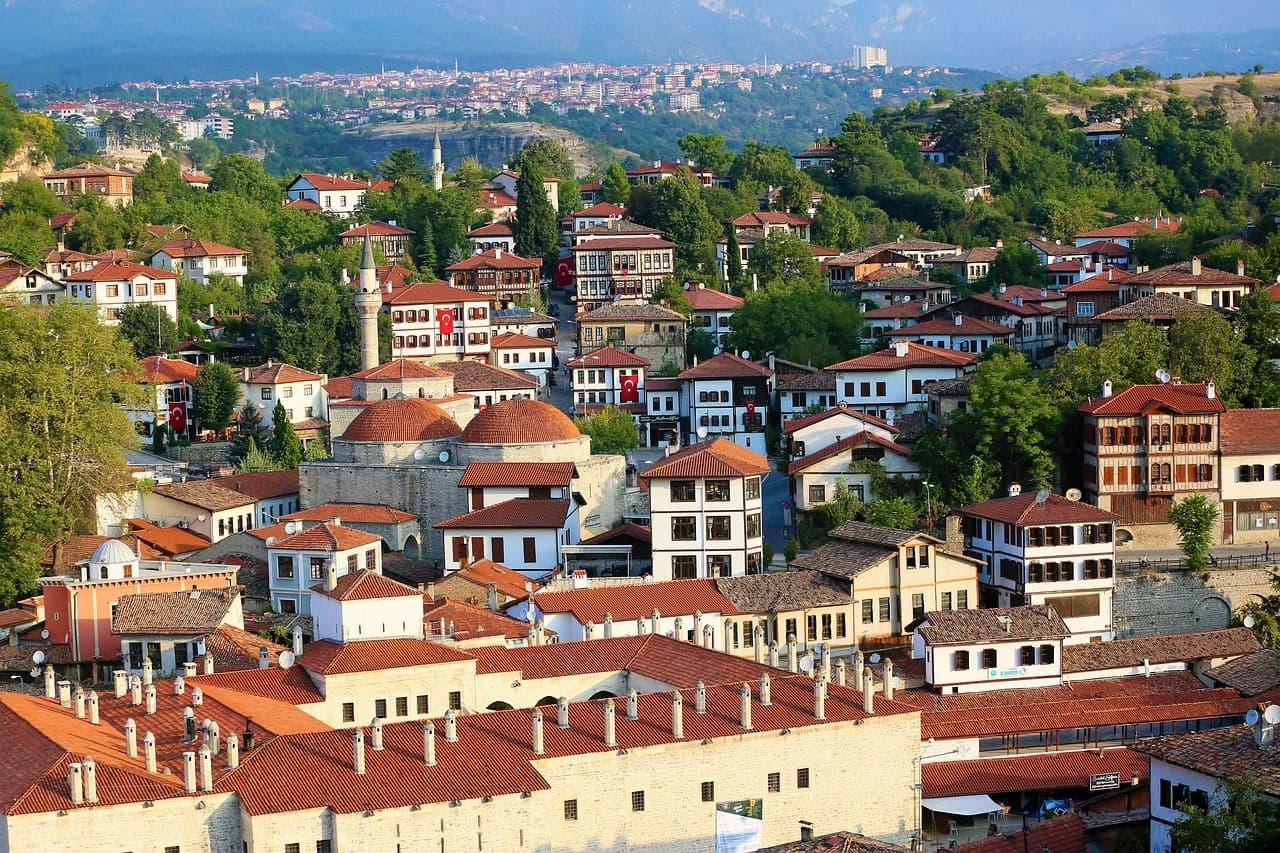
Your first job in Safranbolu is to walk the narrow streets of the old bazaar quarter and then take in the whole townscape from Hıdırlık Hill. This district of Karabük joined the UNESCO World Heritage List in 1994 because it has preserved Ottoman-era domestic architecture so completely. The mansions, the Cinci Han, Yörük Village and the İncekaya Aqueduct in Tokatlı Canyon will easily fill two full days.
What should first-time visitors see in Safranbolu?
Hıdırlık Hill
This hill above the old bazaar quarter is the best place to start understanding how the red-tiled roofs settle into the valley. In the past it was a picnic ground where Hıdırellez spring celebrations and prayers for rain were held. Climb up towards sunset and the facades of the stone houses turn orange.
The Safranbolu houses
The town centre has nearly two thousand traditional houses built between the eighteenth and early twentieth centuries, about eight hundred of which are under legal protection. The houses are gathered in two separate areas: the Çarşı (bazaar) side, lived in during winter, and Bağlar, the garden quarter families moved to in summer. A stone ground floor, timber upper floors, bay windows and the cupboards and small washing alcoves built into every room are the familiar details of these houses. Be sure to go inside at least one of the mansions open to visitors.
The Cinci Han
One of the caravanserais on the Silk Road, the han was built in 1645 by Karabaşzade Hüseyin Efendi, known as Cinci Hoca. The two-storey building with sixty-three rooms served as a caravanserai until the twentieth century, when the trade routes lost their importance, and then for a long time as a storehouse for local tradesmen. After restoration it became a place to stay once again; simply stepping into its courtyard and sitting for a while among the stone arches is impressive enough.
The Cinci Hamam
Dating from the same years as the han, the hamam has two separate sections for women and men, which are almost identical architecturally. As it still works as a bathhouse, it offers a chance to experience the Turkish bath tradition in a historic building.
The Arasta and the Yemeniciler Bazaar
The Arasta, made up of forty-eight wooden shops in a continuous row, is one of Safranbolu's oldest markets. It takes its name from the craftsmen who made yemeni, the traditional shoes. Today there are handmade goods, souvenirs and small cafés; come early in the morning and you will find the street calmer.
The Blacksmiths' Bazaar
This street inside the old bazaar quarter has largely kept its Ottoman-era appearance. Though the ring of anvils is not heard as often as before, hand-beaten copperware and ironwork still catch the eye. It is one of the most characterful corners of the town for photography.
The Köprülü Mehmet Paşa Mosque and its sundial
In the courtyard of this seventeenth-century mosque stands a sundial on a marble base. Its triangular brass pointer casts a shadow on the marble and shows the time of day in ten-minute intervals. Go at midday on a sunny day and you can see for yourself how it works.
The İzzet Mehmet Paşa Mosque
Built in 1796, the mosque is often described as a small version of the Nuruosmaniye Mosque in Istanbul. With its library, ablution fountain, fountains and endowment shops, it looks like a small complex.
The City History Museum and the Clock Tower
The museum building on the castle hill was built in the early twentieth century as the district administration building and was turned into the city museum after being restored following a fire. Through documents, objects and photographs it tells the story of everyday life in Safranbolu. Add the eighteenth-century clock tower right next to it to the same walk. Check current visiting hours in the museum's official announcements.
Yörük Village
The village, a short distance from Safranbolu, is a Turkmen village founded by Yörüks who had settled down, and it has been protected since 1997. With its stone-based houses lined up along a single main street, it looks like a small model of Safranbolu. Take a separate look at the painted decoration in the rooms of the Sipahioğlu House, which is open to visitors.
The İncekaya Aqueduct and Tokatlı Canyon
The aqueduct inside Tokatlı Canyon was built in the late eighteenth century to bring water to Safranbolu. The aqueduct, a hundred and sixteen metres long, stands about sixty metres above the ground and is built of stone and Horasan mortar. It was designed with three bends to even out the speed of the water, and people called the water it brought "the pasha's water". The glass viewing terrace above the canyon and the walking trail along the Tokatlı stream can be seen on the same outing.
Bulak Mencilis Cave
The cave in the village of Bulak, close to town, is among the longest caves in Türkiye. Only its first section is open to visitors; stalactites, stalagmites, small pools and travertines make this short walk worthwhile. It is cool and damp inside, so bring a cardigan.
How are Çarşı, Bağlar and Kıranköy different?
As a visitor, you will spend most of your time in Çarşı: the han, the hamam, the Arasta and the mosques are here. Bağlar is a quieter area of summer houses with large gardens; when the town gets crowded, you can shift your walk here. On the Kıranköy side stands the former Church of Hagios Stefanos, now known as the Ulu Cami, whose inscription dates to the early sixth century. The town also joined the Cittaslow network of slow towns in 2024.
At the table, Safranbolu lokum and saffron desserts stand out; the saffron crocus that gave the town its name is still grown in the area. Try local dishes such as kuyu kebabı (pit-roasted lamb) and bükme pastries too.
How many days do you need in Safranbolu?
Two days is ideal. A sample route:
- Day one: Hıdırlık Hill in the morning, then the Cinci Han, the Arasta and the Blacksmiths' Bazaar; the Köprülü Mehmet Paşa Mosque, the City History Museum and a mansion visit in the afternoon; the Cinci Hamam in the evening.
- Day two: The İncekaya Aqueduct, the glass viewing terrace and the canyon walk in the morning; Yörük Village in the afternoon, and Bulak Mencilis Cave on the way back.
You will find similar historic towns on the City Routes page.
When should you go, and how do you get there?
Spring and autumn are the best seasons for walking the streets and exploring the canyon. Autumn, when the saffron flowers, is especially lovely. Summer weekends are crowded; in winter the snowy roofs make a striking view, but the canyon trail can be slippery. Safranbolu is reached by road via Karabük, with regular bus services from Ankara and Istanbul. For İncekaya and Yörük Village you need your own car or a taxi.
What should you keep in mind?
- The streets of the old quarter are steep and cobbled; wear comfortable, non-slip shoes.
- People still live in most of the mansions. Do not enter the courtyards of houses not open to visitors, and take care when photographing close to windows.
- If you are afraid of heights, take your time on the glass viewing terrace and the canyon trail; walk carefully in wet weather.
- Check current hours and prices for the museum, the han, the hamam and the viewing terrace on official sources.
- The town gets very crowded at weekends and on holidays; go on a weekday if you can.
Frequently asked questions
How many days do you need in Safranbolu?
Allow one day for the mansions, han, hamam and mosques in Çarşı, and one for the İncekaya Aqueduct, Tokatlı Canyon and Yörük Village, and you can explore comfortably in two days.
Is Safranbolu on the UNESCO list?
Yes. Safranbolu was added to the UNESCO World Heritage List in 1994 because it has preserved Ottoman-era domestic architecture as a whole.
When is the best time to visit Safranbolu?
Spring and autumn are the best seasons for walking the streets and exploring the canyon. Summer weekends are crowded; snowy roofs are beautiful in winter, but the trails can get slippery.
How do you get to Safranbolu?
Safranbolu is reached by road via Karabük, with regular bus services from Ankara and Istanbul. For the İncekaya Aqueduct and Yörük Village you need your own car or a taxi.
What can you see in Yörük Village?
Stone-based houses lined up along one main street and the painted rooms of the Sipahioğlu House, which is open to visitors. The village has been protected since 1997.
Editorial desk
Stories signed by the Cultvia editorial desk follow our editorial policy; every story lists its sources at the end and errors are fixed under our corrections policy.
Last updated:
What changed?
- : First published
Sources
- Top Things to See in Karabuk — Go Türkiye (Türkiye Turizm Tanıtım ve Geliştirme Ajansı)
- Cinci Hanı — Kültür Portalı – T.C. Kültür ve Turizm Bakanlığı
- İncekaya Su Kemeri — Kültür Portalı – T.C. Kültür ve Turizm Bakanlığı
- Yörük Köyü — Kültür Portalı – T.C. Kültür ve Turizm Bakanlığı
Up next
 City RoutesParis Photo 2026: opening hours, sectors and what to see13 November 2026 · 1 min read


