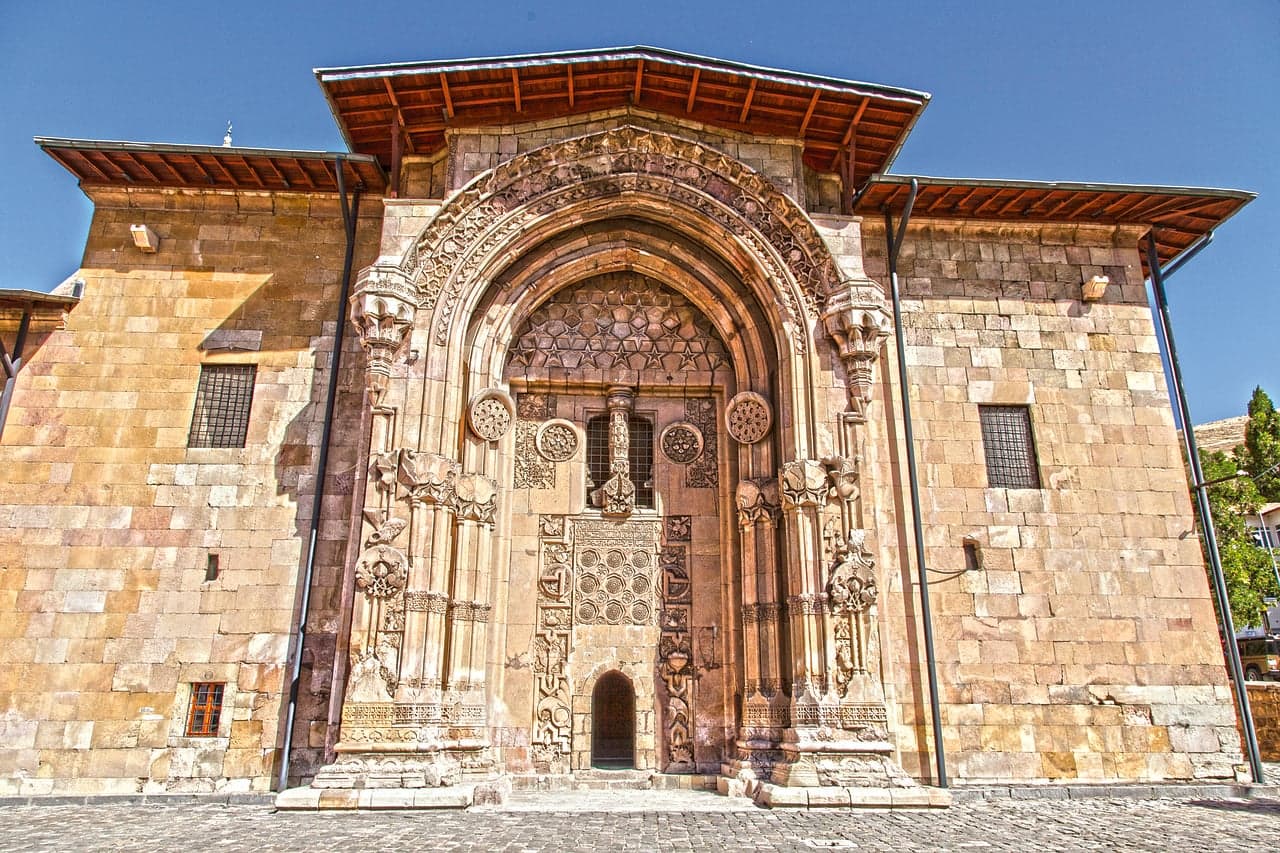
In Sivas, start with the historic square in the city centre: the Çifte Minareli, Buruciye and Şifaiye madrasas, a few steps apart, together show some of the grandest portals of Anatolian Seljuk stonework. Then add to your route the Divriği Grand Mosque and Darüşşifa, world-famous for their stone carving and on the UNESCO World Heritage List. Altınkale with its yellow travertines, the Hittite cities and the Seljuk bridges over the Kızılırmak turn Sivas into a trip spread over several days.
Which madrasas are on the historic city square?
Sivas was one of the most important cities of the Anatolian Seljuks, and the clearest trace of this is the madrasas around the square. In the morning light the reliefs on the portals look sharper; plan your walk for the early hours.
The Çifte Minareli Madrasa
The original part of the madrasa, built in 1271–1272, that has survived is its front facade, with the tallest portal in Anatolia. The minarets rising on either side of the portal have become something of a symbol of the city. Although the building behind it has largely been lost, the facade alone conveys the scale of one of Anatolia's most monumental madrasas.
The Buruciye Madrasa
Built in the same year, 1271, for teaching physics, chemistry and astronomy, the madrasa has the most perfectly symmetrical madrasa plan in Anatolia. The star, rumi and geometric motifs on its portal are worked like lace. Together with other madrasas in Sivas, Konya, Kayseri, Erzurum and Kırşehir, the Buruciye was added to the UNESCO World Heritage Tentative List in 2014 under the heading of "Anatolian Seljuk Madrasas". The building had been closed to visitors for restoration; before you go, ask the provincial directorate of culture and tourism whether it is open.
The Şifaiye Madrasa and Darüşşifa
Built in 1217–1218 by the Seljuk Sultan İzzeddin Keykavus I, the building was both a place where the sick were cared for and a school of medicine. With the part that has survived, it is regarded as the largest Seljuk darüşşifa in Anatolia. Look out for the sun and moon symbols on the portal and the reliefs in the shape of a woman's and a man's head in the main iwan; at the sultan's bequest, the south iwan was turned into his tomb.
The Gök Medrese
The marble portal of the madrasa built in 1271 by the vizier Sahip Ata is one of the Seljuk works that best reflect the play of light and shadow. The two-storey building, with an open courtyard and four iwans, has been visited as the Foundations Museum since 2020, after a restoration faithful to the original. Check the current hours and fees on the museum's official page.
Why is Divriği so famous?
The Divriği Grand Mosque and Darüşşifa
In the period of the Mengücek principality, Ahmet Şah commissioned the mosque section and his wife Melike Turan Melek the darüşşifa section from the architect Hürrem Şah of Ahlat. The motifs on the portals, the work of masters from Ahlat, are carved so deeply and finely that in places the stone looks like fabric or plants. The building was added to the UNESCO World Heritage List in 1985. Because Divriği is far from the city centre, give it a whole day; take binoculars or a good phone camera to see the details of the portals.
Which other stops are there in the city?
The Archaeology Museum
The museum, in a building constructed in 1914 as the workshop of a trade school, is one of the largest archaeology museums in Central Anatolia. Fossils of mammals that lived in the region about nine million years ago, Chalcolithic and Early Bronze Age finds, Hittite works and pieces from the Roman, Byzantine, Seljuk and Ottoman periods are on display.
Historic inns and hamams
The sixteenth-century Subaşı Hanı is today home to shopkeepers selling dried goods; the Çorapçı Hanı is used as a culture and arts house, and the Taş Han, from the second half of the nineteenth century, is also in the city centre. If you want to see Ottoman hamam culture, the Kurşunlu Hamam and the Meydan Hamam are well-known examples of historic hamams. The Abdi Ağa and Osman Ağa mansions show the layout of an old Sivas house.
The Âşık Veysel Museum
The house in Sivrialan village in the Şarkışla district is where the folk poet Âşık Veysel lived. Opened as a museum in 1982, the house displays the poet's personal belongings, photographs and sayings. The Âşık Veysel Culture and Arts House in the city centre was also opened to keep the minstrel tradition alive.
Where should you follow the traces of the Hittites?
Kuşaklı (Sarissa) and Kayalıpınar (Samuha)
Kuşaklı in Altınyayla was the Hittite city of Sarissa and is promoted for its history of about four thousand years. Kayalıpınar in Yıldızeli is known as Samuha, one of the important Hittite settlements. Find out the visiting conditions of the archaeological sites before you go; you can see some of the finds at the Archaeology Museum in the city.
Where do hot springs and nature meet?
Altınkale and Sıcak Çermik
At Sıcak Çermik, thirty-one kilometres from the city centre, the hot spring water comes to the surface at a temperature of about forty-eight degrees. The minerals in the water have formed yellow travertine pools arranged in steps down the slope; the name, "Golden Castle", comes from this golden-yellow colour. The governorship compares the area, with its geological structure, to an open-air geology museum. You can get into the pools; be careful when stepping on the travertine surface.
The Emirhan and Eğribucak rocks
The rock formations, which resemble fairy chimneys, are part of the geological heritage. The Eğribucak Rocks, about five kilometres from Emirhan, have become a regular stop for hikers in recent years.
The Kızılırmak bridges and Yıldız Dağı
The Kesik Köprü, the Eğri Köprü and the Boğaz Köprüsü over the Kızılırmak date from the Seljuk period. In winter the ski centre on Yıldız Dağı opens; in summer there are water sports on Yıldız Gölü at the foot of the mountain, and walking and camping around it.
What is on the table in Sivas?
Sivas cuisine was shaped by preparations for the long winter; flour, bulgur, kavurma, pickles and the long-lasting yoghurt called peskütan are the basis of the larder. Sivas köftesi, made only with minced meat and salt, the meat rested for a day and minced again, was registered in 2011. Sivas kebabı with vegetables, threaded on skewers and cooked in brick ovens, peskütan soup, mıhlama made with pezik pickles and fırın katmeri are the classics of the bazaar. Also try Divriği's alatlı pilav with lamb, chickpeas and pine nuts and hurma tatlısı; on your way home you can buy gilaburu, which received a geographical indication in 2017, and Sivas çöreği.
How many days do you need in Sivas?
Three days is ideal. A sample route:
- Day one: the madrasas on the city square, the Gök Medrese, the Archaeology Museum and the historic inns.
- Day two: leave early in the morning for Divriği and visit the Grand Mosque and Darüşşifa.
- Day three: Altınkale and Sıcak Çermik; on the way back, the Kızılırmak bridges or the Emirhan rocks.
For other routes in Central Anatolia, take a look at the City Routes page.
When should you go, and how do you get there?
May to October is the most comfortable time to visit; winters are long and harsh, but if you want to ski on Yıldız Dağı, that is just the time. You can reach Sivas by air, rail and road. The madrasas are within walking distance; for Divriği, Altınkale and the Hittite cities you need a vehicle.
What should you keep in mind?
- Check the current hours, fees and restoration status of museums and madrasas on their official pages.
- Do not touch the stone decoration on the portals; it is very sensitive to wear.
- In winter the roads can be snowy and icy; check the weather before long trips to the districts.
- Do not stay in the hot water of the spring pools for long, and drink plenty of water.
Frequently asked questions
How many days do you need in Sivas?
With one day for the madrasas and museums in the city centre, one for Divriği and one for Altınkale and its surroundings, you see the main sights in three days.
Why is the Divriği Grand Mosque important?
The mosque and darüşşifa, built by masters from Ahlat in the Mengücek period, were added to the UNESCO World Heritage List in 1985 for the unique stonework on their portals. Because Divriği is far from the city centre, you need a whole day.
When is the best time to visit Sivas?
May to October is the most comfortable time to visit. Winters are long and harsh; the ski centre on Yıldız Dağı opens in winter.
How do you get to Sivas?
You can reach Sivas by air, rail and road. The madrasas on the city square are within walking distance; for Divriği, Altınkale and the Hittite cities you need a vehicle.
What should you eat in Sivas?
Registered Sivas köftesi, Sivas kebabı with vegetables, peskütan soup, pickle mıhlama, fırın katmeri, Divriği pilavı and hurma tatlısı stand out. Gilaburu and Sivas çöreği are among the products to take home.
Editorial desk
Stories signed by the Cultvia editorial desk follow our editorial policy; every story lists its sources at the end and errors are fixed under our corrections policy.
Last updated:
What changed?
- : First published
Sources
- Gör Sivas — Go Türkiye (Türkiye Turizm Tanıtım ve Geliştirme Ajansı)
- Tat Sivas — Go Türkiye (Türkiye Turizm Tanıtım ve Geliştirme Ajansı)
- Altınkale — T.C. Sivas Valiliği
- Buruciye Medresesi — Kültür Portalı – T.C. Kültür ve Turizm Bakanlığı
Up next
 City RoutesParis Photo 2026: opening hours, sectors and what to see13 November 2026 · 1 min read


