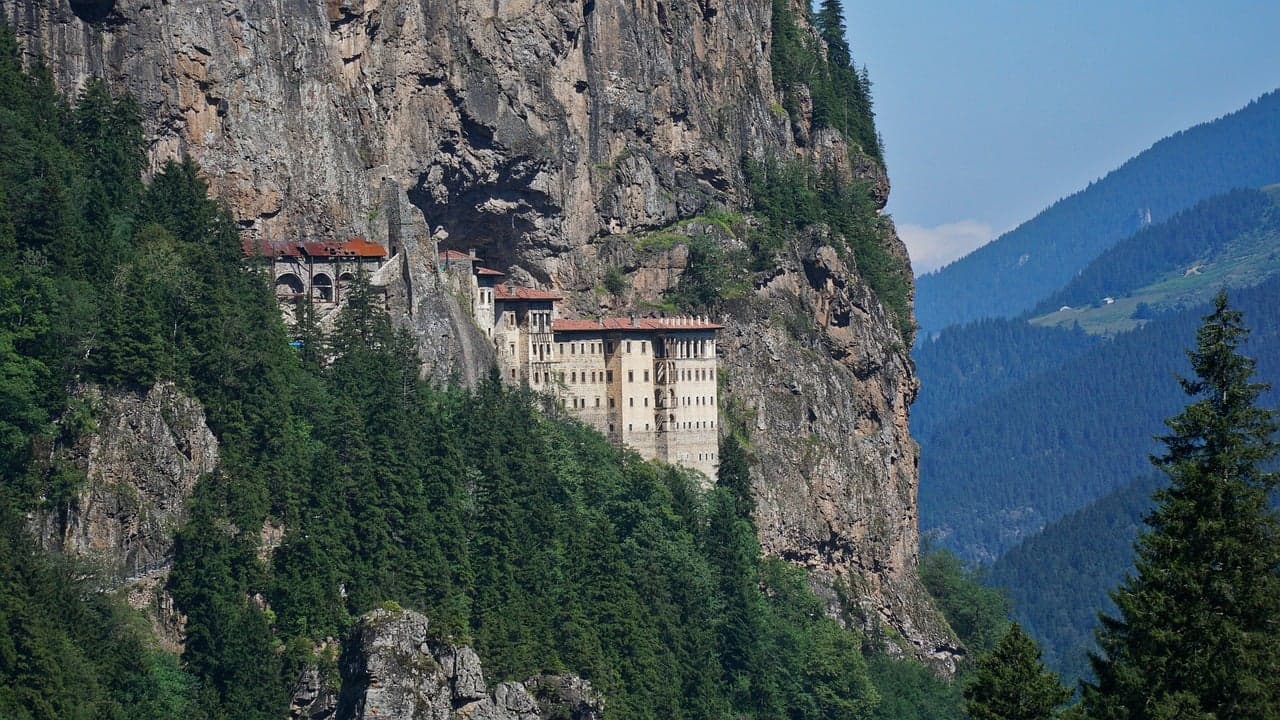
The first place to see in Trabzon is Sümela Monastery, built on a sheer cliff above the Altındere Valley in Maçka. In the city centre, Hagia Sophia, the Atatürk Mansion, the castle walls and Boztepe, and to the east Uzungöl and the highland pastures, show Trabzon's two faces, its history and its green, side by side. With three days you can enjoy both the city and the air of the yaylas at an easy pace.
What should first-time visitors see in Trabzon?
Sümela Monastery
About forty-seven kilometres from the city, the monastery is a group of buildings set against the rock on the slopes of Karadağ, some three hundred metres above the valley floor. Tradition says it was founded in the fourth century; it took its present appearance from the thirteenth century onwards and enjoyed its most brilliant period with the large buildings added in the eighteenth and nineteenth centuries. The frescoes covering the walls of the main rock church and the chapel beside it are the most precious part of the complex. Sümela has been on the UNESCO World Heritage Tentative List since 2000. You walk up through the forest from the car park, so wear comfortable shoes.
Hagia Sophia
On a hill facing the sea in the west of the city, Trabzon's Hagia Sophia was built in the thirteenth century under the Komnenos dynasty that ruled Trabzon. It is considered one of the most important examples of late Byzantine architecture and fresco painting. The stone reliefs on the outer walls and the sea view from the garden add to the visit.
The Atatürk Mansion
The mansion on the Soğuksu heights above the city was built as a summer house, and its facade shows the influence of European and Renaissance architecture. Atatürk decided here, during his stay in June 1937, to donate his property to the nation. The mansion has been open as a museum since 1943, and the garden and woodland around it suit a short walk.
Trabzon Castle and the walls
Counted among the city's oldest structures, the castle and walls rise on foundations going back to the Byzantine period. Walking through the old neighbourhoods between the walls lets you see the city's layered history at street level. The nearby Gülbahar Hatun Mosque and tomb were built in 1514 in the name of the mother of Sultan Selim I.
Trabzon Museum (Kostaki Mansion)
The Kostaki Mansion, built for a banker at the turn of the twentieth century, is one of the rare European-style buildings in Türkiye, designed by Italian architects and built largely with materials brought from Italy. In the mansion, now a museum, the building itself is as interesting as the collection.
Boztepe
Boztepe, right above the city, is a viewpoint that takes in Trabzon and the Black Sea in a single frame. Ending your first day here with tea and the sunset is a habit locals love too.
The City Museum
The City Museum introduces Trabzon's urban fabric, traditional crafts and cultural and economic life through three-dimensional displays, and makes a good stop for getting the big picture before you explore the city.
Why do Uzungöl and the highland culture matter?
Uzungöl
Uzungöl, in the Çaykara district about ninety-nine kilometres from Trabzon, lies 1,090 metres above sea level. The lake formed when rocks falling from the slopes blocked the Haldizen stream. Steep slopes, dense forest and the old wooden houses of the nearby village of Şerah complete the scene. The lakeshore can get crowded, so going early in the morning gives you a calmer experience.
The yaylas
In the eastern Black Sea region, the yayla, or highland pasture, is not just a view but a way of life. In summer, families go up from the villages to the high meadows and spend the season in wooden highland houses. The roads from Uzungöl to yaylas such as Şekersu, Demirkapı and Yaylaönü suit trekking, birdwatching and botanical outings. At the highland festivals held through the summer, the horon dance and the kemençe fiddle bring the region's culture vividly to life.
Çal Cave
Çal Cave in Düzköy is a long cave with natural air currents, open to visitors with lighting and walkways. The stream and waterfalls inside add an unusual break to a city trip.
Trabzon's table is known for fried anchovies (hamsi tava), Akçaabat köfte, Hamsiköy rice pudding, Vakfıkebir bread, Tonya butter and, of course, tea. Corn, black cabbage and hazelnuts are the staples of the local kitchen.
How many days do you need in Trabzon?
Three days is ideal if you count one for the city centre, half a day for Sümela and one for Uzungöl and the yaylas. A sample route:
- Day one: The Atatürk Mansion, the castle walls and the Gülbahar Hatun Mosque; Hagia Sophia and the City Museum in the afternoon; Boztepe in the evening.
- Day two: Sümela Monastery early in the morning; a forest walk around Maçka on the way back.
- Day three: Uzungöl and a short walk to one of the nearby yaylas.
If you only have two days, rather than squeezing Uzungöl and Sümela into one day, pick one and enjoy it without rushing.
When should you go, and how do you get there?
June to September is the best time to experience the highland culture and the green at its most vivid. Autumn, with its changing forests, is lovely for photography too; in winter, roads in the higher areas can be closed by snow. You can reach Trabzon by air through its airport or by road along the coast. For Sümela and Uzungöl, renting a car or taking a day tour helps you use your time well.
What should you keep in mind?
- Check the current visiting hours and ticket prices for Sümela Monastery and the museums on their official pages; the monastery may sometimes be partly closed for maintenance work.
- Rain on the Black Sea coast can surprise you in any season; carry a raincoat and non-slip shoes.
- Find out the weather and road conditions before setting off on highland roads, and plan to be back before dark.
- Follow the visiting rules at historic buildings still in use, such as Hagia Sophia, and wear clothes that cover your shoulders and knees.
For other city articles, browse City Routes.
Frequently asked questions
How many days do you need in Trabzon?
Allow one day for the city centre, half a day for Sümela Monastery and one day for Uzungöl and the yaylas, and you can explore comfortably in three days.
How do you get to Sümela Monastery?
The monastery is in the Altındere Valley in Maçka, about forty-seven kilometres from the city. You go by road, then take a short walk through the forest from the car park. Check current visiting conditions on official sources.
When is the best time to visit Trabzon?
June to September is the best time to experience the highland culture and green landscapes. Autumn is lovely too with its colourful forests; in winter, roads in the higher areas can be closed by snow.
Where is Uzungöl and how did it form?
Uzungöl is in Trabzon's Çaykara district, 1,090 metres above sea level. It formed when rocks falling from the slopes blocked the Haldizen stream.
What should you eat in Trabzon?
Fried anchovies, Akçaabat köfte, Hamsiköy rice pudding, Vakfıkebir bread and Tonya butter are the region's best-known flavours, always with tea.
Editorial desk
Stories signed by the Cultvia editorial desk follow our editorial policy; every story lists its sources at the end and errors are fixed under our corrections policy.
Last updated:
What changed?
- : First published
Sources
- Top Things to See in Trabzon — Go Türkiye (Türkiye Turizm Tanıtım ve Geliştirme Ajansı)
- Meryem Ana (Sümela) Manastırı — Kültür Portalı – T.C. Kültür ve Turizm Bakanlığı
- Uzungöl — Kültür Portalı – T.C. Kültür ve Turizm Bakanlığı
- Atatürk Köşkü — Kültür Portalı – T.C. Kültür ve Turizm Bakanlığı
Up next
 City RoutesParis Photo 2026: opening hours, sectors and what to see13 November 2026 · 1 min read


