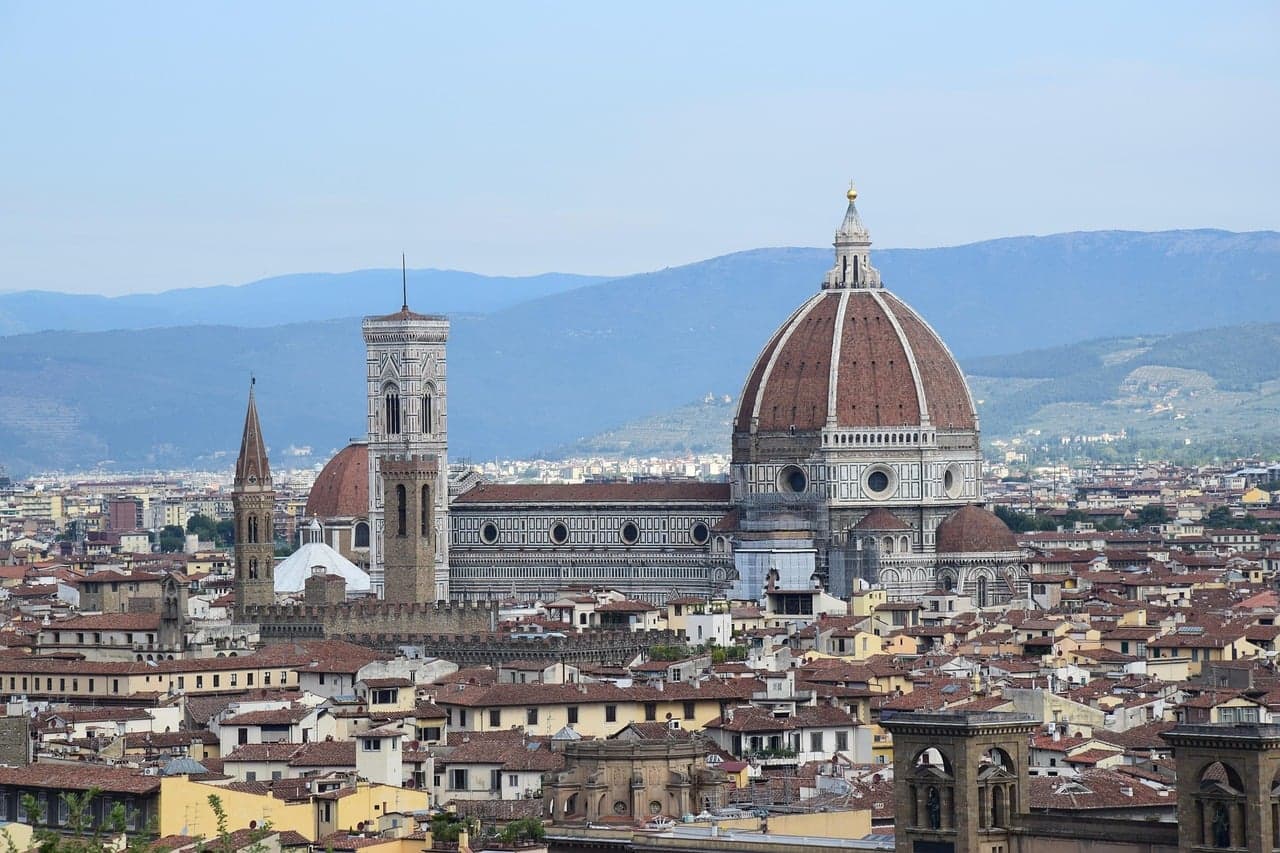
Florence is small, dense and best seen slowly, and three days is a comfortable measure. The route below follows the city's main axis from the cathedral to the river and then across it, using the city's official tourism site Feel Florence and the Uffizi as references.
Where should you start in Florence?
The historic centre was added to the UNESCO World Heritage List in 1982 and is almost entirely within walking distance. Piazza del Duomo lies to the north, Piazza della Signoria and the Uffizi to the south of it, and the Arno beyond. Cross the river and you reach the Oltrarno, the quieter side of the city with palaces, craft workshops and gardens. Keep that north to south line in mind and you will rarely need a map.
What is there to see around the Duomo?
The cathedral of Santa Maria del Fiore was designed by Arnolfo di Cambio at the end of the thirteenth century. When it was consecrated in 1436 it was the largest cathedral in Europe. Its red-tiled dome is Filippo Brunelleschi's work, built in the first half of the fifteenth century without a conventional timber frame. Climbing it takes more than four hundred steps and brings you close to the interior frescoes; the neighbouring bell tower, named after Giotto, gives views that include the dome itself. Both need advance booking. Opposite the cathedral stands the octagonal baptistery, one of the city's oldest buildings; the originals of its gilded east doors are in the Duomo Museum, which also shows a Pietà Michelangelo carved late in life.
What lies between Piazza della Signoria and the Arno?
Palazzo Vecchio has been the seat of city government for centuries. The Uffizi, designed by Giorgio Vasari and built between 1560 and 1580, holds some of the world's most important paintings, from Giotto and Cimabue to Botticelli's Birth of Venus and Primavera, Leonardo da Vinci's Adoration of the Magi and Caravaggio's Bacchus. Feel Florence's page on Ponte Vecchio explains that the bridge was rebuilt after the flood of 1333 and took its present form in 1345; goldsmiths have worked in its shops since 1593, where butchers and fishmongers once traded. Above it runs the Vasari Corridor, built in 1565 and reopened in December 2024 after a long restoration; visits are by reservation and in small groups.
Where do you follow Michelangelo?
The Feel Florence itinerary on Michelangelo is a good companion. Michelangelo's David, carved between 1501 and 1504, has been in the Accademia Gallery since 1873; the unfinished Prisoners in the corridor leading to it are almost as striking. The Bargello holds his early Bacchus and the Pitti Tondo, the New Sacristy at San Lorenzo is both his architecture and his sculpture, and Santa Croce is the burial place of Michelangelo and Galileo Galilei.
What is across the river?
In the Oltrarno, Palazzo Pitti houses several museums and the Boboli Gardens climb behind it. Santo Spirito, one of Brunelleschi's last projects, has a simple facade and a wooden crucifix attributed to the young Michelangelo. At sunset, Piazzale Michelangelo, with its bronze copy of the David, frames the dome and the bridges in one view.
| Day | Morning | Afternoon |
|---|---|---|
| 1 | Piazza del Duomo, dome or bell tower | Piazza della Signoria, Palazzo Vecchio, Ponte Vecchio |
| 2 | Accademia and David, San Lorenzo, Central Market | Uffizi Gallery |
| 3 | Bargello, Santa Croce | Oltrarno, Palazzo Pitti, Boboli, Piazzale Michelangelo at sunset |
For the visitor: what should you know before going?
Book the Uffizi, the Accademia, the dome and the Vasari Corridor in advance and check current hours and prices on the official pages. Cathedrals and churches are working places of worship, so cover shoulders and knees. The dome and bell tower have no lift and narrow steps. Spring and autumn are the most comfortable seasons for walking. For other cities, browse the Reads section.
Frequently asked questions
How many days do you need in Florence?
Three days is a comfortable pace for the main sights; a fourth day allows a trip to the hill town of Fiesole.
When was Ponte Vecchio built?
It was rebuilt after the 1333 flood and took its present form in 1345, according to Feel Florence.
Editorial desk
Stories signed by the Cultvia editorial desk follow our editorial policy; every story lists its sources at the end and errors are fixed under our corrections policy.
Last updated:
What changed?
- : First published
Sources
- Cathedral of Santa Maria del Fiore — Feel Florence, 17 October 2026
- Ponte Vecchio — Feel Florence, 17 October 2026
- Michelangelo in Florence: Beyond David — Feel Florence, 17 October 2026
- The Uffizi — Gallerie degli Uffizi, 17 October 2026
Up next
 City RoutesParis Photo 2026: opening hours, sectors and what to see13 November 2026 · 1 min read


